
USD/INR turns upside down as foreign banks intervene
- The Indian Rupee recovers after hitting a record low near 90.75 against the US Dollar.
- Investors expect the RBI to cut its Repo Rate by 25 bps to 5.25% on Friday.
- Weak US ADP Employment data paves the way for more Fed interest rate cuts.
The Indian Rupee (INR) bounces back against the US Dollar (USD) after sliding to record lows near 90.75 during afternoon trading hours in India on Thursday. The Indian currency snaps six-day losing streak against the US Dollar (USD) after dollar sales from multiple foreign banks, Reuters reported.
Earlier, in the day, the USD/INR pair posted a fresh all-time high around 90.75 as the Indian Rupee continued to face backlash due to the consistent outflow of foreign funds from the Indian equity market.
Foreign Institutional Investors (FIIs) have not stopped paring their stake in the Indian stock market despite remaining net sellers in the July-November period. In the first trading days of December, FIIs have sold shares worth Rs. 8,020.53 crore cumulatively.
The major reason behind weak sentiment towards the Indian stock market is the absence of a trade deal announcement between India and the United States (US). According to comments from the White House, which came a few months back, India could have been the first nation inking a bilateral deal with Washington, but trade talks were delayed due to India-Pakistan tensions. And, now India is one of few nations who have not entered a trade agreement with the US. Also, tariffs imposed on India by the US are 50%, one of highest among Washington’s trading partners, which have dampened the competitiveness of Indian products in the global market.
A Reuters poll of FX strategists showed this week that the Indian Rupee could gain ground against the US Dollar over the next three months if India and the US agree to a trade deal. The poll also showed that the pair could decline 0.3% to near 89.65 in the coming 12 months.
On the domestic front, investors await the monetary policy announcement by the Reserve Bank of India, which is scheduled for Friday. The RBI is expected to cut its Repo Rate by 25 basis points (bps) to 5.25%. This year, the RBI has already reduced its Repo Rate by 100 bps as inflationary pressures have remained lower.
Daily digest market movers: US private sector shed 32K jobs in November
- The US Dollar is broadly underperforming its major currency peers amid firm expectations that the Federal Reserve (Fed) will cut interest rates in its next week’s monetary policy.
- At the press time, the US Dollar Index (DXY), which tracks the Greenback’s value against six major currencies, trades close to its fresh monthly low of 98.80 posted on Wednesday.
- According to the CME FedWatch tool, the probability of the Fed cutting interest rates by 25 basis points (bps) to 3.50%-3.75% in the December policy meeting is 89%.
- Traders are increasingly confident that the Fed will cut interest rates next week as US labor market conditions seem to be worsening further. The US ADP reported on Wednesday that private employers fired 32K jobs in November, while they were expected to have added 5K fresh workers.
- Signs of weakening labor demand often underpin the need to ease monetary policy. Lately, a significant number of Federal Open Market Committee (FOMC) members have also expressed the need to cut interest rates further to support the job market.
- “I view monetary policy as being modestly restrictive, although somewhat less so than before our recent actions, adding that there is room for a further adjustment in the near term,” New York Fed Bank President John Williams said in late November. Williams supported the need for further monetary policy expansion, citing that the "economic growth has slowed and the labor market gradually cooled."
- For more cues on the US interest rate outlook, investors will focus on the Personal Consumption Expenditure Price Index (PCE) data for September, which will be released on Friday. However, the impact of the Fed’s preferred inflation gauge is expected to be limited as the data is older, and therefore will be insufficient to indicate the current status of inflation.
Technical Analysis: USD/INR remains above 20-day EMA
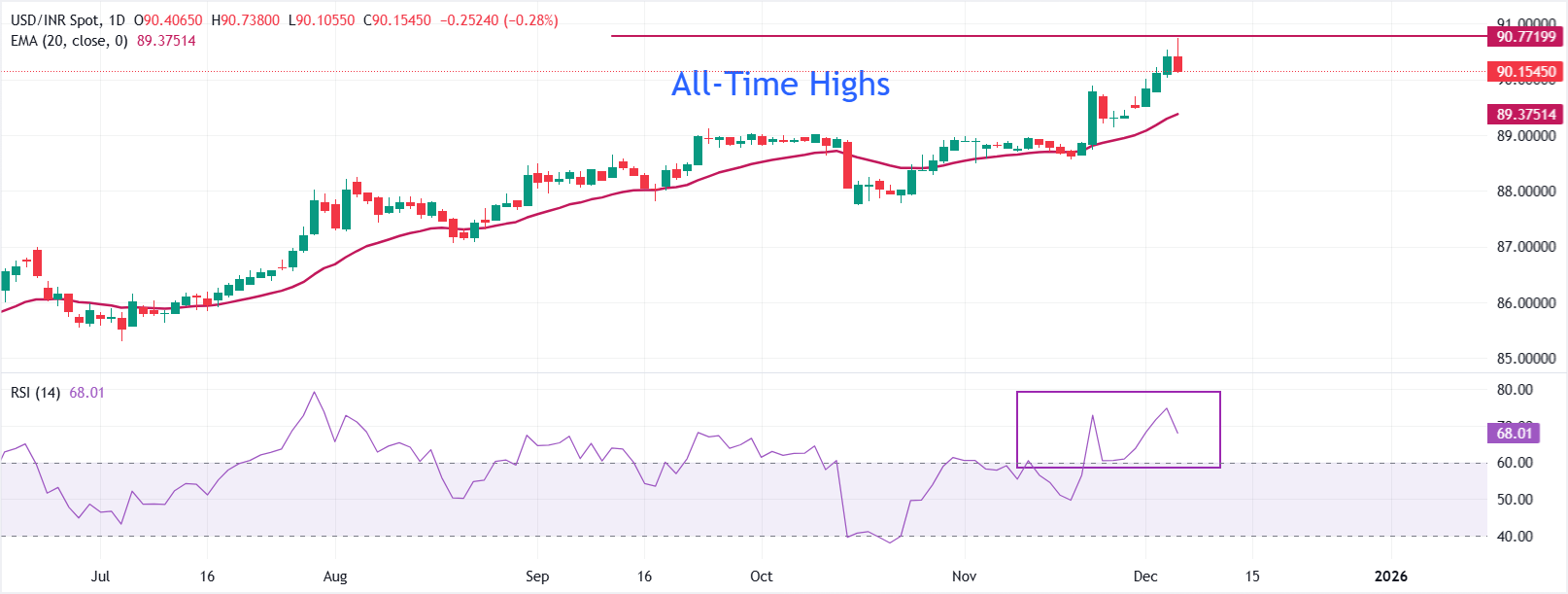
USD/INR corrects to near 90.15 after posting a fresh all-time high around 90.70 during afternoon in India on Thursday.
The 14-day Relative Strength Index (RSI) retraces to near 68.01 after turning overbought around 76.14, flagging a cool down in stretched momentum.
Initial support is the 20-day Exponential Moving Average (EMA) near 89.40; above this gauge, the uptrend would stay in place. On the upside, the pair could extend its rally towards 91.00.
Indian economy FAQs
The Indian economy has averaged a growth rate of 6.13% between 2006 and 2023, which makes it one of the fastest growing in the world. India’s high growth has attracted a lot of foreign investment. This includes Foreign Direct Investment (FDI) into physical projects and Foreign Indirect Investment (FII) by foreign funds into Indian financial markets. The greater the level of investment, the higher the demand for the Rupee (INR). Fluctuations in Dollar-demand from Indian importers also impact INR.
India has to import a great deal of its Oil and gasoline so the price of Oil can have a direct impact on the Rupee. Oil is mostly traded in US Dollars (USD) on international markets so if the price of Oil rises, aggregate demand for USD increases and Indian importers have to sell more Rupees to meet that demand, which is depreciative for the Rupee.
Inflation has a complex effect on the Rupee. Ultimately it indicates an increase in money supply which reduces the Rupee’s overall value. Yet if it rises above the Reserve Bank of India’s (RBI) 4% target, the RBI will raise interest rates to bring it down by reducing credit. Higher interest rates, especially real rates (the difference between interest rates and inflation) strengthen the Rupee. They make India a more profitable place for international investors to park their money. A fall in inflation can be supportive of the Rupee. At the same time lower interest rates can have a depreciatory effect on the Rupee.
India has run a trade deficit for most of its recent history, indicating its imports outweigh its exports. Since the majority of international trade takes place in US Dollars, there are times – due to seasonal demand or order glut – where the high volume of imports leads to significant US Dollar- demand. During these periods the Rupee can weaken as it is heavily sold to meet the demand for Dollars. When markets experience increased volatility, the demand for US Dollars can also shoot up with a similarly negative effect on the Rupee.