
USD/CAD Price Forecast: Attracts bids below 78.6% Fibo retracement at 1.3670
- USD/CAD rises to near 1.3700 as the Canadian Dollar faces slight selling pressure.
- The BoC remains uncertain over further monetary policy adjustments in the near term.
- Investors await the release of the FOMC minutes scheduled for Tuesday.
The USD/CAD pair trades 0.18% higher to near 1.3700 during the European trading session on Monday. The Loonie pair gains as the Canadian Dollar (CAD) is under pressure amid thin liquidity in markets at the start of a holiday-shortened week.
Broadly, the CAD has been outperforming its peers amid expectations that the Bank of Canada (BoC) will not cut interest rates in early 2026. The BoC is unlikely to cut interest rates soon, as the inflation in Canada has remained slightly above the 2% target in the last three months.
Last week, the BoC monetary policy minutes also showed that officials agreed the “current stance is appropriate” and stated that it is “difficult to predict the timing or direction of the next rate move”, but they stand ready “to respond if the outlook changes materially”.
Meanwhile, the US Dollar (USD) trades with caution ahead of the release of Federal Open Market Committee (FOMC) minutes of the December meeting on Tuesday. In the policy, the Fed decided to cut interest rates by 25 basis points (bps) to 3.50%-3.75%.
As of writing, the US Dollar Index (DXY), which tracks the Greenback’s value against six major currencies, trades almost flat near 98.00. The DXY is close to its 12-week low of 97.75 posted last week.
USD/CAD technical analysis
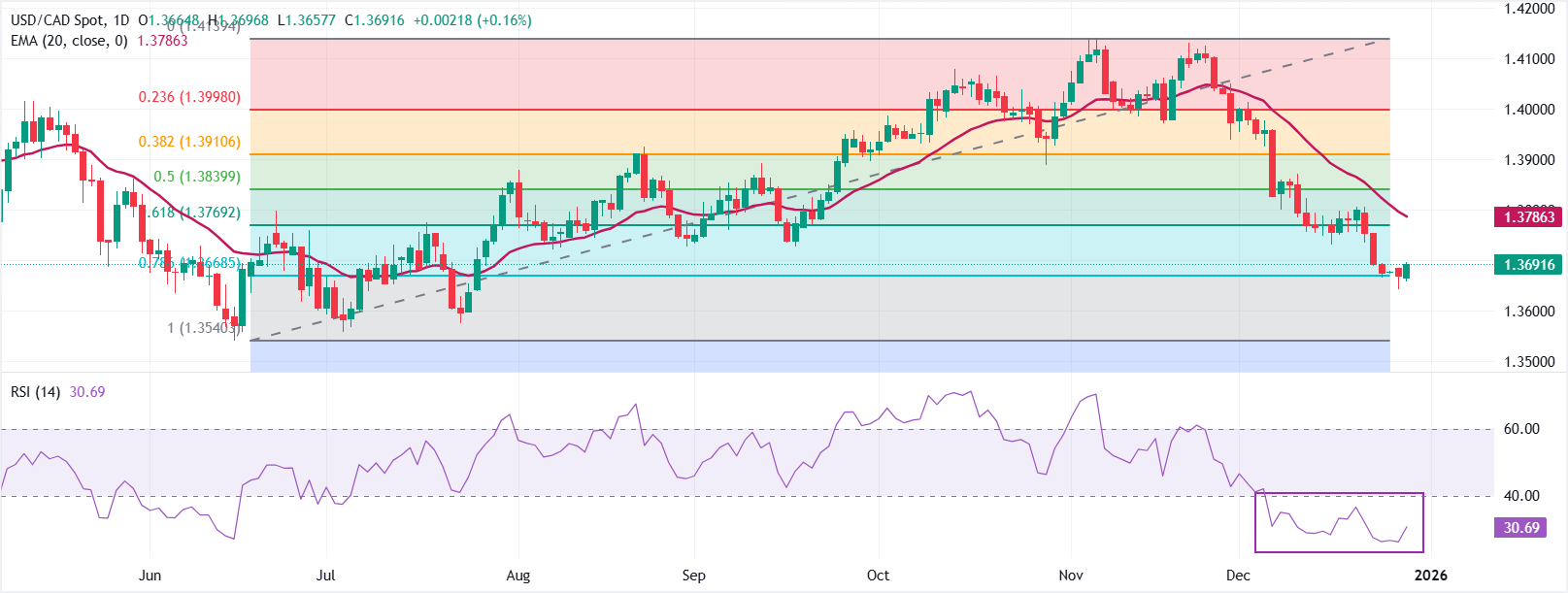
In the daily chart, USD/CAD trades at 1.3692. The pair remains below the 20-day Exponential Moving Average (EMA) at 1.3786, which slopes lower and continues to cap rebounds, preserving a bearish bias.
The 14-day Relative Strength Index (RSI) at 30.69 is near oversold and has ticked higher from recent lows, signaling fading selling pressure. Measured from the 1.3540 low to the 1.4139 high, the 78.6% retracement at 1.3668 offers nearby support amid the pullback.
A bounce from 1.3668 could lift the pair toward the 61.8% retracement at 1.3769, while the 20-day EMA at 1.3786 would act as an additional hurdle. Failure to hold 1.3668 would keep bears in control, with momentum constrained by a sub-50 RSI, until a daily close back above the moving average improves tone.
(The technical analysis of this story was written with the help of an AI tool.)
Bank of Canada FAQs
The Bank of Canada (BoC), based in Ottawa, is the institution that sets interest rates and manages monetary policy for Canada. It does so at eight scheduled meetings a year and ad hoc emergency meetings that are held as required. The BoC primary mandate is to maintain price stability, which means keeping inflation at between 1-3%. Its main tool for achieving this is by raising or lowering interest rates. Relatively high interest rates will usually result in a stronger Canadian Dollar (CAD) and vice versa. Other tools used include quantitative easing and tightening.
In extreme situations, the Bank of Canada can enact a policy tool called Quantitative Easing. QE is the process by which the BoC prints Canadian Dollars for the purpose of buying assets – usually government or corporate bonds – from financial institutions. QE usually results in a weaker CAD. QE is a last resort when simply lowering interest rates is unlikely to achieve the objective of price stability. The Bank of Canada used the measure during the Great Financial Crisis of 2009-11 when credit froze after banks lost faith in each other’s ability to repay debts.
Quantitative tightening (QT) is the reverse of QE. It is undertaken after QE when an economic recovery is underway and inflation starts rising. Whilst in QE the Bank of Canada purchases government and corporate bonds from financial institutions to provide them with liquidity, in QT the BoC stops buying more assets, and stops reinvesting the principal maturing on the bonds it already holds. It is usually positive (or bullish) for the Canadian Dollar.