
NZD/USD Price Forecast: Trades firmly as US-Iran confirm visit to Pakistan for talks
- NZD/USD gains as both the US and Iran confirm sending teams to Pakistan for negotiations on a permanent ceasefire.
- Iran criticizes the US for Israel attacking Lebanon.
- NZD/USD recovers sharply above the 20-day EMA from the four-month low around 0.5680.
The NZD/USD pair trades 0.2% higher to near 0.5835 during the European trading session on Thursday. The Kiwi pair demonstrates strength as the appeal of risk-sensitive currencies has improved, following confirmation from both the United States (US) and Iran that they are sending their respective teams to Pakistan for the first round of negotiations on the 10-point peace proposal.
New Zealand Dollar Price Today
The table below shows the percentage change of New Zealand Dollar (NZD) against listed major currencies today. New Zealand Dollar was the strongest against the Japanese Yen.
| USD | EUR | GBP | JPY | CAD | AUD | NZD | CHF | |
|---|---|---|---|---|---|---|---|---|
| USD | -0.18% | -0.17% | 0.21% | -0.05% | 0.05% | -0.29% | -0.08% | |
| EUR | 0.18% | 0.03% | 0.41% | 0.16% | 0.23% | -0.08% | 0.10% | |
| GBP | 0.17% | -0.03% | 0.36% | 0.09% | 0.20% | -0.12% | 0.07% | |
| JPY | -0.21% | -0.41% | -0.36% | -0.27% | -0.17% | -0.51% | -0.30% | |
| CAD | 0.05% | -0.16% | -0.09% | 0.27% | 0.11% | -0.23% | -0.03% | |
| AUD | -0.05% | -0.23% | -0.20% | 0.17% | -0.11% | -0.31% | -0.12% | |
| NZD | 0.29% | 0.08% | 0.12% | 0.51% | 0.23% | 0.31% | 0.19% | |
| CHF | 0.08% | -0.10% | -0.07% | 0.30% | 0.03% | 0.12% | -0.19% |
The heat map shows percentage changes of major currencies against each other. The base currency is picked from the left column, while the quote currency is picked from the top row. For example, if you pick the New Zealand Dollar from the left column and move along the horizontal line to the US Dollar, the percentage change displayed in the box will represent NZD (base)/USD (quote).
On Wednesday, White House press secretary Karoline Leavitt stated that US President Donald Trump will send Vice President (VP) JD Vance-led team to Pakistan on Saturday to discuss the 10-point peace proposal shared by Iran as demands for a permanent ceasefire.
During the day, Iranian ambassador Reza Amiri Moghadam confirmed, through a tweet on X, that a team is scheduled to visit Pakistan in night for the first round of talks. However, Moghadam alleged that the US violated clauses of the 10-point plan, with Israel attacking Iran-backed Houthis in Lebanon.
Meanwhile, the market sentiment remains slightly risk-averse amid worries that Israel’s continued attacks on Lebanon could raise concerns over the sustainability of the two-week ceasefire. S&P 500 futures are down 0.4% in the European trade. The US Dollar Index (DXY), which tracks the Greenback’s value against six major currencies, trades subduedly around 99.00.
NZD/USD technical analysis
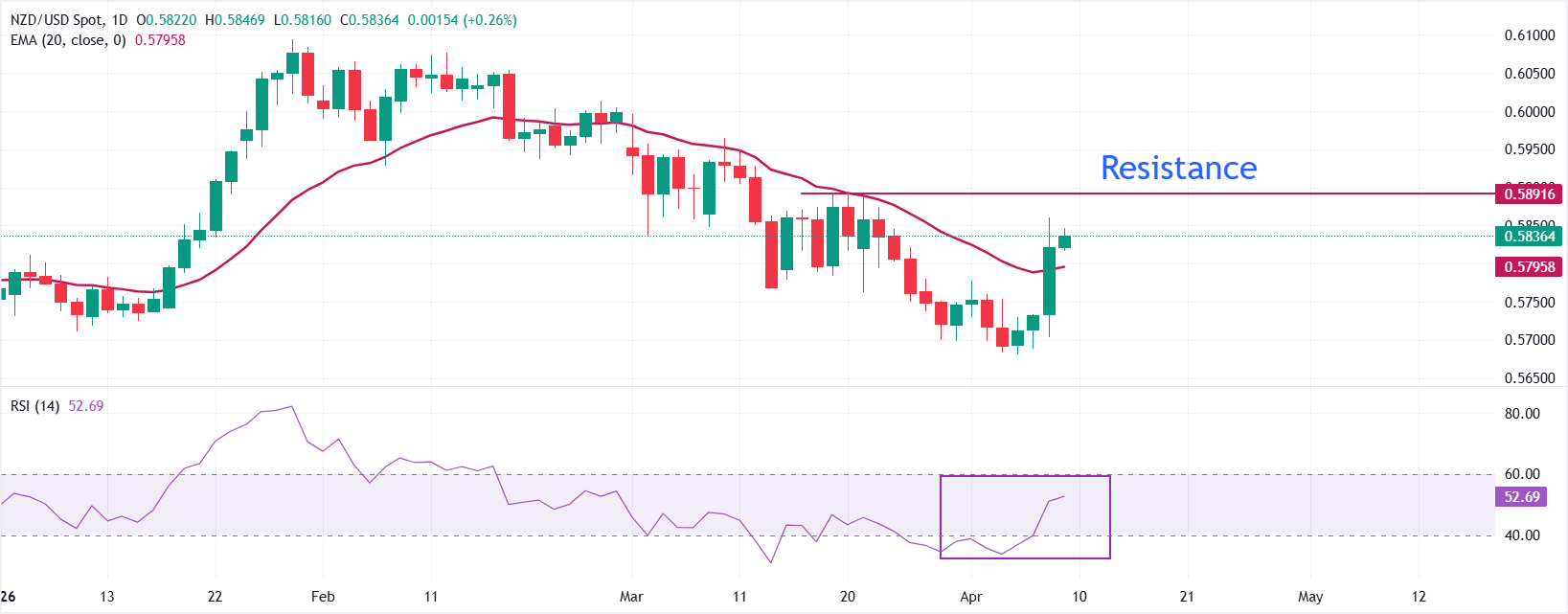
NZD/USD trades higher at around 0.5835 as of writing. The price holds a modest bullish bias as spot remains above the 20-day Exponential Moving Average (EMA) at 0.5796.
The Relative Strength Index (14) quickly shifts into the 40.00-60.00 range from below 40.00, signaling a bullish reversal.
On the downside, immediate support is seen at the 20-period EMA , with a sustained break below this band might negate the nascent recovery and expose the April 3 high of 0.5753. On the topside, the main obstacle will be the March 20 high around 0.5900, and only a decisive move through this level would open the door for a more convincing bullish extension in the days ahead.
(The technical analysis of this story was written with the help of an AI tool.)
New Zealand Dollar FAQs
The New Zealand Dollar (NZD), also known as the Kiwi, is a well-known traded currency among investors. Its value is broadly determined by the health of the New Zealand economy and the country’s central bank policy. Still, there are some unique particularities that also can make NZD move. The performance of the Chinese economy tends to move the Kiwi because China is New Zealand’s biggest trading partner. Bad news for the Chinese economy likely means less New Zealand exports to the country, hitting the economy and thus its currency. Another factor moving NZD is dairy prices as the dairy industry is New Zealand’s main export. High dairy prices boost export income, contributing positively to the economy and thus to the NZD.
The Reserve Bank of New Zealand (RBNZ) aims to achieve and maintain an inflation rate between 1% and 3% over the medium term, with a focus to keep it near the 2% mid-point. To this end, the bank sets an appropriate level of interest rates. When inflation is too high, the RBNZ will increase interest rates to cool the economy, but the move will also make bond yields higher, increasing investors’ appeal to invest in the country and thus boosting NZD. On the contrary, lower interest rates tend to weaken NZD. The so-called rate differential, or how rates in New Zealand are or are expected to be compared to the ones set by the US Federal Reserve, can also play a key role in moving the NZD/USD pair.
Macroeconomic data releases in New Zealand are key to assess the state of the economy and can impact the New Zealand Dollar’s (NZD) valuation. A strong economy, based on high economic growth, low unemployment and high confidence is good for NZD. High economic growth attracts foreign investment and may encourage the Reserve Bank of New Zealand to increase interest rates, if this economic strength comes together with elevated inflation. Conversely, if economic data is weak, NZD is likely to depreciate.
The New Zealand Dollar (NZD) tends to strengthen during risk-on periods, or when investors perceive that broader market risks are low and are optimistic about growth. This tends to lead to a more favorable outlook for commodities and so-called ‘commodity currencies’ such as the Kiwi. Conversely, NZD tends to weaken at times of market turbulence or economic uncertainty as investors tend to sell higher-risk assets and flee to the more-stable safe havens.