
Indian Rupee remains close to all-time lows amid elevated crude oil prices
- The Indian Rupee continues to decline due to elevated oil prices and rising US Treasury yields.
- US President Trump threatens to resume military attacks on Iran.
- The Fed will likely deliver at least one interest rate hike this year.
The Indian Rupee (INR) continues to underperform against the US Dollar (USD) on Wednesday, trading close to its fresh all-time lows.
The USD/INR pair holds onto gains near 97.00 as elevated oil prices due to fears of a prolonged closure of the Strait of Hormuz remain a key drag on the Indian Rupee.
At press time, the WTI Oil price is down to near $101.80, but is up over 50% since the onset of the war in the Middle East.
Currencies from economies, such as India, which rely heavily on oil imports to meet their energy needs, tend to underperform in a high-oil price environment.
Iran uncertainty keeps Oil prices elevated
Oil prices continue to remain elevated as negotiations between the United States (US) and Iran over multiple issues, such as Tehran’s nuclear ambitions, compensation for war damages, and the US blockade of Iranian seaports, remain unsolved.
Iran's Deputy Foreign Minister Kazem Gharibabadi said on Tuesday that lifting sanctions, releasing frozen funds, and ending US blockade are major demands included in Iran's recent proposal to the US, IRNA reported.
Meanwhile, US President Donald Trump has threatened to resume military attacks on Iran if Iran doesn’t agree to a deal soon. Trump said on Tuesday that he doesn’t favor a war, but Washington can hit Iran again in the next few days.
“I hope we don’t have to do the war, but we may have to give them another big hit,” Trump told reporters on Tuesday. When asked how long he would wait, Trump said, “Well, I mean, I’m saying two or three days, maybe Friday, Saturday, Sunday. Something maybe early next week — a limited period of time.”
In response, Iran has stated that it is prepared for any military aggression. On Tuesday, a spokesperson from the Iranian army also said that Iran’s army would “open new fronts” against the US if it resumes attacks on the country.
FIIs turn out to be net sellers after remaining buyers for three straight trading days
After remaining net buyers for three straight trading days in the Indian stock market, the selling pressure from Foreign Institutional Investors (FIIs) has returned amid growing concerns over India’s economic outlook due to higher energy prices. On Tuesday, FIIs emerged as net sellers, paring their stake worth Rs. 2,457.49 crore. In the previous three trading days, FIIs had cumulatively bought shares worth Rs. 4,330.32 crore.
Higher US Treasury Yields diminish appeal of riskier assets
Surging US Treasury yields due to firm expectations that the Federal Reserve (Fed) will not cut interest rates this year are also hurting risk-sensitive currencies, such as the Indian Rupee. The 10-year US bond yields have posted a fresh yearly high at 4.69% during the day.
According to the CME FedWatch tool, the odds of the Fed delivering at least one interest rate hike this year is 56.3%, while the rest almost favor a ‘hold’.
Technical Analysis: USD/INR sees more upside towards 98.00
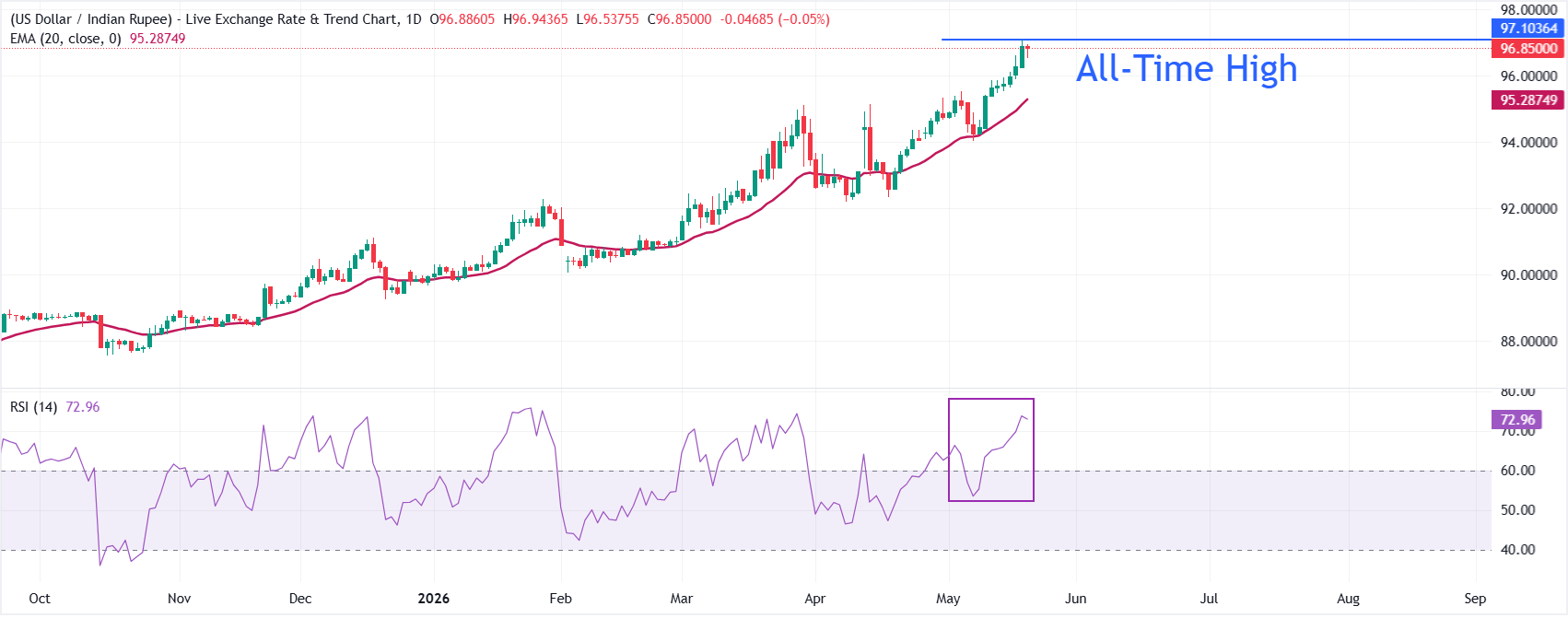
USD/INR trades higher at around 96.85 as of writing. The pair holds well above the 20-day Exponential Moving Average (EMA) at 95.29, keeping the near-term structure firmly supported.
The 14-day Relative Strength Index (RSI) at 72.96 sits in overbought territory, suggesting bullish momentum remains strong but is becoming stretched, which could encourage brief corrective pauses rather than a clean continuation higher.
On the downside, immediate support is seen at the 20-day EMA near 95.29, where a pullback would be expected to attract dip-buying interest while the broader uptrend remains intact. A daily close back below this moving average would hint at a deeper correction toward lower levels, but as long as price holds above it, the path of least resistance stays to the upside despite overbought conditions. Looking up, the pair might aim to extend its advance towards 98.00 if it stabilizes above 97.00.
(The technical analysis of this story was written with the help of an AI tool.)
Economic Indicator
FOMC Minutes
FOMC stands for The Federal Open Market Committee that organizes 8 meetings in a year and reviews economic and financial conditions, determines the appropriate stance of monetary policy and assesses the risks to its long-run goals of price stability and sustainable economic growth. FOMC Minutes are released by the Board of Governors of the Federal Reserve and are a clear guide to the future US interest rate policy.
Next release: Wed May 20, 2026 18:00
Frequency: Irregular
Consensus: -
Previous: -
Source: Federal Reserve
Minutes of the Federal Open Market Committee (FOMC) is usually published three weeks after the day of the policy decision. Investors look for clues regarding the policy outlook in this publication alongside the vote split. A bullish tone is likely to provide a boost to the greenback while a dovish stance is seen as USD-negative. It needs to be noted that the market reaction to FOMC Minutes could be delayed as news outlets don’t have access to the publication before the release, unlike the FOMC’s Policy Statement.