
Gold rises as Iran reopens Hormuz, Oil plunges and Fed rate cut bets strengthen
- Gold edges higher on Friday, on track for fourth straight weekly gain as US-Iran deal hopes build.
- Softer US Dollar and revived Fed rate-cut expectations help cap downside in XAU/USD.
- Technically, XAU/USD consolidates within tightening Bollinger Bands, signaling a potential breakout ahead.
Gold (XAU/USD) gains traction on Friday as US-Iran deal hopes and the reopening of the Strait of Hormuz push Oil prices lower, easing inflation pressure and reinforcing expectations of Federal Reserve (Fed) interest rate cuts. At the time of writing, XAU/USD is trading around $4,870, up nearly 1.67% on the day, and remains on track for a fourth consecutive weekly gain.
US-Iran deal hopes build
Investor sentiment improved after Iran’s Foreign Minister Abbas Araghchi said on Friday that the Strait of Hormuz is now “completely open” for all commercial vessels for the duration of the ceasefire, in line with the truce in Lebanon.
In reaction, Crude prices retreated sharply with West Texas Intermediate (WTI) sliding to its lowest level since March 11. At the time of writing, WTI is trading around $81.50, down nearly 9% on the day.
US President Donald Trump also signaled progress on diplomatic efforts with Iran. “It’s looking very good that we’re going to make a deal with Iran, and it’s going to be a good deal,” Trump told reporters at the White House on Thursday. He added that the next round of talks could take place over the weekend and indicated he would consider extending the current ceasefire if both sides are close to reaching an agreement.
Despite signs of easing tensions, Gold remains largely range-bound. The prospect of a deal has lifted risk appetite, with gains in global equities limiting flows into the metal. At the same time, a softer US Dollar (USD) is helping contain the downside in XAU/USD.
The US Dollar Index (DXY), which tracks the Greenback's value against a basket of six major currencies, is trading near 97.73, slipping to more than one-month lows and on track for a third consecutive weekly decline.
Fed interest rate cut bets return as Oil cools
Meanwhile, markets are also reassessing the Federal Reserve (Fed) monetary policy path as Oil prices trim some geopolitical risk premium on hopes that the Iran conflict may be nearing an end.
This has helped ease immediate inflation concerns and revive expectations that the Fed could lower interest rates later this year. Lower interest rates tend to support non-yielding assets such as Gold.
Looking ahead, traders will closely monitor weekend developments around US-Iran talks, particularly any progress toward fully reopening the Strait of Hormuz. Donald Trump said the US naval blockade “will remain in full force and effect” against Iran until a final agreement is fully completed.
Meanwhile, Fars News Agency reported, citing an Iranian official, that if the blockade persists, Tehran could view it as a violation of the ceasefire and may close the Strait of Hormuz again, according to Reuters.
On the data front, the US economic calendar is quiet, with no major releases. Attention will instead turn to speeches from Fed officials, ahead of the blackout period for the upcoming FOMC meeting scheduled for April 28-29.
Technical analysis: XAU/USD consolidates as Bollinger Bands tighten, breakout in focus
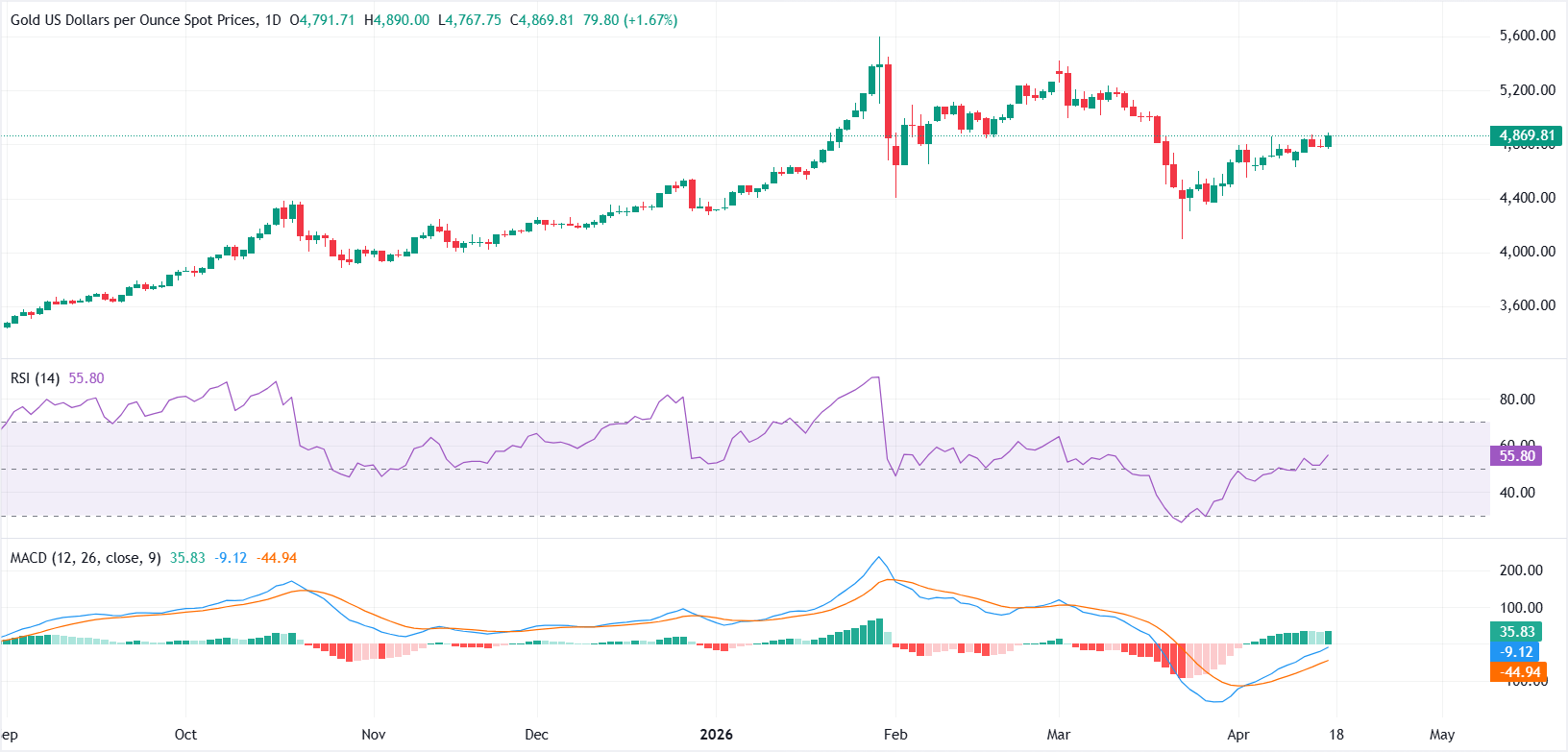
In the daily chart, XAU/USD holds well above the 20-day Simple Moving Average (SMA) from the Bollinger Bands at $4,646, keeping the near-term bias constructive. The recent narrowing of the bands indicates reduced volatility and a potential buildup before the next move.
The Relative Strength Index (RSI 14) is hovering near 52, close to the neutral 50 level. This reflects balanced momentum, with neither buyers nor sellers in clear control. The recovery from earlier oversold conditions suggests downside pressure has eased while the Moving Average Convergence Divergence (MACD) stays in positive territory, suggesting that bullish momentum is still present.
On the topside, immediate resistance is located at the Bollinger upper band near $4,931, where fresh supply could reappear if buyers regain traction. On the downside, initial support is reinforced by the Bollinger middle band/20-day SMA at $4,646 ahead of a deeper cushion at the lower band around $4,361, which should limit a more pronounced correction while the broader uptrend remains intact.
(The technical analysis of this story was written with the help of an AI tool.)
Gold FAQs
Gold has played a key role in human’s history as it has been widely used as a store of value and medium of exchange. Currently, apart from its shine and usage for jewelry, the precious metal is widely seen as a safe-haven asset, meaning that it is considered a good investment during turbulent times. Gold is also widely seen as a hedge against inflation and against depreciating currencies as it doesn’t rely on any specific issuer or government.
Central banks are the biggest Gold holders. In their aim to support their currencies in turbulent times, central banks tend to diversify their reserves and buy Gold to improve the perceived strength of the economy and the currency. High Gold reserves can be a source of trust for a country’s solvency. Central banks added 1,136 tonnes of Gold worth around $70 billion to their reserves in 2022, according to data from the World Gold Council. This is the highest yearly purchase since records began. Central banks from emerging economies such as China, India and Turkey are quickly increasing their Gold reserves.
Gold has an inverse correlation with the US Dollar and US Treasuries, which are both major reserve and safe-haven assets. When the Dollar depreciates, Gold tends to rise, enabling investors and central banks to diversify their assets in turbulent times. Gold is also inversely correlated with risk assets. A rally in the stock market tends to weaken Gold price, while sell-offs in riskier markets tend to favor the precious metal.
The price can move due to a wide range of factors. Geopolitical instability or fears of a deep recession can quickly make Gold price escalate due to its safe-haven status. As a yield-less asset, Gold tends to rise with lower interest rates, while higher cost of money usually weighs down on the yellow metal. Still, most moves depend on how the US Dollar (USD) behaves as the asset is priced in dollars (XAU/USD). A strong Dollar tends to keep the price of Gold controlled, whereas a weaker Dollar is likely to push Gold prices up.