
Gold heads for second weekly loss as higher-for-longer rate bets dominate
- Gold heads for a second straight weekly decline as higher-for-longer rate bets weigh.
- Strong central bank buying and retail investment continue to support the broader trend.
- XAU/USD trades below the 100-day SMA and key Fibonacci retracement levels on the daily chart.
Gold (XAU/USD) edges lower on Friday, heading for a second straight weekly decline as higher-for-longer interest rate expectations continue to dominate price action amid rising inflation concerns driven by elevated Oil prices. At the time of writing, XAU/USD is trading around $4,577, hovering just above the one-month low of $4,510 reached earlier this week.
Surging energy costs have already pushed inflation higher across major economies since the US-Iran war began, prompting central banks to reassess the monetary policy path. Major central banks, including the Federal Reserve (Fed), European Central Bank (ECB), Bank of England (BoE), Bank of Japan (BoJ) and Bank of Canada (BoC), kept interest rates unchanged in their latest policy announcements, while emphasizing a data-dependent approach. The overall tone leaned somewhat hawkish as policymakers look through the inflationary shock.
Against this backdrop, markets increasingly expect the Fed to delay interest rate cuts, or even consider raising rates if inflation pressure intensifies. According to the CME FedWatch Tool, traders are now pricing in a hold through this year, while the probability of a rate hike by April 2027 has risen to 24.2%, up from just 1.9% a week ago.
For Gold, the shift toward higher-for-longer interest rate expectations has led to steady downside pressure since the start of the war, with the metal posting two straight monthly losses despite its role as an inflation hedge and safe-haven asset. Non-yielding assets such as Gold tend to perform well in a low-interest-rate environment, as lower borrowing costs reduce the opportunity cost of holding them.
In the near term, the metal is expected to trade with a downside bias, with any upside likely to be sold into, as there are no signs of an end to Middle East tensions, with supply through the Strait of Hormuz largely disrupted, keeping Oil prices elevated and inflation concerns in focus.
Overall, the broader uptrend remains intact, supported by strong structural demand, including steady central bank buying and resilient investment flows. According to the World Gold Council’s Q1 2026 Gold Demand Trends report, total gold demand, including OTC investment, rose 2% YoY to 1,231 tonnes, while central banks purchased around 244 tonnes, up 3%. Gold-backed ETFs saw inflows of 62 tonnes in Q1, while bar and coin demand surged 42% YoY to 474 tonnes.
Technical Analysis: XAU/USD remains capped under the 100-day SMA
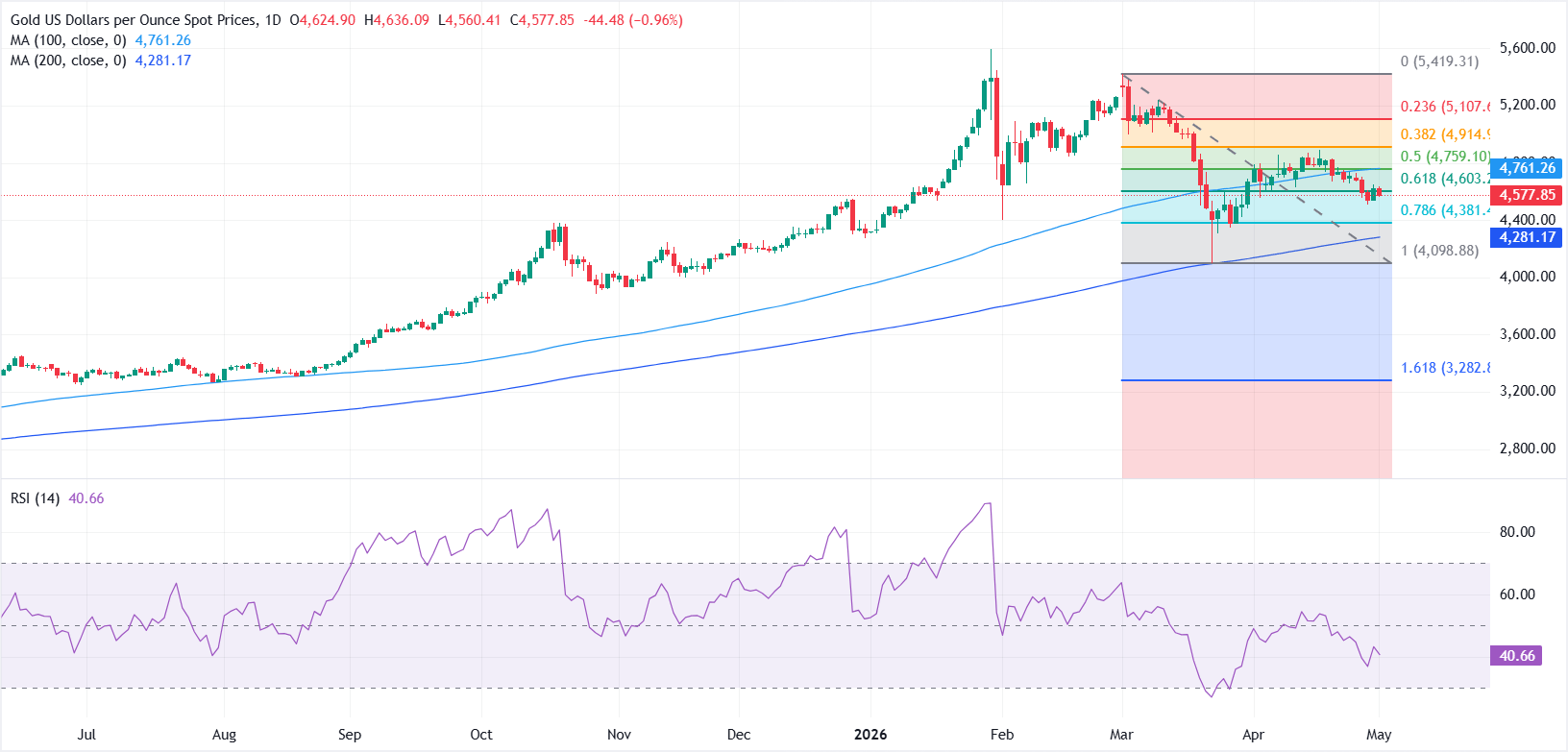
In the daily chart, XAU/USD keeps a bearish near-term bias as spot holds below the 100-day Simple Moving Average (SMA) at $4,761 and the 61.8% Fibonacci retracement at $4,603. The metal remains under corrective pressure after failing to sustain recent highs, while the Relative Strength Index (RSI) around 41 stays in bearish territory without yet reaching oversold conditions, suggesting downside risks persist but with scope for intermittent rebounds.
On the topside, initial resistance is now aligned at the 61.8% retracement near $4,603, followed by a heavier barrier formed by the 50% retracement at $4,759 and the 100-day SMA at $4,761, with further hurdles at the 38.2% retracement at $4,914 and the 23.6% level at $5,108. On the downside, immediate support emerges at the 78.6% retracement around $4,381, ahead of the 200-day SMA at $4,281 and the prior swing base near the 100% retracement at $4,099, where stronger buyers would be expected to defend the broader uptrend.
(The technical analysis of this story was written with the help of an AI tool.)