
EUR/USD hesitates near highs with all eyes on US Jobless Claims
- The Euro remains bid near five-week highs, at 1.1680 against the US Dollar.
- Eurozone Retail sales stalled in October against expectations of a 0.1% growth.
- The US Dollar is on the defensive amid rising hopes of Fed cuts.
EUR/USD keeps trading back and forth on Wednesday, and holds marginal gains on the daily chart at 1.1670, after hitting the highest levels in more than six weeks, at 1.1682. The weaker-than-expected Eurozone Retail Sales figures have put some pressure on the Euro, but the generalised US Dollar weakness is keeping the pair's downside attempts limited so far.
Data released by Eurostat revealed that Retail Sales stalled in October, following an upwardly revised 0.1% increase in September, against market expectations of another 0.1% growth. Year-on-year, however, sales rose at a 1.5% pace, beyond the 1.4% forecasted by market analysts and also above September's 1.0% reading.
The Euro has been drawing support from the bright Eurozone final HCOB Services Purchasing Managers' Index figures released on Wednesday. US economic data, on the contrary, failed to cheer investors, as the ADP Employment Change report showed an unexpected loss in net jobs, adding to evidence of the deteriorating labour market and cementing hopes that the US Federal Reserve (Fed) will cut interest rates by 25 basis points next week.
Later today, the focus will be on the US weekly Jobless Claims release, which is not expected to improve the outlook of the employment market. The highlight of the week, however, will be Friday's Personal Consumption Expenditures (PCE) Price Index release, which will be the last inflation reading ahead of next week's Fed meeting.
Euro Price Today
The table below shows the percentage change of Euro (EUR) against listed major currencies today. Euro was the strongest against the New Zealand Dollar.
| USD | EUR | GBP | JPY | CAD | AUD | NZD | CHF | |
|---|---|---|---|---|---|---|---|---|
| USD | -0.02% | 0.01% | -0.34% | 0.15% | -0.08% | 0.17% | 0.08% | |
| EUR | 0.02% | 0.04% | -0.32% | 0.18% | -0.06% | 0.19% | 0.11% | |
| GBP | -0.01% | -0.04% | -0.35% | 0.14% | -0.10% | 0.15% | 0.07% | |
| JPY | 0.34% | 0.32% | 0.35% | 0.49% | 0.27% | 0.48% | 0.43% | |
| CAD | -0.15% | -0.18% | -0.14% | -0.49% | -0.22% | 0.00% | -0.07% | |
| AUD | 0.08% | 0.06% | 0.10% | -0.27% | 0.22% | 0.25% | 0.14% | |
| NZD | -0.17% | -0.19% | -0.15% | -0.48% | -0.01% | -0.25% | -0.09% | |
| CHF | -0.08% | -0.11% | -0.07% | -0.43% | 0.07% | -0.14% | 0.09% |
The heat map shows percentage changes of major currencies against each other. The base currency is picked from the left column, while the quote currency is picked from the top row. For example, if you pick the Euro from the left column and move along the horizontal line to the US Dollar, the percentage change displayed in the box will represent EUR (base)/USD (quote).
Daily Digest Market Movers: ECB-Fed monetary policy divergence supports the Euro
- Euro dips are likely to remain shallow, as monetary policy divergence between the Fed and the European Central Bank (ECB)supports the common currency. The market is pricing a 25-basis-points rate cut by the Fed after its December 10 meeting, and probably two or three more cuts next year. The ECB, on the contrary, is widely expected to stand pat in December, and odds of a rate cut in 2026 are minimal so far.
- The US Challenger Job Cuts released earlier on Thursday revealed a 53% decline in lay-off plans from US businesses, to 71,321 in November, from 153,074 last month. The report also affirmed that hiring remains stalled, due to the uncertain economic context, which has tempered investors' optimism about the data.
- Later on the day, Initial Jobless Claims are expected to have increased by 220,000 in the last week of November, up from 216,00 in the previous week.
- Eurozone data released on Wednesday endorsed this view. November's final HCOB Services Purchasing Managers Index was revised up to 53.6 from the previously estimated 53.1 reading. This marks the sixth consecutive month of expansion of the sector's activity and the best performance since May 2023. Likewise, service activity data from France was revised to 51.4 from 50.8, and German HCOB Services PMI to 53.1 from the previously estimated 52.7 reading.
- ECB President Christine Lagarde showed a positive tone regarding the Eurozone economy in her speech on Wednesday, assessing that household spending and a resilient labour market are supporting the economy of the region, and that underlying inflation remains consistent. These comments hint at steady interest rates after the December 18 meeting.
- The US ADP Employment Change report showed a 32,000 decline in net jobs in November, against market expectations of a 5,000 gain and following an upwardly revised 47,000 increase in October. This is the largest decline in more than two years and has boosted market concerns about the labour market's deterioration.
- US services activity data, on the contrary, beat expectations in November. The US ISM Services PMI rose to 52.6 from 52.4, and against the market consensus of a moderate slowdown to 52.1. New Orders, however, slowed down to 52.9 from 56.2 in the previous month, and the Employment Index contracted for the sixth consecutive month.
Technical Analysis: EUR/USD keeps pushing against resistance at the 1.1675 area
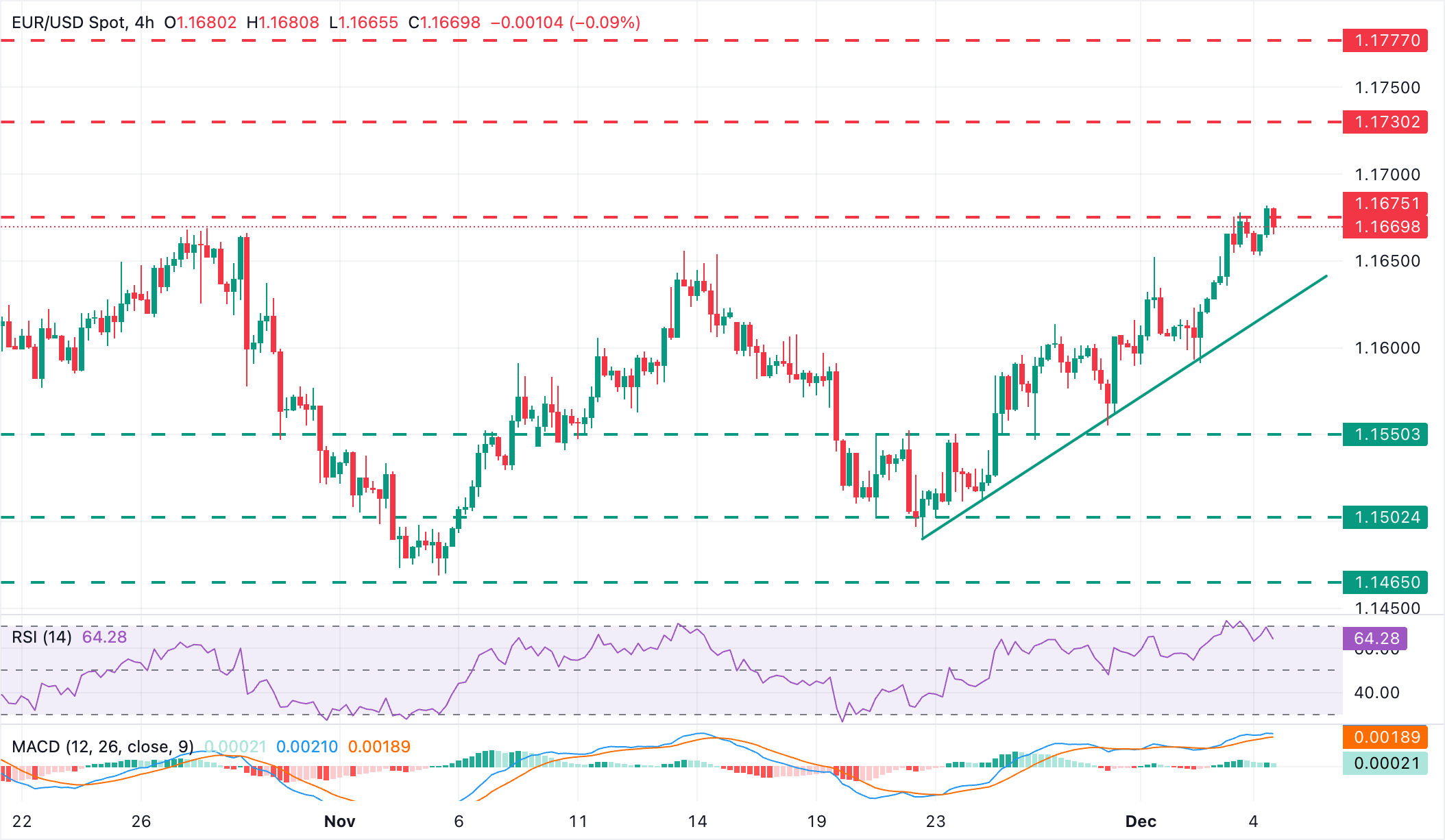
EUR/USD bulls found resistance at the 1.1675 area following an eight-day rally. The 4-hour Relative Strength Index (RSI) is pulling back from overbought levels, while the Moving Average Convergence Divergence (MACD) indicator remains above zero, highlighting a mild positive momentum.
Bulls have been capped a few pips above the 1.1670 area, where the pair was halted on October 28 and 29. A confirmation above that level would clear the path to the October 17 high, near 1.1730, ahead of the October 1 high, at 1.1778.
The broader upside bias from mid-November lows sub-1.1500 remains in play. Bears are limited above November 13 and 14 highs in the 1.1650 area, and trendline support is at 1.1615. Further down, the target is the December 2 low, at 1.1590.
Economic Indicator
Initial Jobless Claims
The Initial Jobless Claims released by the US Department of Labor is a measure of the number of people filing first-time claims for state unemployment insurance. A larger-than-expected number indicates weakness in the US labor market, reflects negatively on the US economy, and is negative for the US Dollar (USD). On the other hand, a decreasing number should be taken as bullish for the USD.
Read more.Next release: Thu Dec 04, 2025 13:30
Frequency: Weekly
Consensus: 220K
Previous: 216K
Source: US Department of Labor
Every Thursday, the US Department of Labor publishes the number of previous week’s initial claims for unemployment benefits in the US. Since this reading could be highly volatile, investors may pay closer attention to the four-week average. A downtrend is seen as a sign of an improving labour market and could have a positive impact on the USD’s performance against its rivals and vice versa.
Economic Indicator
Continuing Jobless Claims
The Continuing Jobless Claims released by the US Department of Labor measure the number of individuals who are unemployed and are currently receiving unemployment benefits. It is representative of the strength of the labor market. A rise in this indicator has negative implications for consumer spending which discourages economic growth. Generally speaking, a high reading is seen as bearish for the US Dollar (USD), while a low reading is seen as bullish.
Read more.Next release: Thu Dec 04, 2025 13:30
Frequency: Weekly
Consensus: -
Previous: 1.96M
Source: US Department of Labor