
Gold holds firm as uncertainty lingers around US-Iran negotiations
- Gold holds steady, heading for a third weekly gain as traders weigh Middle East developments and US inflation data.
- Softer US Dollar supports prices, though upside momentum remains limited amid the Fed’s higher-for-longer interest rate outlook.
- Technically, XAU/USD consolidates within a rising channel below the 200-SMA on the 4-hour chart.
Gold (XAU/USD) holds steady on Friday but lacks strong upside momentum as markets continue to monitor the evolving situation in the Middle East, while traders digest the latest US inflation data. At the time of writing, XAU/USD is trading flat around $4,775 and is on track for a third straight weekly gain.
Data released by the US Bureau of Labor Statistics showed a clear impact of higher energy costs, with inflation coming in line with expectations. The Consumer Price Index (CPI) rose 0.9% MoM in March, accelerating sharply from 0.3% in the previous month. Annual inflation increased to 3.3% YoY from 2.4% in February.
However, the data failed to provide support to the US Dollar (USD), which remains under pressure amid a modest improvement in risk sentiment following the two-week ceasefire agreement between the US and Iran. This, in turn, is supporting XAU/USD and helping limit the downside.
US President Donald Trump told NBC News on Thursday that he was “very optimistic” a peace deal with Iran was within reach. Meanwhile, Israeli Prime Minister Benjamin Netanyahu said his country would begin direct talks with Lebanon “as soon as possible.”
Still, tensions remain elevated as Israeli strikes continue in Lebanon, keeping markets cautious ahead of upcoming US-Iran negotiations in Pakistan.
Iran’s Parliament Speaker Mohammad Bagher Ghalibaf said a ceasefire in Lebanon and the release of Iranian blocked assets must be secured before negotiations can proceed.
Against this backdrop, Gold's price action remains driven by geopolitical headlines and shifting expectations for Federal Reserve (Fed) interest rates.
Fed policymakers have repeatedly highlighted that both sides of the dual mandate are at risk, with the disinflation process slowing while labor market conditions show signs of strain. In this context, Oil-driven inflation is likely to keep the Fed on hold in the coming months, unless a meaningful breakthrough in US-Iran talks leads to a sustained decline in Oil prices.
Technical analysis: XAU/USD consolidates within a rising channel
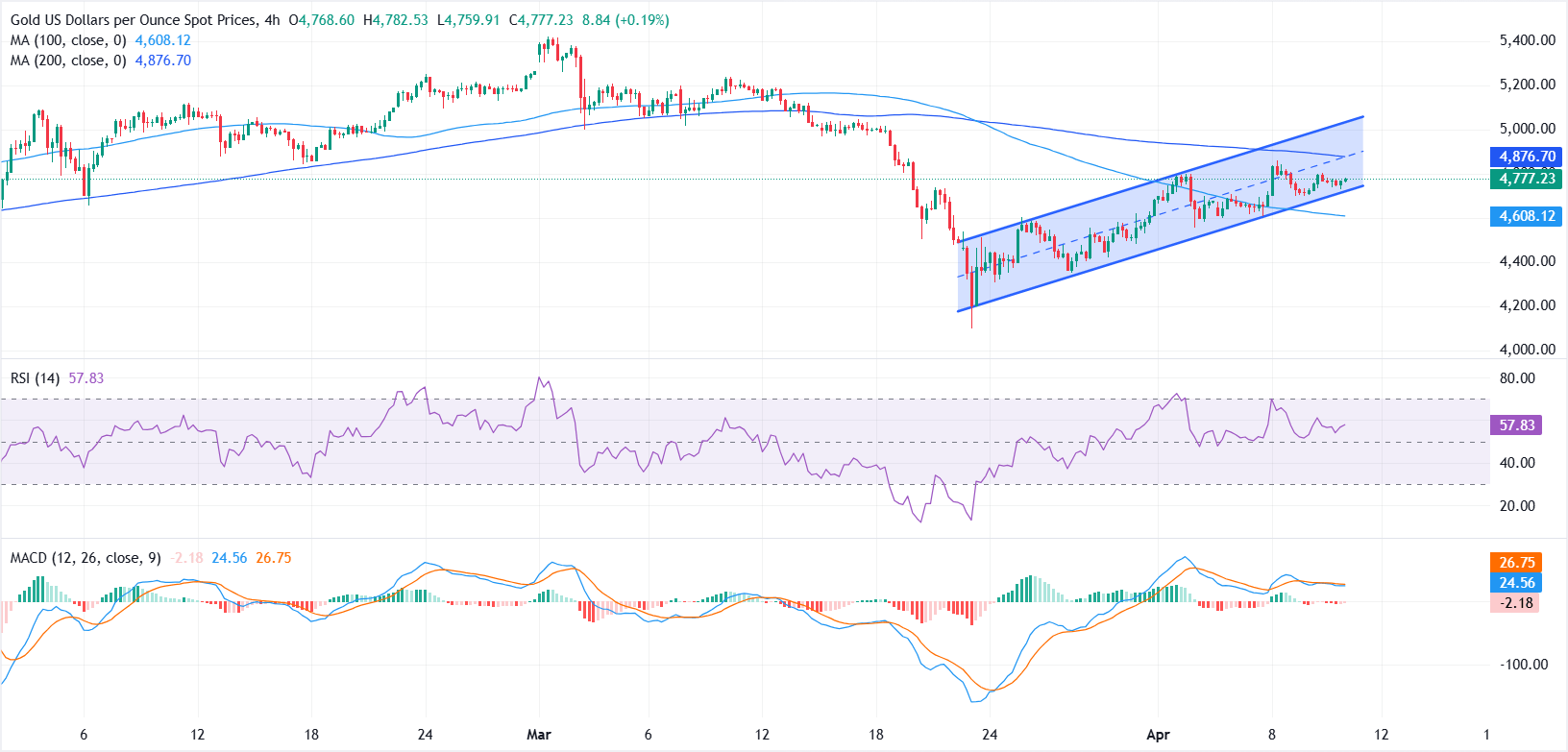
From a technical perspective, the 4-hour chart shows XAU/USD trading within an upward-sloping parallel channel, forming a series of higher highs and higher lows since bottoming near the $4,100 March swing low.
However, price action reflects a neutral-to-capped near-term tone, as the pair trades below the 200-period Simple Moving Average (SMA) at $4,876 while holding above the 100-period SMA at $4,608.
The Relative Strength Index (RSI) around 57 hints at mildly positive momentum, yet the Moving Average Convergence Divergence (MACD) line remains below the signal line and above zero, with negative histogram bars holding, reinforcing a consolidative phase within the rising channel.
On the topside, immediate resistance is defined first by the 200-period SMA at $4,878, with a break higher opening the way toward the channel’s upper boundary near $5,000 as the next significant supply zone.
On the downside, initial demand emerges around the channel bottom at $4,700, which guards more substantive support at the 100-period SMA at $4,608. A sustained move below the latter would weaken the broader constructive channel narrative and expose deeper losses, while holding above these supports would keep the current consolidation phase intact inside the rising structure.
(The technical analysis of this story was written with the help of an AI tool.)
Inflation FAQs
Inflation measures the rise in the price of a representative basket of goods and services. Headline inflation is usually expressed as a percentage change on a month-on-month (MoM) and year-on-year (YoY) basis. Core inflation excludes more volatile elements such as food and fuel which can fluctuate because of geopolitical and seasonal factors. Core inflation is the figure economists focus on and is the level targeted by central banks, which are mandated to keep inflation at a manageable level, usually around 2%.
The Consumer Price Index (CPI) measures the change in prices of a basket of goods and services over a period of time. It is usually expressed as a percentage change on a month-on-month (MoM) and year-on-year (YoY) basis. Core CPI is the figure targeted by central banks as it excludes volatile food and fuel inputs. When Core CPI rises above 2% it usually results in higher interest rates and vice versa when it falls below 2%. Since higher interest rates are positive for a currency, higher inflation usually results in a stronger currency. The opposite is true when inflation falls.
Although it may seem counter-intuitive, high inflation in a country pushes up the value of its currency and vice versa for lower inflation. This is because the central bank will normally raise interest rates to combat the higher inflation, which attract more global capital inflows from investors looking for a lucrative place to park their money.
Formerly, Gold was the asset investors turned to in times of high inflation because it preserved its value, and whilst investors will often still buy Gold for its safe-haven properties in times of extreme market turmoil, this is not the case most of the time. This is because when inflation is high, central banks will put up interest rates to combat it. Higher interest rates are negative for Gold because they increase the opportunity-cost of holding Gold vis-a-vis an interest-bearing asset or placing the money in a cash deposit account. On the flipside, lower inflation tends to be positive for Gold as it brings interest rates down, making the bright metal a more viable investment alternative.