
Euro stands tall as hopes of a swift end to Iran's war boost risk appetite
- EUR/USD holds in the upper range of the 1.1700s, after rallying above 0.6% in the last two days.
- Hopes of a swift end to the US-Iran war are keeping a moderate risk appetite alive, supporting the Euro.
- German Factory Orders and Eurozone Retail Sales figures for March beat expectations.
The Euro (EUR) appreciates against the US Dollar (USD) for the second consecutive day on Thursday, trading at 1.1765 at the time of writing, fuelled by hopes of a peace deal that would end Iran’s war and upbeat Eurozone macroeconomic releases.
The pair is drawing some support from lower Oil prices amid news of progress in the peace negotiations between the US and Iran. Latest reports affirm that Tehran is reviewing a peace plan submitted by the US, while Al Hadath, a sister channel of Al Arabiya, posted on X that talks to reopen the Strait of Hormuz are advanced.
US Boston Federal Reserve (Fed) President Susan Collins stated during the European trading hours that interest rates will be on hold for a long time, but that she sees the rate cuts baseline scenario still standing. The impact of these comments on the pair has been minimal.
A few hours earlier, data released by Eurostat showed that Eurozone Retail Sales edged down by 0.1% in March, above the market consensus of a 0.3% drop, amid the impact of the energy shock stemming from the blockade of the Strait of Hormuz. These figures follow a downwardly revised 0.3% decline in February. Year-on-year, sales grew by 1.2%, also beating the 1% advance expected and following a 1.3% growth in February.
Before that, German Factory Orders figures for March also beat expectations, with a 5% growth in March, well above the 1% forecast by market analysts and accelerating from the 1.4% increase posted in February.
Technical Analysis: Key resistance remains at 1.1790
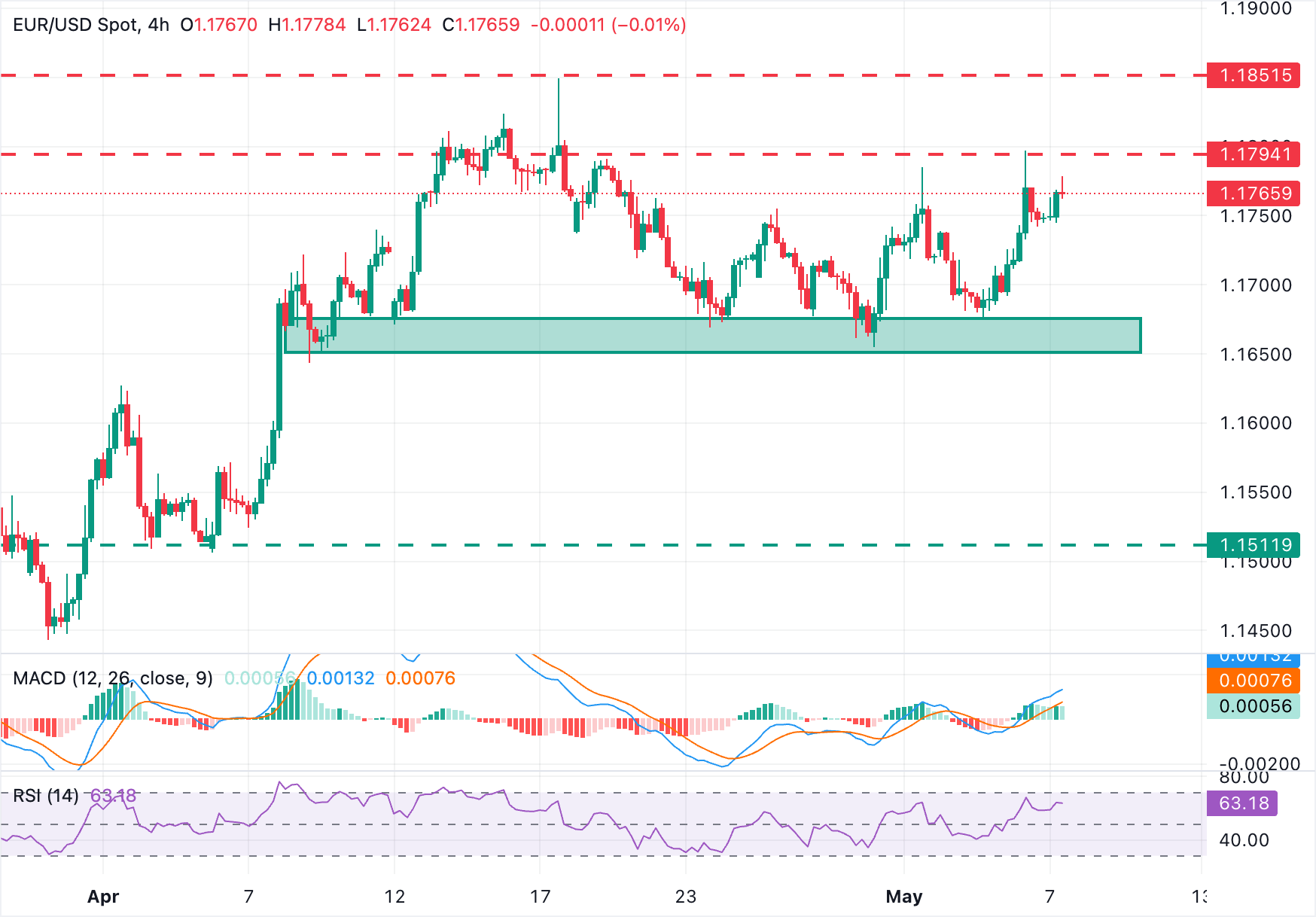
EUR/USD maintains a constructive near-term bias, yet with price action contained below the top of the last three weeks' trading channel, in the area between 1.1790 and the 1.1800 psychological level.
Momentum dynamics support the bullish tone, with the 4-hour Relative Strength Index (RSI) hovering near 65, signaling firm buying interest, while the Moving Average Convergence Divergence (MACD) histogram prints widening green bars.
Bulls, however, will likely be challenged at the mentioned resistance below 1.1800, which closes the path towards April's peak near 1.1850. On the downside, session lows are at 1.1745, but the key area for bears lies between there and 1.1775, which contained downside attempts several times in April.
(The technical analysis of this story was written with the help of an AI tool.)
Risk sentiment FAQs
In the world of financial jargon the two widely used terms “risk-on” and “risk off'' refer to the level of risk that investors are willing to stomach during the period referenced. In a “risk-on” market, investors are optimistic about the future and more willing to buy risky assets. In a “risk-off” market investors start to ‘play it safe’ because they are worried about the future, and therefore buy less risky assets that are more certain of bringing a return, even if it is relatively modest.
Typically, during periods of “risk-on”, stock markets will rise, most commodities – except Gold – will also gain in value, since they benefit from a positive growth outlook. The currencies of nations that are heavy commodity exporters strengthen because of increased demand, and Cryptocurrencies rise. In a “risk-off” market, Bonds go up – especially major government Bonds – Gold shines, and safe-haven currencies such as the Japanese Yen, Swiss Franc and US Dollar all benefit.
The Australian Dollar (AUD), the Canadian Dollar (CAD), the New Zealand Dollar (NZD) and minor FX like the Ruble (RUB) and the South African Rand (ZAR), all tend to rise in markets that are “risk-on”. This is because the economies of these currencies are heavily reliant on commodity exports for growth, and commodities tend to rise in price during risk-on periods. This is because investors foresee greater demand for raw materials in the future due to heightened economic activity.
The major currencies that tend to rise during periods of “risk-off” are the US Dollar (USD), the Japanese Yen (JPY) and the Swiss Franc (CHF). The US Dollar, because it is the world’s reserve currency, and because in times of crisis investors buy US government debt, which is seen as safe because the largest economy in the world is unlikely to default. The Yen, from increased demand for Japanese government bonds, because a high proportion are held by domestic investors who are unlikely to dump them – even in a crisis. The Swiss Franc, because strict Swiss banking laws offer investors enhanced capital protection.