
USD/INR plunges as RBI intervenes again to support Indian Rupee
- The Indian Rupee surges against the US Dollar as the RBI intervenes again this week.
- FIIs turned out to be net buyers on Wednesday and Thursday.
- US President Trump called Fed’s Waller “great” after interviewing him for the next chairman.
The Indian Rupee (INR) gains sharply against the US Dollar (USD) during late trading hours in India on Friday. The USD/INR pair plunges over 1% to near 89.50 as the Reserve Bank of India (RBI) has intervened to support the Indian Rupee
Traders pointed out that a large state-run bank heavily sold US dollars, most likely on behalf of the RBI, near the close of the spot market session at 3:30 IST, Reuters reported.
This is the second time this week that the RBI has intervened to provide tentative support to the Indian Rupee due to its one-way depreciation against the US Dollar. India's central bank also sold US Dollars on Wednesday, when the USD/INR pair posted record highs at 91.55.
However, the Indian Rupee's recovery seems unlikely to last long due to an absence of supportive fundamentals. So far this year, the Indian Rupee has depreciated more than 6% against the US Dollar due to strong demand for Greenback by Indian importers and the persistent outflow of foreign funds from the Indian stock market amid the absence of a US-India trade deal announcement.
Currently, Washington is charging 50% tariffs on imports from New Delhi, which includes a 25% punitive import duty for buying Oil from Russia. This is one of the highest tariffs charged by Washington among its trading partners.
This month, Foreign Institutional Investors (FIIs) have offloaded a stake worth Rs. 21,688.26 crore in the Indian equity market. However, some sort of buying has been observed in the past two trading days. FIIs have turned out to be net buyers of Rs. 1,767.49 crore worth of shares collectively on Wednesday and Thursday. Nominal buying interest in FIIs' activity is unlikely to provide a sustainable boost to risk sentiment, as the overall mood is still cautious amid the US-India trade stalemate.
The table below shows the percentage change of Indian Rupee (INR) against listed major currencies today. Indian Rupee was the strongest against the Japanese Yen.
| USD | EUR | GBP | JPY | CAD | AUD | INR | CHF | |
|---|---|---|---|---|---|---|---|---|
| USD | 0.09% | 0.04% | 1.07% | 0.13% | 0.08% | -0.61% | 0.18% | |
| EUR | -0.09% | -0.05% | 0.99% | 0.04% | -0.01% | -0.97% | 0.09% | |
| GBP | -0.04% | 0.05% | 1.05% | 0.09% | 0.00% | -0.65% | 0.14% | |
| JPY | -1.07% | -0.99% | -1.05% | -0.93% | -0.99% | -1.94% | -0.89% | |
| CAD | -0.13% | -0.04% | -0.09% | 0.93% | -0.06% | -1.01% | 0.05% | |
| AUD | -0.08% | 0.01% | -0.01% | 0.99% | 0.06% | -0.97% | 0.10% | |
| INR | 0.61% | 0.97% | 0.65% | 1.94% | 1.01% | 0.97% | 1.03% | |
| CHF | -0.18% | -0.09% | -0.14% | 0.89% | -0.05% | -0.10% | -1.03% |
The heat map shows percentage changes of major currencies against each other. The base currency is picked from the left column, while the quote currency is picked from the top row. For example, if you pick the Indian Rupee from the left column and move along the horizontal line to the US Dollar, the percentage change displayed in the box will represent INR (base)/USD (quote).
US Dollar gains as Fed dovish expectations for January remain lower
- The Indian Rupee strengthens against the US Dollar, even as the latter outperforms its other peers. At the time of writing, the US Dollar Index (DXY), which tracks the Greenback's value against six major currencies, trades 0.25% higher to near 98.65, the highest level seen in a week.
- The US Dollar trades firmly despite an unexpected slowdown in the United States (US) inflation data for November. On Thursday, the US Consumer Price Index (CPI) data showed that the headline inflation cooled down to 2.7% year-on-year (YoY) from 3% in October. Economists expected the inflation data to come in higher at 3.1%. The so-called core reading, which strips out volatile food and energy items, dropped to 2.6% from estimates and the prior reading of 3%.
- Initially, the US Dollar reacted negatively to soft inflation data, but has since recovered losses as the data has not materially affected dovish expectations for the Federal Reserve’s (Fed) January policy meeting. According to the CME FedWatch tool, the probability of the Fed reducing interest rates by 25 basis points (bps) to 3.25%-3.50% in the January meeting is 25.5%, marginally higher from 24.4% recorded on Wednesday.
- Chicago President Austan Goolsbee welcomed soft inflation prints in his interview with Fox Business on Thursday, stating that “there’s a lot to like” in the data. Goolsbee signaled that there could be additional interest rate cuts next year if inflation remains on track toward the 2% target.
- Going forward, the next major trigger for the USD/INR pair will be the announcement of Fed Chair Jerome Powell’s successor by the White House. On Thursday, US President Donald Trump interviewed Fed Governor Christopher Waller for the Chairman post, and praised him as “great”, while responding to reporters. Trump also called Governor Michelle Bowman, "fantastic", when asked about his views on her as Powell’s successor.
- Last week, US President Trump stated he has downsized his choices for Fed’s chairman to both Kevins, who are White House Economic Adviser Kevin Hassett and former Fed Chairman Kevin Warsh.
Technical Analysis: USD/INR dives below 20-day EMA
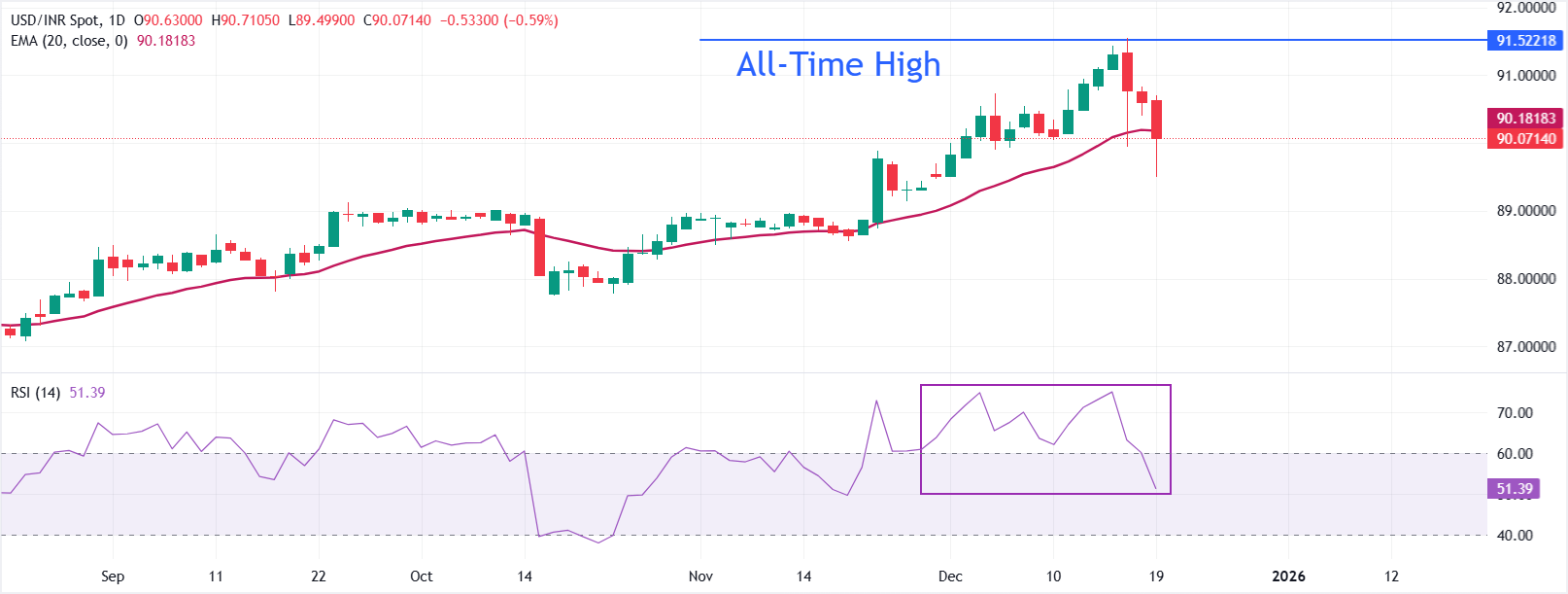
USD/INR slides to near 90.0714 on Friday. The price sits marginally below the 20-day Exponential Moving Average (EMA), which has flattened after a multi-week ascent. The 20-day EMA at 90.1818 caps immediate topside while the prior upward bias pauses.
The 14-day Relative Strength Index (RSI) falls sharply to 51, reflects balanced momentum after cooling from recent overbought readings.
A daily close back above the 20-day EMA would reassert bullish bias and open room for extension towards the all-time high near 91.55, whereas a sustained trade below the average would keep the cross in consolidation and leave risks skewed toward a drift lower. RSI holding above 50 would support stabilization; a break beneath 50 could tilt pressure to the downside and extend the pause in trend.
(The technical analysis of this story was written with the help of an AI tool.)
Economic Indicator
Consumer Price Index (YoY)
Inflationary or deflationary tendencies are measured by periodically summing the prices of a basket of representative goods and services and presenting the data as The Consumer Price Index (CPI). CPI data is compiled on a monthly basis and released by the US Department of Labor Statistics. The YoY reading compares the prices of goods in the reference month to the same month a year earlier.The CPI is a key indicator to measure inflation and changes in purchasing trends. Generally speaking, a high reading is seen as bullish for the US Dollar (USD), while a low reading is seen as bearish.
Read more.Last release: Thu Dec 18, 2025 13:30
Frequency: Monthly
Actual: 2.7%
Consensus: 3.1%
Previous: 3%
Source: US Bureau of Labor Statistics
The US Federal Reserve (Fed) has a dual mandate of maintaining price stability and maximum employment. According to such mandate, inflation should be at around 2% YoY and has become the weakest pillar of the central bank’s directive ever since the world suffered a pandemic, which extends to these days. Price pressures keep rising amid supply-chain issues and bottlenecks, with the Consumer Price Index (CPI) hanging at multi-decade highs. The Fed has already taken measures to tame inflation and is expected to maintain an aggressive stance in the foreseeable future.