
USD/INR falls sharply as oil prices face bloodbath on US-Iran ceasefire
- The Indian Rupee nears a three-week high against the US Dollar on the US-Iran temporary ceasefire.
- Iran delivers a 10-point proposal plan to the US, which includes recognition of Tehran’s authority at Hormuz.
- The RBI leaves its Repo Rate steady at 5.25%, as expected.
The Indian Rupee (INR) jumps to a fresh over three-week high against the US Dollar (USD) on Wednesday. The USD/INR pair slides to near 92.30 as the US Dollar weakens and global oil prices nosedive, following a temporary ceasefire between the United States (US) and Iran.
As of writing, the US Dollar Index (DXY), which tracks the Greenback’s value against six major currencies, is down 0.55% to near 99.00. WTI Oil price plummets almost 11% to near $90.00.
Trump suspends planned Iranian attacks
Earlier in the day, US President Donald Trump announced, through a post on Truth.Social, that he has suspended planned attacks on Iranian power plants and bridges for two weeks, as it has agreed to a “complete, immediate, and safe opening of the Strait of Hormuz”, a critical gateway to almost 20% of global oil supply. Trump added, “We received a 10-point proposal from Iran, and believe it is a workable basis on which to negotiate.”
Meanwhile, Iran has also acknowledged the Hormuz reopening, and the delivery of the 10-point proposal, which includes controlled transit through the Hormuz coordinated with Iranian armed forces, ending war against Iran and allied groups, the withdrawal of US combat forces from all regional bases, lifting all primary and secondary sanctions, payment of full compensation to Iran and the release of all frozen Iranian assets.
The Hormuz reopening has battered the oil price badly, a scenario that is favorable for currencies from economies like India, which rely heavily on oil imports to meet their energy needs.
However, the continuation of the Foreign Institutional Investors (FIIs) selling in the Indian stock market is expected to cap the upside in the Indian Rupee. So far in April, FIIs have offloaded their stake worth Rs. 35,121.56 crore.
RBI keeps Repo Rate steady at 5.25%
The Reserve Bank of India (RBI) has kept key interest rates unchanged in the monetary policy meeting on Wednesday, keeping the Repo Rate steady at 5.25%. The Indian central bank was expected to maintain the status quo, as the war in the Middle East has increased inflation globally.
RBI Governor Sanjay Malhotra has stated in the monetary policy statement that higher oil prices due to disruptions in the Strait of Hormuz are likely to impact growth this year. “Elevated crude oil prices could increase imported inflation and widen the current account deficit,” Malhotra said.
Technical Analysis: USD/INR faces selling pressure near 20-day EMA
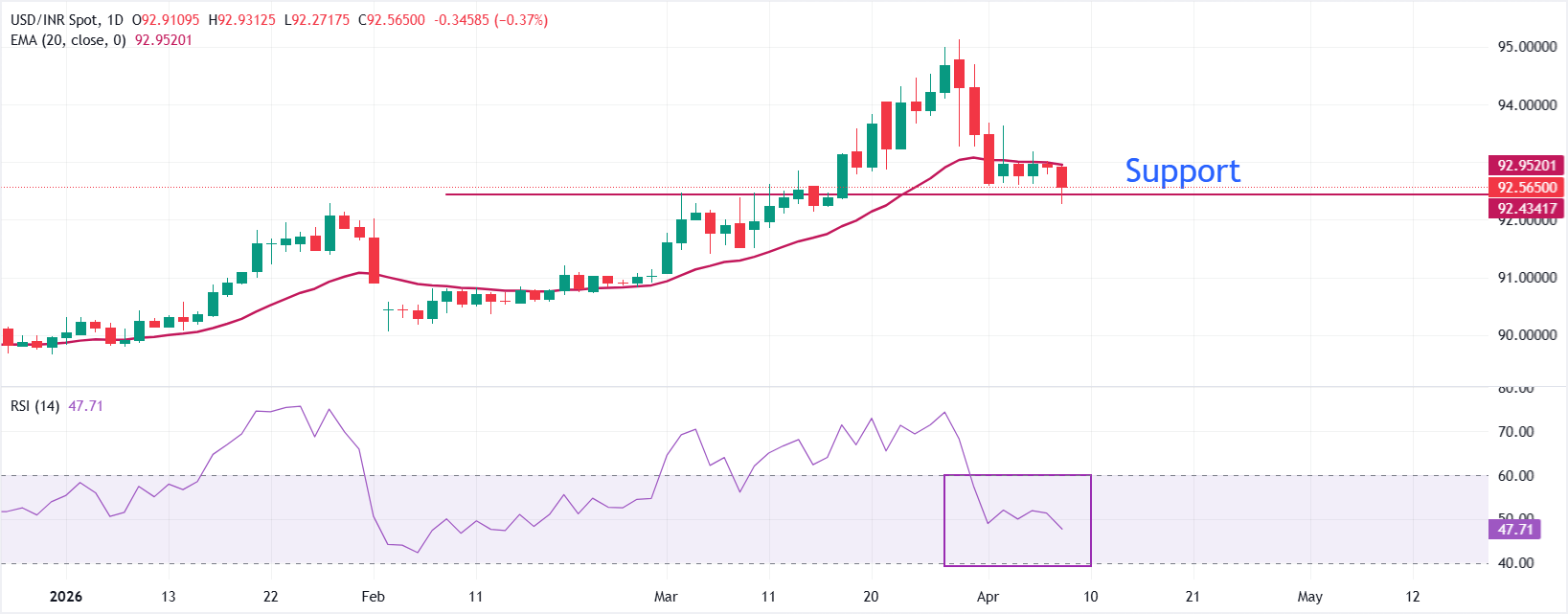
USD/INR declines to near 92.30 on Wednesday. The pair trades below the 20-day Exponential Moving Average (EMA), shifting the near-term bias to mildly bearish.
The 14-day Relative Strength Index (RSI) has dropped to 47, moving below the 50 midline and confirming that sellers have gained control after the overbought readings seen above 70 in late March.
Immediate support emerges at 92.00 and then 91.50, where the previous consolidation zone sits. On the topside, initial resistance is now located at 93.00, with stronger resistance at 93.70 ahead of the recent 95.12 peak. As long as price holds below this resistance band while RSI remains under 50, rallies are expected to be capped and vulnerable to renewed selling pressure.
(The technical analysis of this story was written with the help of an AI tool.)
Economic Indicator
RBI Interest Rate Decision (Repo Rate)
The RBI Interest Rate Decision is announced by the Reserve Bank of India. If the bank is hawkish about the inflationary outlook of the economy and rises the interest rates, it is seen as positive, or bullish, for the INR, while a dovish outlook for the economy (or a rate cut) is seen as negative, or bearish, for the currency.
Read more.Last release: Wed Apr 08, 2026 04:30
Frequency: Irregular
Actual: 5.25%
Consensus: 5.25%
Previous: 5.25%
Source: Reserve Bank of India