
Gold slips near $4,500 as Oil rally and US yields weigh on bullion
- Gold drops nearly 2% to $4,560, heading for weekly losses above 8.5%.
- US 10-year yield jumps to 4.38% as markets price out Fed cuts.
- Oil near $98 and Middle East escalation boost DXY to 99.58, pressuring bullion.
Gold (XAU/USD) price extended on Friday its losses for the eighth straight day, poised to end the week down by more than 8.50% as Oil prices continued to rally, boosting the haven appeal of the Greenback. The jump in US Treasury yields and market participants' pricing in no rate cuts by the Federal Reserve (Fed) keep the yellow metal downward pressured.
Gold set for 8% weekly loss as Fed rate cut bets vanish, Middle East conflict escalates
At the time of writing, XAU/USD trades at $4,560, down nearly 2% in the day. The US Dollar Index (DXY), which measures the buck's performance against a basket of six currencies, is up 0.43% at 99.58.
The escalation of the Middle East conflict is weighing on the precious metals segment. A Wall Street Journal headline read "Pentagon Sends More Troops to the Middle East," pushing oil prices higher amid growing speculation of boots on the ground in Iran.
Consequently, US Treasury bond yields have risen and are weighing on the yellow metal, as the 10-year Treasury note is soaring nearly 14 basis points to 4.384%, signalling that investors are not expecting rate cuts; instead, they've begun to price in rate increases this year.
WTI rally weighs on Gold prices
West Texas Intermediate (WTI), the US Crude Oil benchmark, is gaining nearly 4% up at $98.29 per barrel. Israel's attacks on Iran's energy facilities triggered a retaliation from the latter, which struck energy infrastructure in Gulf states, such as Saudi Arabia, Qatar and Kuwait.
Last Wednesday, the Federal Reserve delivered a hawkish hold, with Fed Chair Jerome Powell stating that if he does not see disinflation progress, "I won't see a rate cut." Despite this, the dot plot in the Summary of Economic Projections (SEP) showed that policymakers are still eyeing a rate cut amid the Middle East conflict.
On Friday, Federal Reserve Governor Christopher Waller told CNBC that he initially planned to support a rate cut based on the jobs report, but rising inflation has shifted his focus. He mentioned that prolonged high oil prices can eventually impact core inflation.
Fed Governor Michelle Bowman also crossed the wires, stating that she had penciled in three rate cuts this year. She added that she expects strong economic growth and that she still sees a weak labour market.
In the upcoming week, the US economic calendar will include the Flash PMIs, Current Account, Jobless Claims, and Wholesale Inventories.
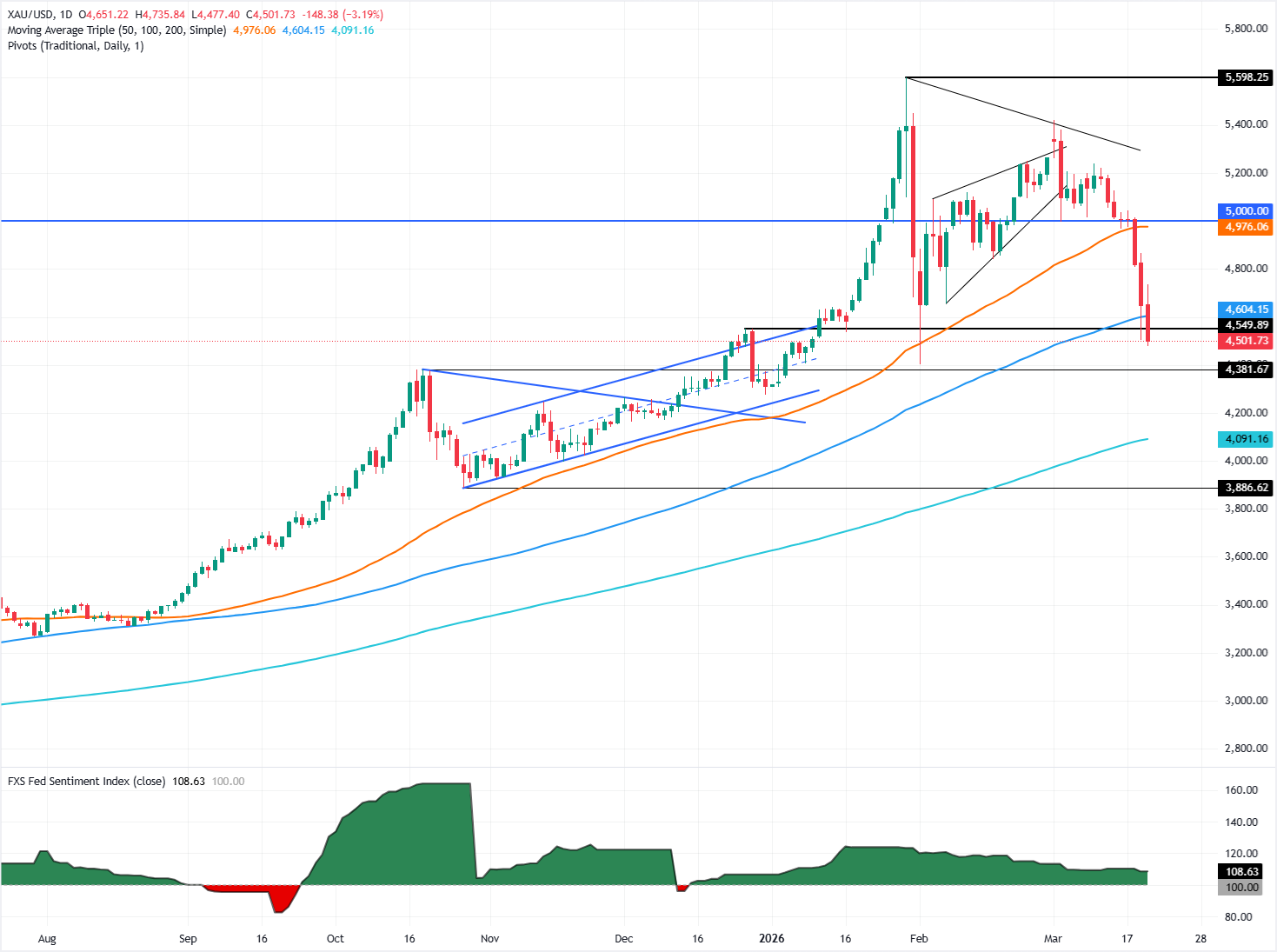
XAU/USD technical analysis: Gold poised to test $4,000 on a breach of $4,400
Gold price hovers around $4,500 after breaching key support at the 100-day Simple Moving Average (SMA) at $4,581, which could open the door for further downside. Worth noting that market structure still supports a neutral-to-bullish bias, but a daily-weekly close beneath the February 2 cycle low of $4,402 it would clear the path to challenge the 200-day SMA at $4,066.
In the short term, the momentum has turned bearish, as depicted by the Relative Strength Index (RSI), which has cleared the neutral level since Monday and is now approaching oversold territory.
On the bullish side, if XAU/USD climbs past the 100-day SMA and reclaims $4,600, traders could expect a near-term retest of the 50-day SMA at $4,961.
Gold FAQs
Gold has played a key role in human’s history as it has been widely used as a store of value and medium of exchange. Currently, apart from its shine and usage for jewelry, the precious metal is widely seen as a safe-haven asset, meaning that it is considered a good investment during turbulent times. Gold is also widely seen as a hedge against inflation and against depreciating currencies as it doesn’t rely on any specific issuer or government.
Central banks are the biggest Gold holders. In their aim to support their currencies in turbulent times, central banks tend to diversify their reserves and buy Gold to improve the perceived strength of the economy and the currency. High Gold reserves can be a source of trust for a country’s solvency. Central banks added 1,136 tonnes of Gold worth around $70 billion to their reserves in 2022, according to data from the World Gold Council. This is the highest yearly purchase since records began. Central banks from emerging economies such as China, India and Turkey are quickly increasing their Gold reserves.
Gold has an inverse correlation with the US Dollar and US Treasuries, which are both major reserve and safe-haven assets. When the Dollar depreciates, Gold tends to rise, enabling investors and central banks to diversify their assets in turbulent times. Gold is also inversely correlated with risk assets. A rally in the stock market tends to weaken Gold price, while sell-offs in riskier markets tend to favor the precious metal.
The price can move due to a wide range of factors. Geopolitical instability or fears of a deep recession can quickly make Gold price escalate due to its safe-haven status. As a yield-less asset, Gold tends to rise with lower interest rates, while higher cost of money usually weighs down on the yellow metal. Still, most moves depend on how the US Dollar (USD) behaves as the asset is priced in dollars (XAU/USD). A strong Dollar tends to keep the price of Gold controlled, whereas a weaker Dollar is likely to push Gold prices up.