
Gold rebounds as Iran-US deal hopes drive upside
- Gold recovers as renewed Iran talk hopes keep risk sentiment upbeat.
- Falling US Treasury yields and a weaker US Dollar underpin bullion prices.
- Traders remain cautious as failed earlier talks keep uncertainty elevated.
Gold (XAU/USD) price recovers some ground on Friday, extending its gains above $4,700 as market sentiment remains upbeat amid headlines from Iran and the US pointing to a resumption of second-round talks aimed at ending the conflict. At the time of writing XAU/USD trades at $4,726, up 0.47%.
Bullion firms as softer Dollar and lower yields fuel rebound anew
Middle East headlines kept investors optimistic about a diplomatic end to the war. However, traders must be aware that uncertainty remains high after scheduled talks at the beginning of the week failed as the Iranian delegation didn’t confirm its attendance.
Newswires reported that Iranian Foreign Minister Abbas Araghchi is expected in Islamabad, Pakistan, on Friday. The White House Press Secretary Karoline Leavitt stated that Steve Wytkoff and Jared Kushner are heading to Pakistan on Saturday morning for Iran talks.
After the news, West Texas Intermediate (WTI), the US crude Oil benchmark, is extending its losses by some 3.50%, a relief for major central banks worried that the energy shock could trigger a second wave of inflation.
The US 10-year Treasury note is yielding 4.31%, down 1.5 basis points, an indication that investors are confident the Federal Reserve (Fed) might ease policy ahead.
The fall in US Treasury yields is also undermining the Greenback. The US Dollar Index (DXY), which measures the buck’s advance against a basket of six other currencies, is down 0.22% at 98.57. Despite this, Gold prices are poised to sustain a 2.30% loss for the week.
In April, the University of Michigan Consumer Sentiment Index dropped to 49.8 from 53.3 in March, its lowest level since 1978, signaling that US households turned pessimistic about the economy. One-year inflation expectations rose to 4.7%, and five-year expectations increased to 3.5%.
Joanne Hsu, the director of the poll, said that “The Iran conflict appears to influence consumer views primarily through shocks to gasoline and potentially other prices.”
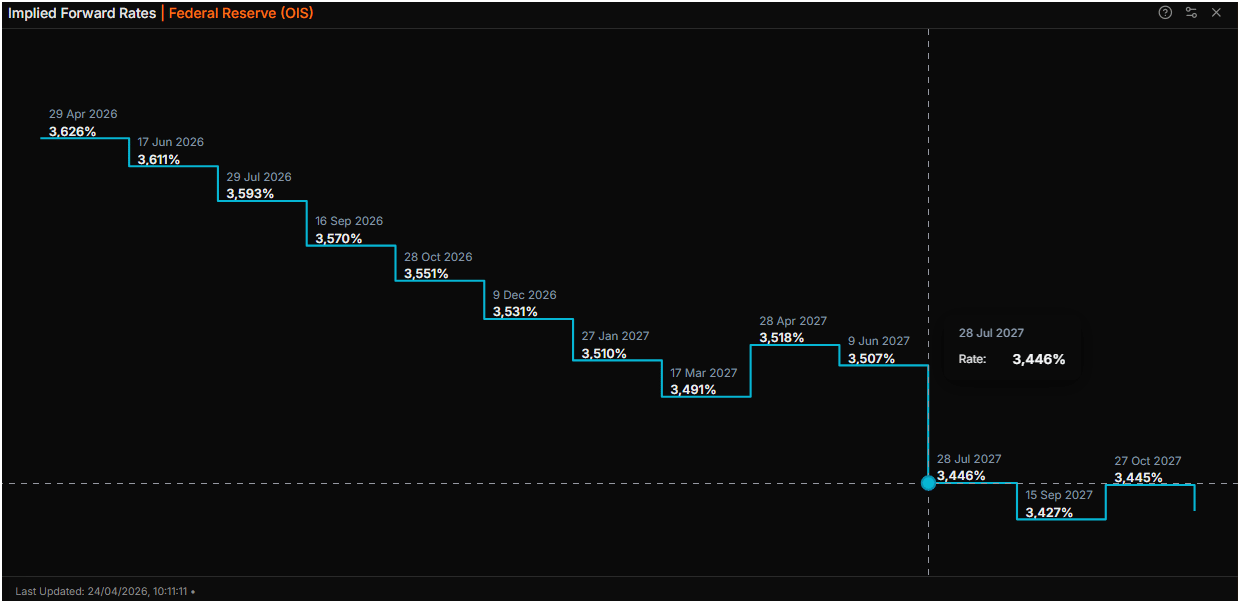
Meanwhile, the Federal Reserve is expected to keep rates on hold through 2026, with the first rate cut in July 2027, according to the Prime Terminal implied forward rate curve.
Fed implied forward rates
Next week, the US economic docket will feature the Federal Reserve’s monetary policy decision along with GDP, Durable Goods Orders, and jobs data.
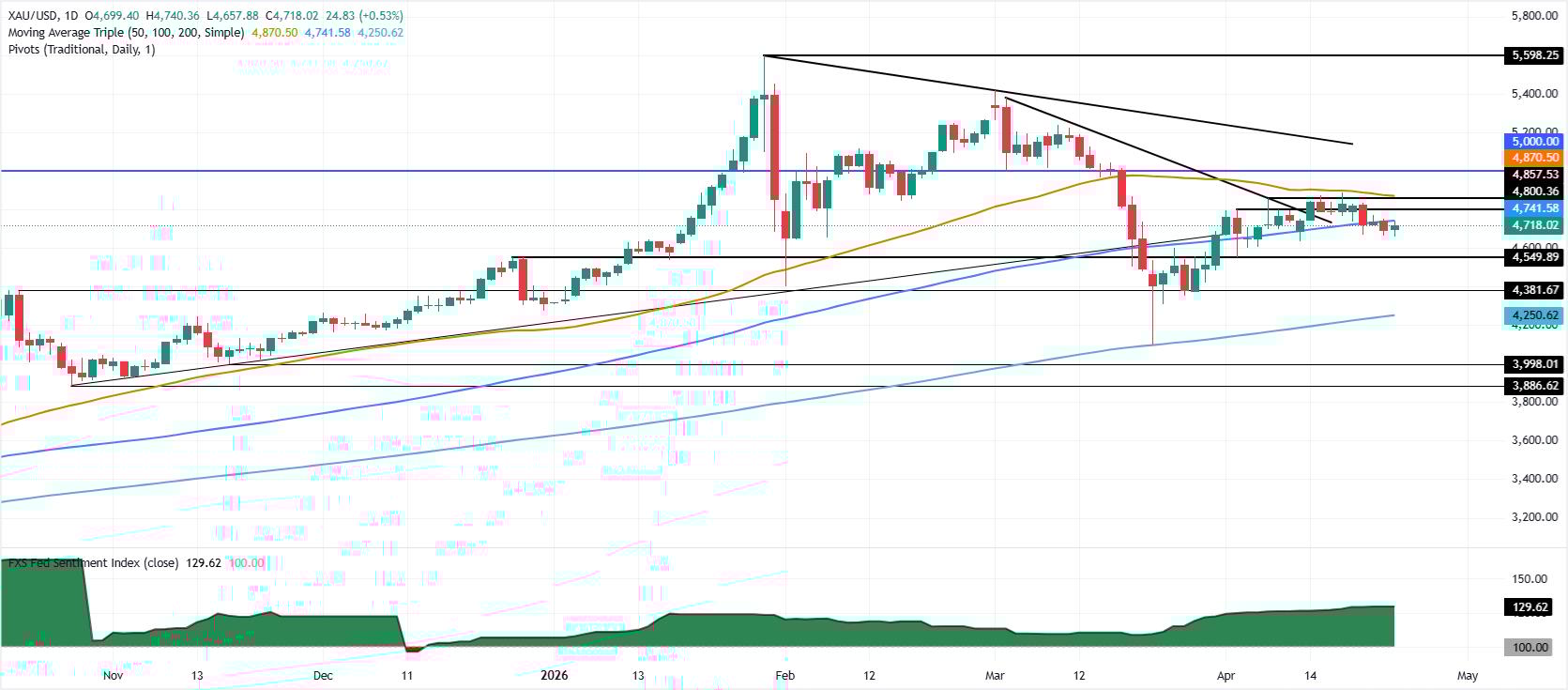
XAU/USD technical analysis: Stuck within a range of $4,700-$4,730
Gold’s price continues to trade sideways despite a recovery in the day. Although sentiment improved, downside risks remain with XAU/USD supported by the $4,700 psychological level.
Momentum, as measured by the Relative Strength Index (RSI), is bearish, though it is close to its 50 neutral level, suggesting neither buyers nor sellers are in control.
On the upside, the first resistance is at the 100-day Simple Moving Average (SMA) at $4,729. A breach of the latter exposes the psychological $4,750 and $4,800 levels ahead of challenging the 50-day SMA at $4,869.
Downwards, if XAU/USD collapses below $4,700, the first support is the day’s low at $4,657, with the next area of interest at $4,600. Below this area, sellers eye the April 2 swing low of $4,554.
Gold FAQs
Gold has played a key role in human’s history as it has been widely used as a store of value and medium of exchange. Currently, apart from its shine and usage for jewelry, the precious metal is widely seen as a safe-haven asset, meaning that it is considered a good investment during turbulent times. Gold is also widely seen as a hedge against inflation and against depreciating currencies as it doesn’t rely on any specific issuer or government.
Central banks are the biggest Gold holders. In their aim to support their currencies in turbulent times, central banks tend to diversify their reserves and buy Gold to improve the perceived strength of the economy and the currency. High Gold reserves can be a source of trust for a country’s solvency. Central banks added 1,136 tonnes of Gold worth around $70 billion to their reserves in 2022, according to data from the World Gold Council. This is the highest yearly purchase since records began. Central banks from emerging economies such as China, India and Turkey are quickly increasing their Gold reserves.
Gold has an inverse correlation with the US Dollar and US Treasuries, which are both major reserve and safe-haven assets. When the Dollar depreciates, Gold tends to rise, enabling investors and central banks to diversify their assets in turbulent times. Gold is also inversely correlated with risk assets. A rally in the stock market tends to weaken Gold price, while sell-offs in riskier markets tend to favor the precious metal.
The price can move due to a wide range of factors. Geopolitical instability or fears of a deep recession can quickly make Gold price escalate due to its safe-haven status. As a yield-less asset, Gold tends to rise with lower interest rates, while higher cost of money usually weighs down on the yellow metal. Still, most moves depend on how the US Dollar (USD) behaves as the asset is priced in dollars (XAU/USD). A strong Dollar tends to keep the price of Gold controlled, whereas a weaker Dollar is likely to push Gold prices up.