
Gold extends downside despite cautious optimism surrounding US-Iran negotiations
- Gold slides to its lowest level since March 30 despite a softer US Dollar and declining Oil prices.
- Expectations that the Fed will keep interest rates higher for longer continue to weigh on non-yielding Gold.
- Technically, XAU/USD trades near the lower Bollinger Band while RSI remains below the neutral zone, keeping the broader bias bearish.
Gold (XAU/USD) struggles to attract buying interest on Wednesday, even as the US Dollar (USD) and Oil prices trade on the back foot, with markets remaining cautiously optimistic that the United States (US) and Iran could eventually reach a deal to end the war in the Middle East. At the time of writing, XAU/USD is trading around $4,430, its lowest level since March 30.
Market sentiment improved after Iran’s State TV reported that Tehran and Washington had prepared an initial unofficial framework for a memorandum of understanding (MOU). Under the proposed framework, US military forces would withdraw from Iran and lift the naval blockade, while Iran would restore commercial transit through the Strait of Hormuz to pre-war levels within one month.
The report added that any final agreement reached within 60 days would be formalized through a binding United Nations Security Council resolution. The headlines weighed on the Greenback, with the US Dollar Index (DXY), which tracks the Greenback’s value against a basket of six major currencies, retreating toward the 99.00 mark, reversing the previous day’s gains.
US President Donald Trump is scheduled to hold a cabinet meeting later on Wednesday, with investors closely watching for further updates on the ongoing negotiations with Iran.
However, Gold is struggling to capitalize on the improving sentiment as traders increasingly view Oil-driven inflation as the bigger near-term risk. Higher energy prices have strengthened expectations that major central banks, including the Federal Reserve (Fed), may need to maintain restrictive monetary policy for longer.
At the same time, the broader US macroeconomic backdrop continues to reflect resilient growth and sticky inflation, further supporting expectations of a hawkish Fed.
Even if a US-Iran peace deal is eventually reached and the major Oil chokepoint reopens, restoring normal shipping flows could take months, likely keeping Crude prices elevated and inflation concerns in focus. As a result, markets expect the Fed to remain patient before shifting back toward policy easing.
With markets pricing in a hawkish Fed outlook, Gold may continue to trade with a downside bias in the near term, as higher interest rates tend to weigh on non-yielding assets.
Traders now await the US Personal Consumption Expenditures (PCE) data due on Thursday and speeches from several Fed officials throughout the week for fresh clues on the monetary policy outlook.
Technical Analysis: XAU/USD trades near the lower Bollinger Band as sellers retain control
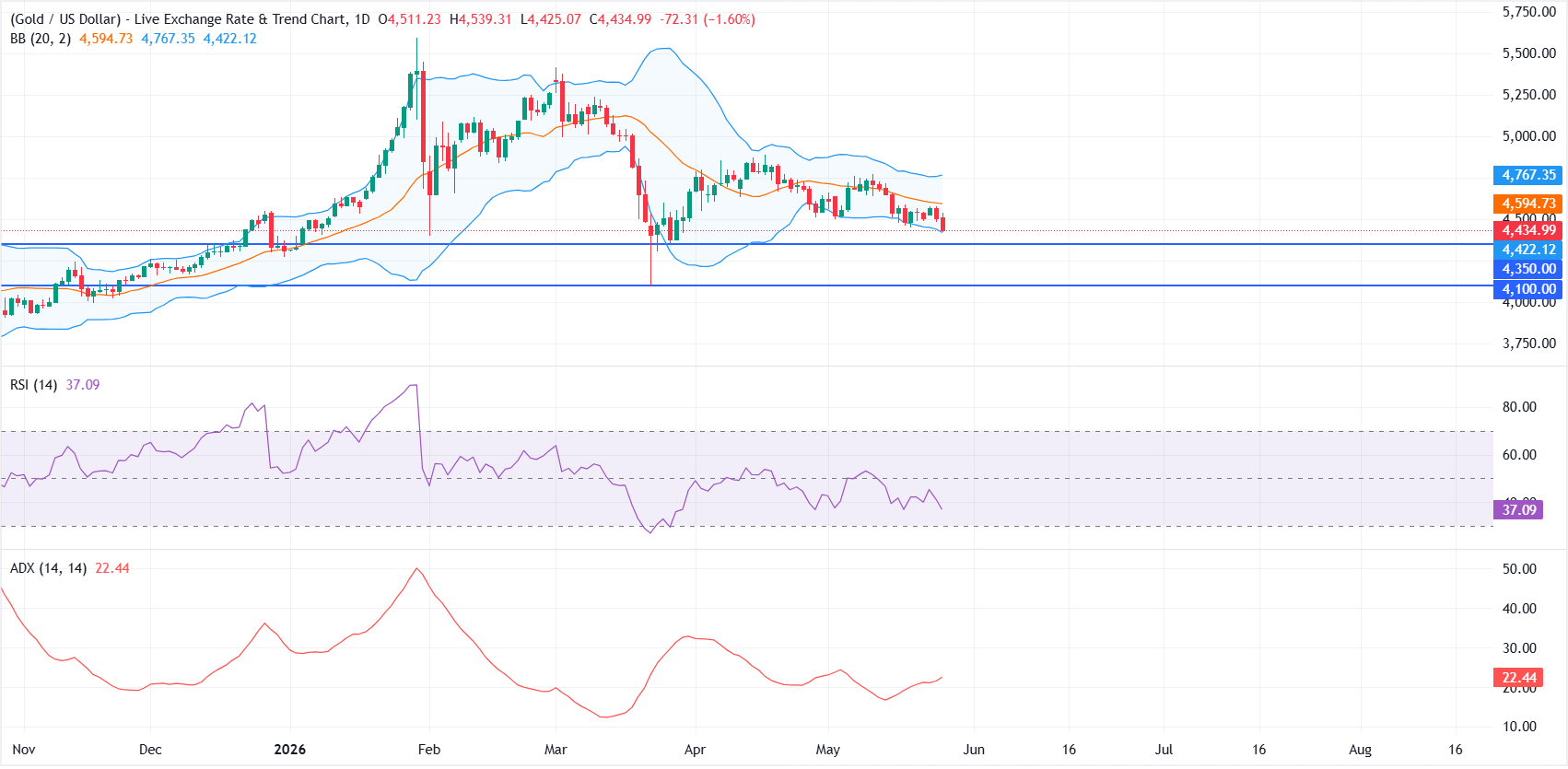
On the daily chart, XAU/USD hovers just above the lower Bollinger Band, which sits near $4,422, keeping the broader tone fragile as price remains capped below the 20-period Simple Moving Average (SMA) around $4,594. The Relative Strength Index (RSI) holds near 37, pointing to weak but not extreme downside momentum, while the Average Directional Index (ADX) near 22 suggests a developing but not yet robust trend.
On the topside, initial resistance is located at the 20-period SMA near $4,594, ahead of the upper band around $4,767. On the downside, immediate support aligns with the lower Bollinger Band near $4,422, followed by a horizontal floor at $4,350 and a deeper level near $4,100, where a break would likely reinforce the prevailing bearish bias.
(The technical analysis of this story was written with the help of an AI tool.)
Inflation FAQs
Inflation measures the rise in the price of a representative basket of goods and services. Headline inflation is usually expressed as a percentage change on a month-on-month (MoM) and year-on-year (YoY) basis. Core inflation excludes more volatile elements such as food and fuel which can fluctuate because of geopolitical and seasonal factors. Core inflation is the figure economists focus on and is the level targeted by central banks, which are mandated to keep inflation at a manageable level, usually around 2%.
The Consumer Price Index (CPI) measures the change in prices of a basket of goods and services over a period of time. It is usually expressed as a percentage change on a month-on-month (MoM) and year-on-year (YoY) basis. Core CPI is the figure targeted by central banks as it excludes volatile food and fuel inputs. When Core CPI rises above 2% it usually results in higher interest rates and vice versa when it falls below 2%. Since higher interest rates are positive for a currency, higher inflation usually results in a stronger currency. The opposite is true when inflation falls.
Although it may seem counter-intuitive, high inflation in a country pushes up the value of its currency and vice versa for lower inflation. This is because the central bank will normally raise interest rates to combat the higher inflation, which attract more global capital inflows from investors looking for a lucrative place to park their money.
Formerly, Gold was the asset investors turned to in times of high inflation because it preserved its value, and whilst investors will often still buy Gold for its safe-haven properties in times of extreme market turmoil, this is not the case most of the time. This is because when inflation is high, central banks will put up interest rates to combat it. Higher interest rates are negative for Gold because they increase the opportunity-cost of holding Gold vis-a-vis an interest-bearing asset or placing the money in a cash deposit account. On the flipside, lower inflation tends to be positive for Gold as it brings interest rates down, making the bright metal a more viable investment alternative.