
Gold declines as hawkish Fed bets and firm US Dollar weigh
- Gold remains under pressure as hawkish interest rate expectations weigh on the non-yielding metal.
- Tensions in the Strait of Hormuz rise as US-Iran diplomatic efforts fail to produce a breakthrough.
- XAU/USD holds near the lower edge of the Bollinger Band on the 4-hour chart.
Gold (XAU/USDS) kicks off the week under pressure, hovering near one-month lows as hawkish interest rate expectations continue to weigh on the non-yielding metal amid ongoing tensions in the Middle East. At the time of writing, XAU/USD is trading around $4,565 during the American session, down nearly 1.10% on the day.
Strait of Hormuz tensions keep markets on edge
Market sentiment remains fragile amid uncertainty over the future of US-Iran peace talks, with tensions escalating. Iran’s Fars news agency reported that two missiles struck a US naval vessel near the island of Jask after it allegedly ignored warnings from the Islamic Revolutionary Guard Corps (IRGC) to halt.
The incident follows US President Donald Trump’s announcement of a naval initiative dubbed “Project Freedom,” aimed at escorting stranded commercial vessels through the Strait of Hormuz. In response, Tehran warned it would attack US forces if they attempted to approach or enter the waterway. However, a US official denied that any American vessel had been hit, according to Axios.
Meanwhile, diplomatic efforts remain stalled. Washington has rejected Iran’s revised 14-point proposal and presented a counteroffer, now under review in Tehran, with nuclear disagreements still unresolved.
Hawkish Fed bets pressure Gold
While a ceasefire appears to be holding, the conflict drags on with no clear end in sight. Ongoing supply disruptions in the Strait of Hormuz are keeping Oil prices elevated, sustaining global inflation risks.
The resulting energy shock is adding pressure on central banks, particularly the Federal Reserve (Fed), to keep borrowing costs higher for longer, or even tighten policy if inflationary pressures intensify. This is pushing US Treasury yields higher, weighing on the non-yielding metal.
The CME FedWatch Tool shows the Fed is expected to hold rates through this year, while markets are now pricing in rate hikes next year, with the probability of a January 2027 rate hike rising to 22% from near 0% a week ago.
At the same time, persistent geopolitical tensions and growing hawkish Fed expectations are supporting the US Dollar (USD), adding further pressure on dollar-denominated XAU/USD.
Looking ahead, traders will continue to monitor US-Iran developments alongside upcoming US economic data for fresh clues on the Fed’s monetary policy path, with Fed officials also scheduled to speak throughout the week.
The US economic calendar features ISM Services Purchasing Managers Index (PMI) and JOLTS Job Openings on Tuesday, followed by ADP Employment Change on Wednesday, weekly Jobless Claims on Thursday, and the Employment report on Friday, which includes Nonfarm Payrolls (NFP) data.
Technical Analysis: XAU/USD hovers near support as momentum softens
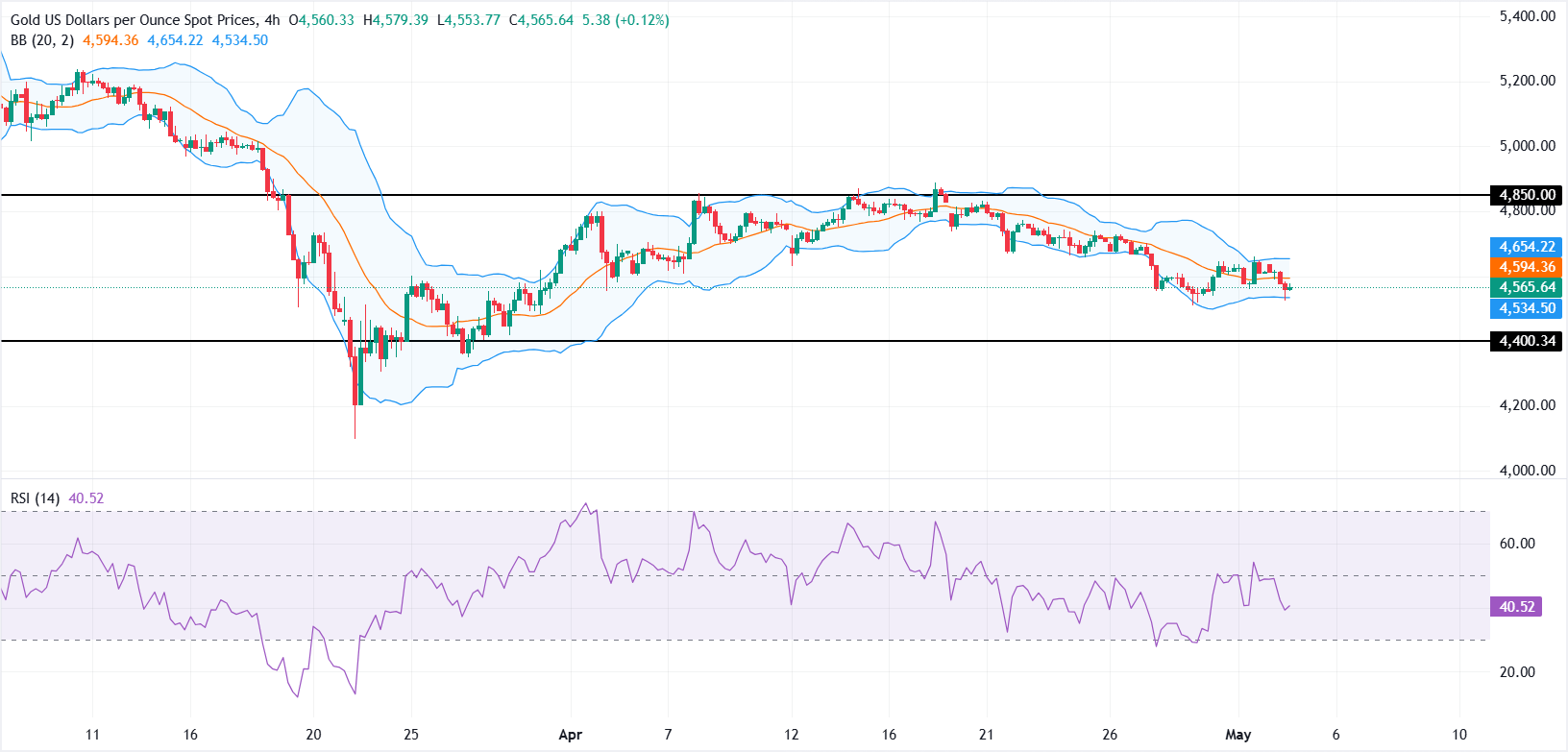
In the 4-hour chart, XAU/USD holds just above the lower Bollinger Band at $4,533, but the price remains capped beneath the 20-period Bollinger Simple Moving Average around $4,594, keeping the near-term tone bearish. The Relative Strength Index hovers near 39, pointing to weak momentum after a failed recovery attempt toward the mid-$4,600s.
On the topside, initial resistance is located at the Bollinger mid-line near $4,594, followed by the upper band around $4,655, with a more substantial barrier at the horizontal level of $4,850. On the downside, immediate support aligns with the lower Bollinger Band at $4,533, ahead of the previously drawn horizontal floor at $4,400, where buyers would be expected to show more interest if the decline extends.
(The technical analysis of this story was written with the help of an AI tool.)
Gold FAQs
Gold has played a key role in human’s history as it has been widely used as a store of value and medium of exchange. Currently, apart from its shine and usage for jewelry, the precious metal is widely seen as a safe-haven asset, meaning that it is considered a good investment during turbulent times. Gold is also widely seen as a hedge against inflation and against depreciating currencies as it doesn’t rely on any specific issuer or government.
Central banks are the biggest Gold holders. In their aim to support their currencies in turbulent times, central banks tend to diversify their reserves and buy Gold to improve the perceived strength of the economy and the currency. High Gold reserves can be a source of trust for a country’s solvency. Central banks added 1,136 tonnes of Gold worth around $70 billion to their reserves in 2022, according to data from the World Gold Council. This is the highest yearly purchase since records began. Central banks from emerging economies such as China, India and Turkey are quickly increasing their Gold reserves.
Gold has an inverse correlation with the US Dollar and US Treasuries, which are both major reserve and safe-haven assets. When the Dollar depreciates, Gold tends to rise, enabling investors and central banks to diversify their assets in turbulent times. Gold is also inversely correlated with risk assets. A rally in the stock market tends to weaken Gold price, while sell-offs in riskier markets tend to favor the precious metal.
The price can move due to a wide range of factors. Geopolitical instability or fears of a deep recession can quickly make Gold price escalate due to its safe-haven status. As a yield-less asset, Gold tends to rise with lower interest rates, while higher cost of money usually weighs down on the yellow metal. Still, most moves depend on how the US Dollar (USD) behaves as the asset is priced in dollars (XAU/USD). A strong Dollar tends to keep the price of Gold controlled, whereas a weaker Dollar is likely to push Gold prices up.