
Gold bounces off $4,200 neighborhood, down a little amid mixed fundamental cues
- Gold struggles to capitalize on an intraday uptick to a fresh weekly high on Thursday.
- A positive risk tone and a modest USD recovery exert some pressure on XAU/USD.
- Dovish Fed expectations should cap the USD and offer support to the XAU/USD pair.
Gold (XAU/USD) recovers slightly from the vicinity of the $4,200 mark, though it sticks to its negative bias through the first half of the European session on Thursday. The US Dollar (USD) attracts some buyers and recovers a part of the previous day's post-FOMC slump to its lowest level since October 24. This, in turn, fails to assist the commodity in capitalizing on its modest intraday uptick to the weekly high.
The upside for the USD, however, seems limited amid bets for more interest rate cuts by the US Federal Reserve (Fed), which continues to act as a tailwind for the non-yielding Gold. Apart from this, persistent geopolitical uncertainties stemming from the protracted Russia-Ukraine war limit the downside for the safe-haven commodity, warranting caution before positioning for any meaningful depreciating move.
Daily Digest Market Movers: Gold trader seem non-committed as dovish Fed bets counter modest USD recovery
- In a widely expected move, the US Federal Reserve lowered borrowing costs by 25 basis points at the end of a two-day policy meeting on Wednesday and projected just one more rate cut in 2026. Investors, however, remained hopeful about two more rate cuts in 2026 in the wake of Fed Chair Jerome Powell's dovish remarks.
- Powell told reporters during the post-meeting press conference that the US labor market has significant downside risks and the US central bank does not want its policy to push down on job creation. This, in turn, dragged the US Dollar to its lowest level since October 24 and pushed the Gold to a fresh weekly high on Thursday.
- Powell, however, declined to offer guidance on the timing of the next rate cut and signaled a tougher road ahead for further reductions. Moreover, two hawkish dissents were opposing even Wednesday's move, fueling uncertainty about the pace of Fed policy easing next year and acting as a headwind for the non-yielding yellow metal.
- Furthermore, a positive risk tone turns out to be another factor driving flows away from the safe-haven precious metal. That said, slow progress in the Russia-Ukraine ceasefire talks keep geopolitical risks in play and might hold back traders from placing aggressive bearish bets around the commodity and limit deeper losses.
- Ukrainian drones hit and disabled a tanker involved in trading Russian oil in the Black Sea. This marks the third sea drone strike in two weeks on vessels that are part of Russia’s so-called “shadow fleet”. Meanwhile, President Vladimir Putin had said that Russia would seize Ukraine’s Donbas region by military or other means.
- The mixed fundamental backdrop warrants some caution for the XAU/USD bears. Market participants now look to Thursday's US economic docket – featuring the release of the usual Weekly Initial Jobless Claims and Trade Balance data. This, along with USD price dynamics, should provide a fresh trading impetus to the commodity.
Gold bears need to wait for break below $4,200 before placing fresh bets
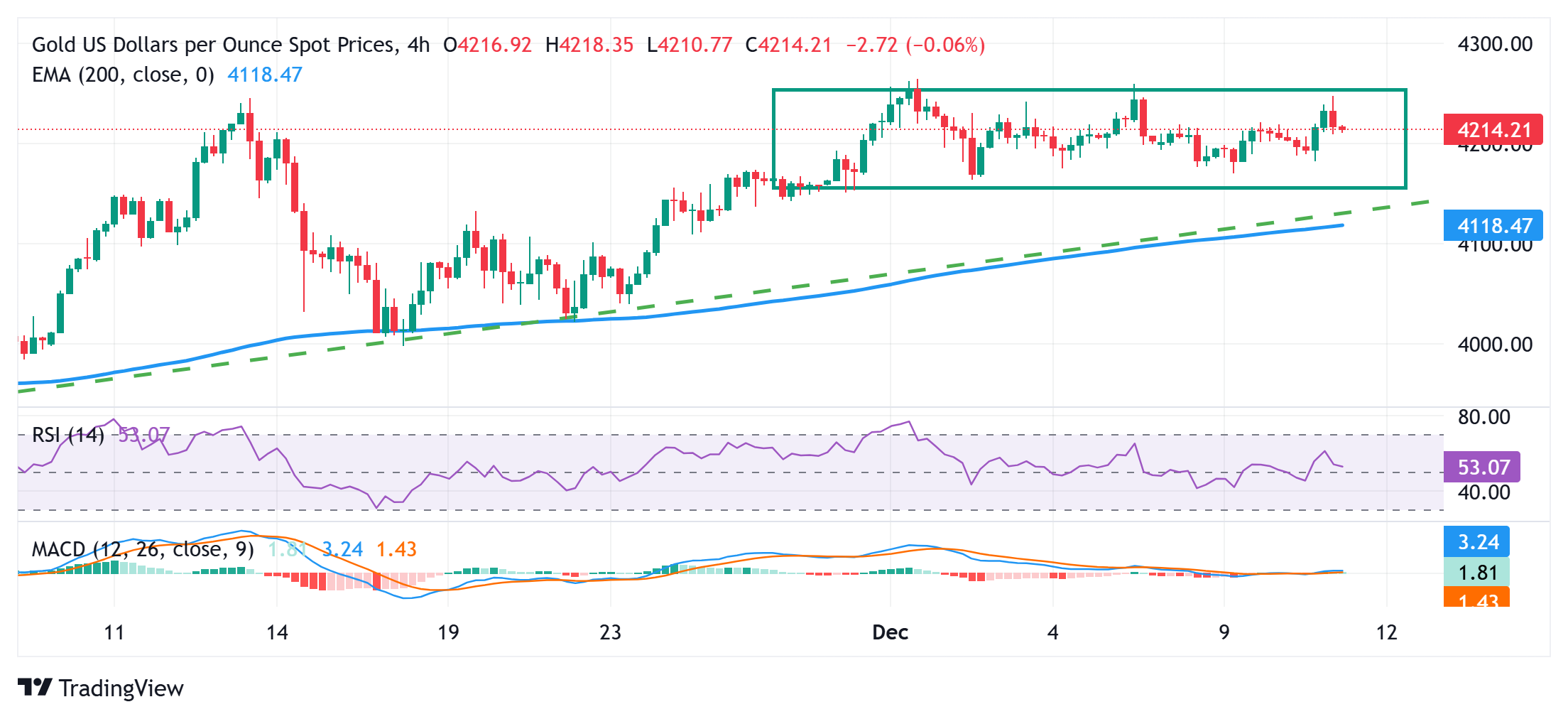
The intraday pullback from the vicinity of a resistance marked by the top boundary of a two-week-old trading range warrants some caution for the XAU/USD bulls. However, positive oscillators on the daily chart suggest that any further decline below the $4,200 mark could be seen as a buying opportunity and find decent support near the $4,170-4,165 region. A convincing break below the latter, however, might expose the $4,125-4,120 confluence – comprising the 200-period Exponential Moving Average (EMA) on the 4-hour chart and an ascending trend line extending from the late October swing low.
On the flip side, bulls need to wait for sustained strength and acceptance above the $4,245-4,250 supply zone. The subsequent move up has the potential to lift the Gold price to the $4,277-4,278 intermediate hurdle en route to the $4,300 mark. Some follow-through buying will be seen as a key trigger for the XAU/USD bulls and pave the way for additional near-term gains.
Fed FAQs
Monetary policy in the US is shaped by the Federal Reserve (Fed). The Fed has two mandates: to achieve price stability and foster full employment. Its primary tool to achieve these goals is by adjusting interest rates. When prices are rising too quickly and inflation is above the Fed’s 2% target, it raises interest rates, increasing borrowing costs throughout the economy. This results in a stronger US Dollar (USD) as it makes the US a more attractive place for international investors to park their money. When inflation falls below 2% or the Unemployment Rate is too high, the Fed may lower interest rates to encourage borrowing, which weighs on the Greenback.
The Federal Reserve (Fed) holds eight policy meetings a year, where the Federal Open Market Committee (FOMC) assesses economic conditions and makes monetary policy decisions. The FOMC is attended by twelve Fed officials – the seven members of the Board of Governors, the president of the Federal Reserve Bank of New York, and four of the remaining eleven regional Reserve Bank presidents, who serve one-year terms on a rotating basis.
In extreme situations, the Federal Reserve may resort to a policy named Quantitative Easing (QE). QE is the process by which the Fed substantially increases the flow of credit in a stuck financial system. It is a non-standard policy measure used during crises or when inflation is extremely low. It was the Fed’s weapon of choice during the Great Financial Crisis in 2008. It involves the Fed printing more Dollars and using them to buy high grade bonds from financial institutions. QE usually weakens the US Dollar.
Quantitative tightening (QT) is the reverse process of QE, whereby the Federal Reserve stops buying bonds from financial institutions and does not reinvest the principal from the bonds it holds maturing, to purchase new bonds. It is usually positive for the value of the US Dollar.