
EUR/USD nears weekly highs at 1.1755 as the US Dollar falters
- EUR/USD extends gains on Friday, approaching weekly highs, at 1.1755.
- Another alleged Yen intervention has hit the US Dollar on a holiday-thinned market.
- The Euro bounced up on Thursday amid hot Eurozone inflation and a hawkish hold by the ECB.
The Euro (EUR) has turned positive against a weaker US Dollar (USD) on Friday, and is trading at 1.1742 at the time of writing, a few pips short of the top of the weekly trading range, at 1.1755. An alleged intervention by Japanese authorities, presumably the second in the last two days, hit the USD/JPY earlier on Friday, hammering the Greenback in thinned Labour Day trading.
The USD/JPY dropped nearly 200 pips in a matter of seconds at the early European session, in a move that reverberated throughout the market, sending the US Dollar lower across the board. The EUR/USD, which hitherto was featuring moderate losses, resumed its positive trend from Thursday's lows at 1.1655.
The pair regained lost ground on Thursday, as investors prioritised the hot Eurozone inflation figures over the weakening Gross Domestic Product (GDP) figures. Later on, the European Central Bank (ECB) delivered a "hawkish hold," keeping interest rates unchanged but hinting at a rate hike in the near term.
The ECB's stance was reaffirmed by the Bundesbank president and committee member, Joachim Nagel, who said on Friday that the baseline scenario entails a more restrictive monetary policy and flagged the possibility of a rate hike in June.
Meanwhile, the situation in the Middle East remains stalled. The US and Iran have continued exchanging threats, with the Strait of Hormuz entering its third month of blockade and no credible plan to reopen it at sight. Oil prices are above the key $100, with Brent Oil at $113.94 at the time of writing, a very painful level for Eurozone Crude-importing economies, which will, highly likely, weigh on the Euro in the long run.
Technical Analysis: EUR/USD keeps looking for direction around 1.1700
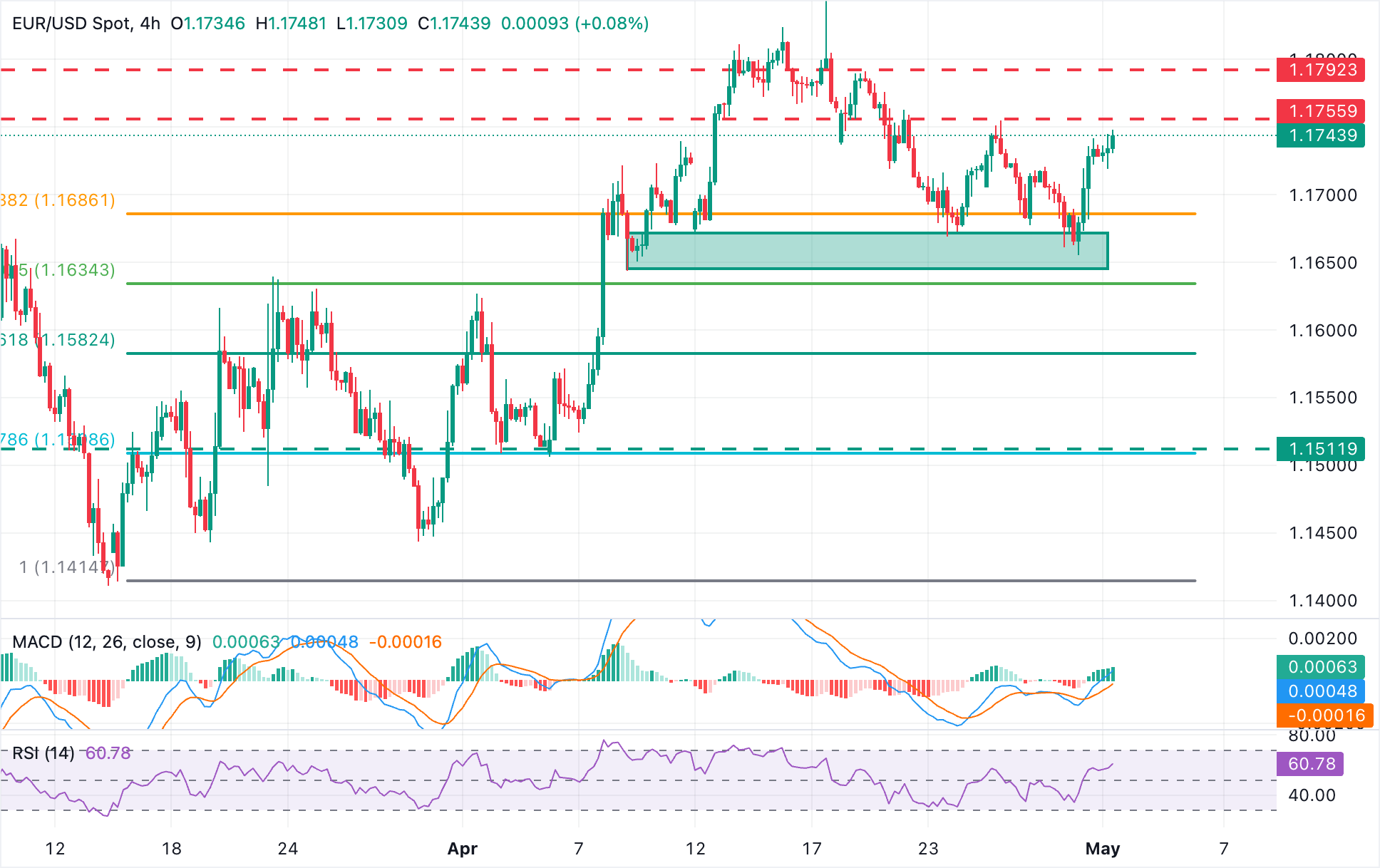
From a technical perspective, the EUR/USD remains trapped within a broadly 100-pip range, with support above 1.1650 holding bears and upside attempts limited below 1.1750.
Technical indicators on the 4-hour chart are showing an improving momentum. The Relative Strength Index (RSI) reaches the 60 level, and the Moving Average Convergence Divergence (MACD) is showing a widening green histogram, suggesting that the bullish momentum is gathering pace.
Bulls, however, would need to break the mentioned 1.1755 resistance (April 27 high) to confirm that the bearish correction from 1.1850 highs has been completed. Further up, the April 20 high near 1.1790 is likely to test the Euro's recovery ahead of April's peak, right below 1.1850.
Bears, on the other hand, are struggling to extend dips below a cluster of supports between 1.1675 and the April 8 intraday low, near 1.1645. A confirmation below here would clear the way to the 61.8% Fibonacci retracement of the early April rally, at 1.1580, and the April 2 and 3 low, near 1.1500.
(The technical analysis of this story was written with the help of an AI tool.)
US Dollar FAQs
The US Dollar (USD) is the official currency of the United States of America, and the ‘de facto’ currency of a significant number of other countries where it is found in circulation alongside local notes. It is the most heavily traded currency in the world, accounting for over 88% of all global foreign exchange turnover, or an average of $6.6 trillion in transactions per day, according to data from 2022. Following the second world war, the USD took over from the British Pound as the world’s reserve currency. For most of its history, the US Dollar was backed by Gold, until the Bretton Woods Agreement in 1971 when the Gold Standard went away.
The most important single factor impacting on the value of the US Dollar is monetary policy, which is shaped by the Federal Reserve (Fed). The Fed has two mandates: to achieve price stability (control inflation) and foster full employment. Its primary tool to achieve these two goals is by adjusting interest rates. When prices are rising too quickly and inflation is above the Fed’s 2% target, the Fed will raise rates, which helps the USD value. When inflation falls below 2% or the Unemployment Rate is too high, the Fed may lower interest rates, which weighs on the Greenback.
In extreme situations, the Federal Reserve can also print more Dollars and enact quantitative easing (QE). QE is the process by which the Fed substantially increases the flow of credit in a stuck financial system. It is a non-standard policy measure used when credit has dried up because banks will not lend to each other (out of the fear of counterparty default). It is a last resort when simply lowering interest rates is unlikely to achieve the necessary result. It was the Fed’s weapon of choice to combat the credit crunch that occurred during the Great Financial Crisis in 2008. It involves the Fed printing more Dollars and using them to buy US government bonds predominantly from financial institutions. QE usually leads to a weaker US Dollar.
Quantitative tightening (QT) is the reverse process whereby the Federal Reserve stops buying bonds from financial institutions and does not reinvest the principal from the bonds it holds maturing in new purchases. It is usually positive for the US Dollar.