
Euro extends losses against US Dollar amid fears of an escalation of Iran's war
- EUR/USD hits session lows below 1.1700, down from Friday's highs near 1.1785.
- Trump's vow to free ships in Hormuz has triggered a verbal escalation with Iran.
- Eurozone Manufacturing PMI confirms that business activity accelerated, despite war pressures, in April.
The Euro (EUR) is retreating further from last week's highs at the 1.1785 area against the US Dollar (USD) on Monday, reaching levels below 1.1700 heading into the US session opening. Investors' concerns about a re-escalation of the US-Iran war are underpinning demand for the safe-haven US Dollar, letting fairly positive Eurozone data go practically unnoticed.
Investors' appetite for risk was hit on Monday amid US President Donald Trump's announcement of a plan to release vessels stranded in the Strait of Hormuz, and the following response by the Iranian authorities, warning that they would respond with “full strength” to any US vessel approaching Iranian waters.
News from the Iranian Fars news agency that a US warship had been hit by Iranian missiles soured sentiment further during the European session, although it was denied by Washington shortly afterward.
Oil prices, however, remain on the rise. The barrel of Brent trades above $110, and the WTI extends its rally beyond $101, adding pressure on the Euro, as Eurozone countries are net Oil importers, and the current energy costs pose a serious challenge for growth
Eurozone economic data released on Monday has fallen on the bright side, but the impact on the pair has been marginal so far. The final HCOB Manufacturing Purchasing Managers’ Index (PMI) has confirmed preliminary figures of a 52.2 reading in April, a 47-month high, and up from 51.6 in March, and the Sentix Investors' Confidence Index improved moderately to -16.4 in May from -19.2 in April
In the US, the focus will be on March Factory Orders, although the highlights of the week will be April’s employment reports, with particular interest in Friday's Nonfarm Payrolls (NFP) reading.
Technical Analysis: Looking for direction around 1.1700
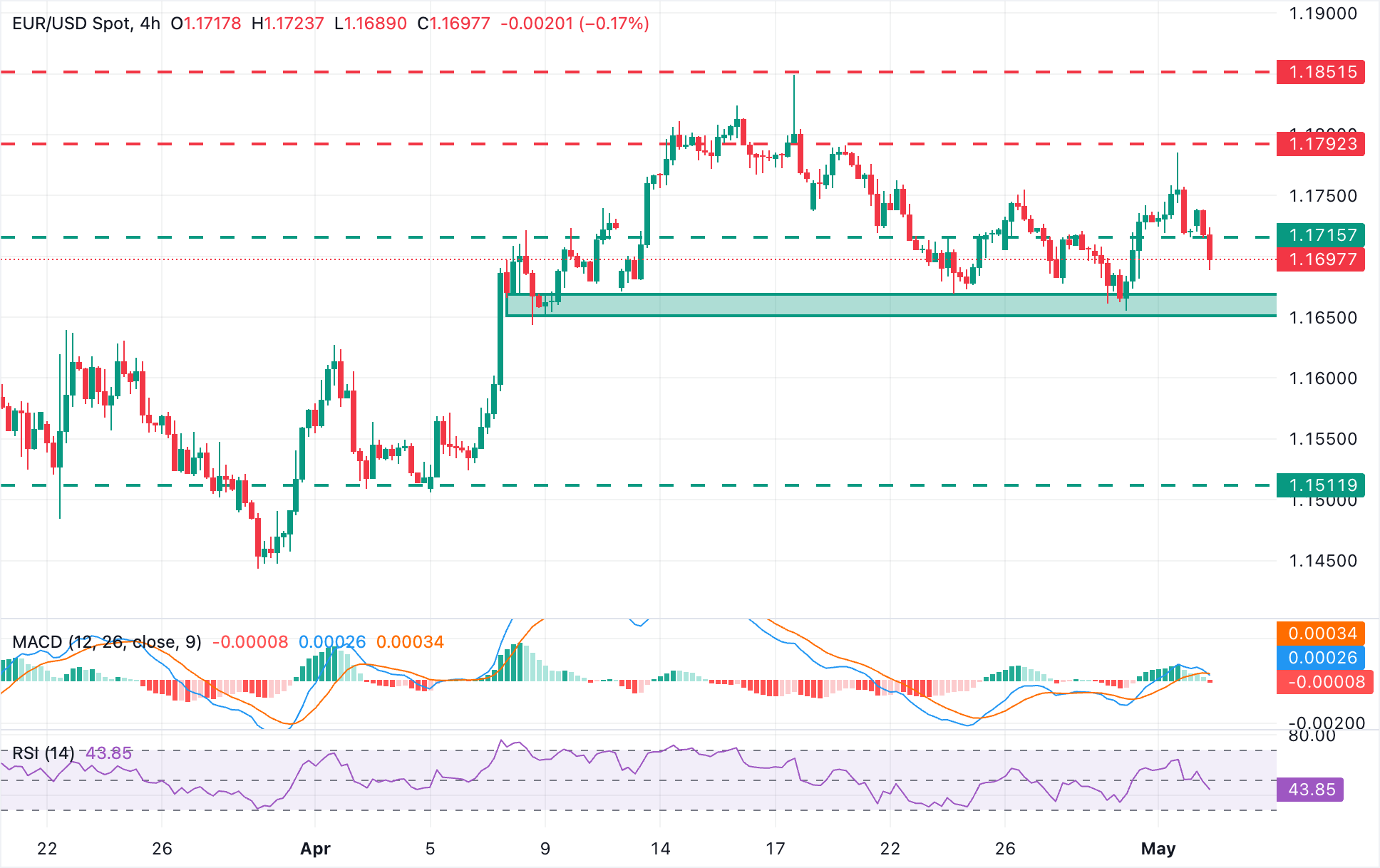
EUR/USD found support above the 1.1650 area and is looking for direction halfway through a broadly 100-pip range, with upside attempts capped below the 1.1785 area.
Recent price action, however, shows a building bearish momentum. The Relative Strength Index (RSI) on 4-hour charts has dived below the key 50 level, with the Moving Average Convergence Divergence (MACD) histogram in the same timeframe also dipping below zero, which shows that sellers are taking the upper hand.
The pair has broken intraday support in the 1.1700 area and approaches a cluster of supports between 1.1645 and 1.1675, which have held bears several times over the last month. The pair is likely to need a fresh catalyst to confirm below those levels
On the topside, daily highs are at 1.1750 ahead of Friday's peak at the 1.1785 area. Further up, the April 17 high at 1.1850 and the February 10 high, near 1.1930, would come into focus.
(The technical analysis of this story was written with the help of an AI tool.)
Euro FAQs
The Euro is the currency for the 20 European Union countries that belong to the Eurozone. It is the second most heavily traded currency in the world behind the US Dollar. In 2022, it accounted for 31% of all foreign exchange transactions, with an average daily turnover of over $2.2 trillion a day. EUR/USD is the most heavily traded currency pair in the world, accounting for an estimated 30% off all transactions, followed by EUR/JPY (4%), EUR/GBP (3%) and EUR/AUD (2%).
The European Central Bank (ECB) in Frankfurt, Germany, is the reserve bank for the Eurozone. The ECB sets interest rates and manages monetary policy. The ECB’s primary mandate is to maintain price stability, which means either controlling inflation or stimulating growth. Its primary tool is the raising or lowering of interest rates. Relatively high interest rates – or the expectation of higher rates – will usually benefit the Euro and vice versa. The ECB Governing Council makes monetary policy decisions at meetings held eight times a year. Decisions are made by heads of the Eurozone national banks and six permanent members, including the President of the ECB, Christine Lagarde.
Eurozone inflation data, measured by the Harmonized Index of Consumer Prices (HICP), is an important econometric for the Euro. If inflation rises more than expected, especially if above the ECB’s 2% target, it obliges the ECB to raise interest rates to bring it back under control. Relatively high interest rates compared to its counterparts will usually benefit the Euro, as it makes the region more attractive as a place for global investors to park their money.
Data releases gauge the health of the economy and can impact on the Euro. Indicators such as GDP, Manufacturing and Services PMIs, employment, and consumer sentiment surveys can all influence the direction of the single currency. A strong economy is good for the Euro. Not only does it attract more foreign investment but it may encourage the ECB to put up interest rates, which will directly strengthen the Euro. Otherwise, if economic data is weak, the Euro is likely to fall. Economic data for the four largest economies in the euro area (Germany, France, Italy and Spain) are especially significant, as they account for 75% of the Eurozone’s economy.
Another significant data release for the Euro is the Trade Balance. This indicator measures the difference between what a country earns from its exports and what it spends on imports over a given period. If a country produces highly sought after exports then its currency will gain in value purely from the extra demand created from foreign buyers seeking to purchase these goods. Therefore, a positive net Trade Balance strengthens a currency and vice versa for a negative balance.