
ECB Press Conference: Lagarde explains decision to leave key rates unchanged
Christine Lagarde, President of the European Central Bank (ECB), explains the ECB's decision to leave key rates unchanged at the March policy meeting and responds to questions from the press.
Follow FXStreet's ECB Live Coverage here
This section below was published at 13:15 GMT to cover the European Central Bank's (ECB) monetary policy announcements and the immediate market reaction.
The European Central Bank (ECB) announced on Thursday that it left key rates unchanged following the March policy meeting, as expected. With this decision, the interest rate on the main refinancing operations, the interest rates on the marginal lending facility and the deposit facility stood at 2.15%, 2.4% and 2%, respectively.
Key takeaways from ECB policy statement
"ECB is determined to ensure that inflation stabilises at 2% target in medium term."
"War in Middle East has made outlook significantly more uncertain, creating upside risks for inflation and downside risks for economic growth."
"ECB is well-positioned to navigate this uncertainty."
"Incoming information in period ahead will help ECB assess how war will affect inflation outlook and risks surrounding it."
"ECB is closely monitoring situation, and its data-dependent approach will help it set monetary policy as appropriate."
"Staff projections exceptionally incorporate information up to 11 March, a later cut-off date than usual."
"Inflation has been revised up compared with December projections, especially for 2026."
"For inflation excluding energy and food, staff project an average of 2.3% in 2026, 2.2% in 2027 and 2.1% in 2028."
"This is also higher than path in December projections, mainly owing to higher energy prices feeding into inflation excluding energy and food."
"Staff expect economic growth to average 0.9% in 2026, 1.3% in 2027 and 1.4% in 2028."
"In line with ECB’s monetary policy strategy commitment to incorporate risks and uncertainty into its decision-making, staff also assessed how war in Middle East could affect economic growth and inflation under some alternative illustrative scenarios."
"Scenario analysis suggests that a prolonged disruption in supply of oil and gas would result in inflation being above, and growth being below, baseline projections."
"ECB will follow a data-dependent and meeting-by-meeting approach to determining appropriate monetary policy stance."
"Interest rate decisions will be based on the assessment of inflation outlook and risks surrounding it, in light of incoming economic and financial data, as well as dynamics of underlying inflation and strength of monetary policy transmission."
"ECB is not pre-committing to a particular rate path."
"APP and Pandemic Emergency Purchase Programme (PEPP) APP and PEPP portfolios are declining at a measured and predictable pace, as Eurosystem no longer reinvests principal payments from maturing securities."
Market reaction to the ECB policy decision
EUR/USD rose sharply with the immediate reaction to the ECB's policy announcements and was last seen gaining 0.45% on the day at 1.1500.
Euro Price Today
The table below shows the percentage change of Euro (EUR) against listed major currencies today. Euro was the strongest against the Australian Dollar.
| USD | EUR | GBP | JPY | CAD | AUD | NZD | CHF | |
|---|---|---|---|---|---|---|---|---|
| USD | -0.37% | -0.43% | -0.73% | -0.03% | 0.09% | -0.30% | 0.05% | |
| EUR | 0.37% | -0.06% | -0.36% | 0.33% | 0.47% | 0.06% | 0.42% | |
| GBP | 0.43% | 0.06% | -0.32% | 0.40% | 0.53% | 0.13% | 0.47% | |
| JPY | 0.73% | 0.36% | 0.32% | 0.69% | 0.81% | 0.38% | 0.78% | |
| CAD | 0.03% | -0.33% | -0.40% | -0.69% | 0.13% | -0.29% | 0.07% | |
| AUD | -0.09% | -0.47% | -0.53% | -0.81% | -0.13% | -0.40% | -0.10% | |
| NZD | 0.30% | -0.06% | -0.13% | -0.38% | 0.29% | 0.40% | 0.34% | |
| CHF | -0.05% | -0.42% | -0.47% | -0.78% | -0.07% | 0.10% | -0.34% |
The heat map shows percentage changes of major currencies against each other. The base currency is picked from the left column, while the quote currency is picked from the top row. For example, if you pick the Euro from the left column and move along the horizontal line to the US Dollar, the percentage change displayed in the box will represent EUR (base)/USD (quote).
This section below was published as a preview of the European Central Bank's policy announcements at 05:00 GMT.
- The European Central Bank is likely to adopt a wait-and-see approach amid the Iran war.
- ECB President Lagarde is likely to face multiple questions related to the impact of the Middle East conflict.
- The Federal Reserve kept rates unchanged, as expected, and forecasts one rate cut in 2026.
- EUR/USD heads into the ECB announcement with a firming bearish tone.
The European Central Bank (ECB) will announce its monetary policy decision on Thursday, following a two-day meeting.
The ECB is widely expected to keep interest rates on hold for the sixth consecutive meeting, leaving the main refinancing operations, the marginal lending facility, and the deposit facility at 2.15%, 2.4% and 2%, respectively.
Nevertheless, the macroeconomic scenario is much different from that at all previous meetings: a war in the Middle East has changed it all. ECB President Christine Lagarde has coined a new financial term, “good place,” to describe the ECB’s monetary policy stance before the war unfolded.
ECB President Christine Lagarde will hold a press conference following the announcement. Lagarde usually responds to questions aimed at explaining the reasoning behind the central bank’s decision. It’s quite likely that the Q&A will revolve around the war, oil prices, and their potential impact on inflation, and hence, future ECB monetary policy decisions.
Ahead of the announcement, the EUR/USD pair trades around the 1.1500 mark, following the Federal Reserve (Fed) monetary policy announcement.
What to expect from the ECB interest rate decision?
The ECB found a delicate balance in which inflation reached policymakers’ 2% inflation threshold, growth began to show signs of life, and interest rates were more than halved from the post-pandemic record highs.
As said, the Iran war changed it all. United States (US) President Donald Trump’s decision to join Israel and crush Iran’s nuclear power has resulted in an all-in Persian Gulf conflict, which has pushed Oil prices to levels last seen in 2021. Fears of inflation resuming its upward trend hit all major economies amid energy supply disruptions, as the war interrupted transit through the Strait of Hormuz.
It is quite unlikely that officials will immediately respond to the new world frame. Policymakers are likely to adopt a wait-and-see stance while repeating they are vigilant of macroeconomic developments and ready to act as needed.
Days after the war began, ECB President Christine Lagarde noted that the central bank would do everything necessary to keep price pressures tamed. “We will do everything necessary to keep inflation under control and ensure that the French and the Europeans do not experience inflation increases like those we saw in 2022 and 2023,” comparing the current situation to that triggered by the Russia-Ukraine war.
Also, ECB policymaker Joachim Nagel said that the central bank will move “quickly and decisively” if higher fuel prices lead to rising inflation in the EU, in an interview with Reuters.
Meanwhile, the Federal Reserve (Fed) announced its decision on monetary policy. As expected, the Fed kept its Fed Funds Target Range (FFTR) unchanged at 3.50%–3.75%.
The Summary of Economic Projections (SEP) showed policymakers still expect to deliver one rate cut in 2026 and another one in 2027. Additionally, officials revised inflation higher, with PCE inflation now expected at 2.7% at the end of 2026 vs 2.4% in December. Officials also revised their growth forecast, now seen at 2.4% for this year vs 2.3% in the previous SEP. Unemployment is seen at 4.4% for this year, unchanged from the previous estimate.
The market showed a limited reaction to the news, although prevalent risk-aversion maintained the USD on the winning side across the FX board.
The ECB is likely to adopt a cautious approach to current developments and refrain from taking a certain position on the war’s potential impact on the Euro (EUR). President Christine Lagarde is likely to repeat that officials are ready to act when needed, but refrain from providing details on the matter.
How could the ECB meeting impact EUR/USD?
As previously noted, the EUR/USD pair is hovering around 1.1500 as the USD benefits from a risk-averse environment.
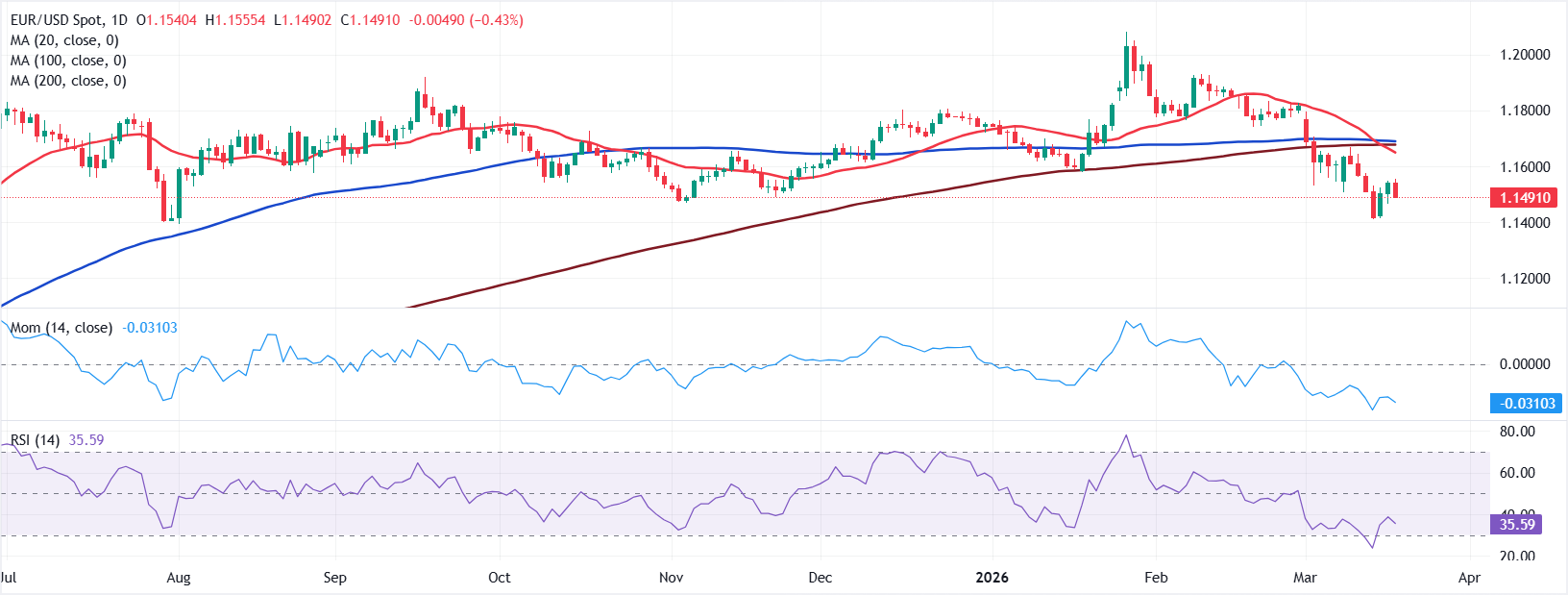
Valeria Bednarik, FXStreet Chief Analyst, notes: “Technically speaking, the EUR/USD pair is bearish. The daily chart shows it remains far below all its moving averages, with a bearish 20-day Simple Moving Average (SMA) having crossed below directionless 100-day and 200-day SMAs. At the same time, technical indicators maintain their downward slopes within negative levels after correcting oversold conditions. Immediate support comes at around 1.1480, ahead of March's monthly low at 1.1411, which stands as a critical bearish barrier, unlikely to be tested within the ECB event.”
Bednarik adds: “The EUR/USD pair would need to recover beyond 1.1560 to shrug off the near-term negative tone. Additional gains expose the 1.1600 mark ahead of the 1.1640 price zone, although it seems unlikely the ECB could deliver a hawkishly enough message to push the pair towards the latter.”
ECB FAQs
The European Central Bank (ECB) in Frankfurt, Germany, is the reserve bank for the Eurozone. The ECB sets interest rates and manages monetary policy for the region. The ECB primary mandate is to maintain price stability, which means keeping inflation at around 2%. Its primary tool for achieving this is by raising or lowering interest rates. Relatively high interest rates will usually result in a stronger Euro and vice versa. The ECB Governing Council makes monetary policy decisions at meetings held eight times a year. Decisions are made by heads of the Eurozone national banks and six permanent members, including the President of the ECB, Christine Lagarde.
In extreme situations, the European Central Bank can enact a policy tool called Quantitative Easing. QE is the process by which the ECB prints Euros and uses them to buy assets – usually government or corporate bonds – from banks and other financial institutions. QE usually results in a weaker Euro. QE is a last resort when simply lowering interest rates is unlikely to achieve the objective of price stability. The ECB used it during the Great Financial Crisis in 2009-11, in 2015 when inflation remained stubbornly low, as well as during the covid pandemic.
Quantitative tightening (QT) is the reverse of QE. It is undertaken after QE when an economic recovery is underway and inflation starts rising. Whilst in QE the European Central Bank (ECB) purchases government and corporate bonds from financial institutions to provide them with liquidity, in QT the ECB stops buying more bonds, and stops reinvesting the principal maturing on the bonds it already holds. It is usually positive (or bullish) for the Euro.