
Breaking: Canada headline CPI rose 1.8% YoY in February
Canada’s inflation cooled in February, with the Consumer Price Index (CPI) rising 1.8% from a year earlier, a touch below market expectations and easing from the 2.3% increase recorded in January. On a monthly basis, prices rose 0.5%.
Meanwhile, the Bank of Canada’s (BoC) preferred core measure, which excludes more volatile components such as food and energy, rose 2.3% over the past year and increased by 0.4% compared with the previous month.
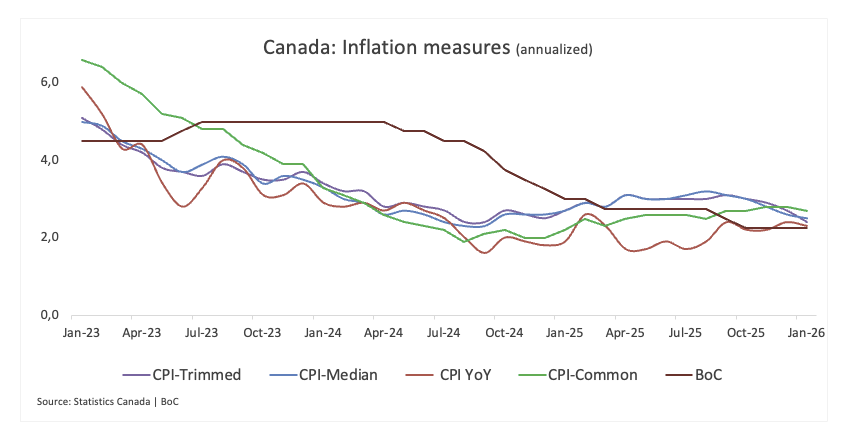
Looking at the BoC’s other key inflation gauges, Common CPI came in at 2.4% (from 2.7% ), Trimmed CPI at 2.3% (from 2.4%), and Median CPI at 2.3% (from 2.5%). Together, they show that underlying price pressures are still fairly sticky albeit on a downward trend.
According to the press release: “The slowdown in the all-items CPI on a year-over-year basis was largely driven by a monthly increase in prices in February 2025, when the GST/HST break ended partway through the month, and as a result, consumers paid more for affected products. This month-over-month increase fell out of the 12-month price movement in February 2026, resulting in a decelerating base-year effect on headline inflation”
Market reaction
The Canadian Dollar (CAD) gathers fresh traction on Monday, motivating USD/CAD to breach below the 1.3700 support zone in the current context of a generalised pullback in the US Dollar.
Inflation FAQs
Inflation measures the rise in the price of a representative basket of goods and services. Headline inflation is usually expressed as a percentage change on a month-on-month (MoM) and year-on-year (YoY) basis. Core inflation excludes more volatile elements such as food and fuel which can fluctuate because of geopolitical and seasonal factors. Core inflation is the figure economists focus on and is the level targeted by central banks, which are mandated to keep inflation at a manageable level, usually around 2%.
The Consumer Price Index (CPI) measures the change in prices of a basket of goods and services over a period of time. It is usually expressed as a percentage change on a month-on-month (MoM) and year-on-year (YoY) basis. Core CPI is the figure targeted by central banks as it excludes volatile food and fuel inputs. When Core CPI rises above 2% it usually results in higher interest rates and vice versa when it falls below 2%. Since higher interest rates are positive for a currency, higher inflation usually results in a stronger currency. The opposite is true when inflation falls.
Although it may seem counter-intuitive, high inflation in a country pushes up the value of its currency and vice versa for lower inflation. This is because the central bank will normally raise interest rates to combat the higher inflation, which attract more global capital inflows from investors looking for a lucrative place to park their money.
Formerly, Gold was the asset investors turned to in times of high inflation because it preserved its value, and whilst investors will often still buy Gold for its safe-haven properties in times of extreme market turmoil, this is not the case most of the time. This is because when inflation is high, central banks will put up interest rates to combat it. Higher interest rates are negative for Gold because they increase the opportunity-cost of holding Gold vis-a-vis an interest-bearing asset or placing the money in a cash deposit account. On the flipside, lower inflation tends to be positive for Gold as it brings interest rates down, making the bright metal a more viable investment alternative.
This section below was published as a preview of the Canadian inflation report for February at 08:00 GMT.
- Canadian inflation is expected to rise by 2.1% YoY in February.
- The core CPI is still seen well above the BoC’s 2% target.
- The Canadian Dollar remains on the defensive vs. the US Dollar.
On Monday, attention in Canada will turn to the release of February’s Consumer Price Index (CPI) figures. The data from Statistics Canada will offer the Bank of Canada (BoC) a fresh read on inflation dynamics just ahead of its March 18 meeting, where policymakers are widely expected to leave the policy rate unchanged at 2.25%.
Economists anticipate headline CPI rising by 2.1% YoY in February, still above the BoC’s target but easing from January’s 2.3% annual increase. On a monthly basis, prices are projected to rise 0.4%. Policymakers will also keep a close eye on the core measure, which excludes food and energy, that is set to increase by 2.4% after printing at 2.6% YoY in the opening month of 2026.
Analysts remain uneasy as inflation remains above the BoC’s target, although it has shown some cooling in January. The risk of US tariffs feeding into domestic prices is still seen as adding another layer of uncertainty.
What can we expect from Canada’s inflation rate?
At its latest meeting, the central bank signalled that policy is broadly where it needs to be to keep inflation close to the 2% target, assuming the economy evolves as expected. Still, officials were careful to stress that they are not operating on autopilot. Should the outlook weaken or inflation risks re-emerge, they stand ready to adjust policy accordingly.
When it comes to inflation, the message was cautiously reassuring. Headline price growth is expected to hover around the target, with spare capacity in the economy helping to offset part of the cost pressures linked to ongoing trade reconfiguration. That said, underlying inflation remains somewhat elevated, a reminder that the disinflation process is still incomplete.
Inflation therefore remains the key variable to watch. The latest data showed headline CPI easing to 2.3% YoY in January, while core inflation moderated to 2.6% YoY. The Bank’s preferred gauges, CPI-Common, Trimmed Mean and Median, also softened. However, at 2.7%, 2.4% and 2.5%, respectively, they continue to run above the 2% objective.
When is the Canada CPI data due, and how could it affect USD/CAD?
Markets will turn their full attention to Monday at 12:30 GMT, when Statistics Canada releases its latest inflation figures. There is a noticeable sense of caution ahead of the print, with traders wary that price pressures may prove stickier than expected and keep the broader inflation trend from easing too quickly.
A stronger-than-expected reading would likely revive concerns that tariff-related costs are beginning to filter through to consumers. That scenario could push the Bank of Canada towards a slightly more cautious tone in the near term. It would also tend to offer the Canadian Dollar (CAD) some short-term support, as investors reassess the policy outlook in light of evolving trade tensions and their potential impact on inflation.
Pablo Piovano, Senior Analyst at FXStreet, notes that the Canadian Dollar has surrendered a large portion of its monthly gains in recent sessions, allowing USD/CAD to rebound sharply and approach the 1.3750 area after finding a monthly base near 1.3530.
According to Piovano, a continuation of the renewed bullish momentum could see the pair challenge the March peak at 1.3752 (March 3), followed by the key 200-day SMA near 1.3800. Beyond that, attention would shift to the provisional 100-day SMA around 1.3810, ahead of the 2026 high at 1.3928 (January 16).
On the downside, Piovano highlights initial support at the monthly low of 1.3525 (March 9), followed by the February trough at 1.3504 (February 11) and the 2026 bottom at 1.3481 (January 30).
“In addition, momentum indicators continue to lean modestly bullish. The Relative Strength Index (RSI) is approaching the 59 area, while the Average Directional Index (ADX) near 14 suggests the trend still lacks strong conviction,” he adds.
Inflation FAQs
Inflation measures the rise in the price of a representative basket of goods and services. Headline inflation is usually expressed as a percentage change on a month-on-month (MoM) and year-on-year (YoY) basis. Core inflation excludes more volatile elements such as food and fuel which can fluctuate because of geopolitical and seasonal factors. Core inflation is the figure economists focus on and is the level targeted by central banks, which are mandated to keep inflation at a manageable level, usually around 2%.
The Consumer Price Index (CPI) measures the change in prices of a basket of goods and services over a period of time. It is usually expressed as a percentage change on a month-on-month (MoM) and year-on-year (YoY) basis. Core CPI is the figure targeted by central banks as it excludes volatile food and fuel inputs. When Core CPI rises above 2% it usually results in higher interest rates and vice versa when it falls below 2%. Since higher interest rates are positive for a currency, higher inflation usually results in a stronger currency. The opposite is true when inflation falls.
Although it may seem counter-intuitive, high inflation in a country pushes up the value of its currency and vice versa for lower inflation. This is because the central bank will normally raise interest rates to combat the higher inflation, which attract more global capital inflows from investors looking for a lucrative place to park their money.
Formerly, Gold was the asset investors turned to in times of high inflation because it preserved its value, and whilst investors will often still buy Gold for its safe-haven properties in times of extreme market turmoil, this is not the case most of the time. This is because when inflation is high, central banks will put up interest rates to combat it. Higher interest rates are negative for Gold because they increase the opportunity-cost of holding Gold vis-a-vis an interest-bearing asset or placing the money in a cash deposit account. On the flipside, lower inflation tends to be positive for Gold as it brings interest rates down, making the bright metal a more viable investment alternative.
Canadian Dollar FAQs
The key factors driving the Canadian Dollar (CAD) are the level of interest rates set by the Bank of Canada (BoC), the price of Oil, Canada’s largest export, the health of its economy, inflation and the Trade Balance, which is the difference between the value of Canada’s exports versus its imports. Other factors include market sentiment – whether investors are taking on more risky assets (risk-on) or seeking safe-havens (risk-off) – with risk-on being CAD-positive. As its largest trading partner, the health of the US economy is also a key factor influencing the Canadian Dollar.
The Bank of Canada (BoC) has a significant influence on the Canadian Dollar by setting the level of interest rates that banks can lend to one another. This influences the level of interest rates for everyone. The main goal of the BoC is to maintain inflation at 1-3% by adjusting interest rates up or down. Relatively higher interest rates tend to be positive for the CAD. The Bank of Canada can also use quantitative easing and tightening to influence credit conditions, with the former CAD-negative and the latter CAD-positive.
The price of Oil is a key factor impacting the value of the Canadian Dollar. Petroleum is Canada’s biggest export, so Oil price tends to have an immediate impact on the CAD value. Generally, if Oil price rises CAD also goes up, as aggregate demand for the currency increases. The opposite is the case if the price of Oil falls. Higher Oil prices also tend to result in a greater likelihood of a positive Trade Balance, which is also supportive of the CAD.
While inflation had always traditionally been thought of as a negative factor for a currency since it lowers the value of money, the opposite has actually been the case in modern times with the relaxation of cross-border capital controls. Higher inflation tends to lead central banks to put up interest rates which attracts more capital inflows from global investors seeking a lucrative place to keep their money. This increases demand for the local currency, which in Canada’s case is the Canadian Dollar.
Macroeconomic data releases gauge the health of the economy and can have an impact on the Canadian Dollar. Indicators such as GDP, Manufacturing and Services PMIs, employment, and consumer sentiment surveys can all influence the direction of the CAD. A strong economy is good for the Canadian Dollar. Not only does it attract more foreign investment but it may encourage the Bank of Canada to put up interest rates, leading to a stronger currency. If economic data is weak, however, the CAD is likely to fall.