
USD/JPY Price Forecast: At make or a break near advancing trendline around 157.00
- USD/JPY jumps to near 157.00 as higher oil prices raise concerns over Japan’s economic prospects.
- US President Trump dismisses Iran’s demands against the peace proposal.
- Investors await the US CPI data for fresh cues on the Fed’s monetary policy outlook.
The USD/JPY pair trades 0.25% higher to near 157.00 during the European trading session on Monday. The pair trades firmly as the Japanese Yen (JPY) underperforms across the board amid growing concerns over Japan’s economic outlook due to higher oil prices.
Japanese Yen Price Today
The table below shows the percentage change of Japanese Yen (JPY) against listed major currencies today. Japanese Yen was the weakest against the Canadian Dollar.
| USD | EUR | GBP | JPY | CAD | AUD | NZD | CHF | |
|---|---|---|---|---|---|---|---|---|
| USD | 0.08% | 0.17% | 0.20% | -0.06% | 0.03% | 0.26% | 0.17% | |
| EUR | -0.08% | 0.09% | 0.11% | -0.17% | -0.03% | 0.19% | 0.09% | |
| GBP | -0.17% | -0.09% | 0.00% | -0.28% | -0.13% | 0.10% | -0.01% | |
| JPY | -0.20% | -0.11% | 0.00% | -0.27% | -0.13% | 0.07% | -0.04% | |
| CAD | 0.06% | 0.17% | 0.28% | 0.27% | 0.13% | 0.30% | 0.23% | |
| AUD | -0.03% | 0.03% | 0.13% | 0.13% | -0.13% | 0.21% | 0.11% | |
| NZD | -0.26% | -0.19% | -0.10% | -0.07% | -0.30% | -0.21% | -0.08% | |
| CHF | -0.17% | -0.09% | 0.01% | 0.04% | -0.23% | -0.11% | 0.08% |
The heat map shows percentage changes of major currencies against each other. The base currency is picked from the left column, while the quote currency is picked from the top row. For example, if you pick the Japanese Yen from the left column and move along the horizontal line to the US Dollar, the percentage change displayed in the box will represent JPY (base)/USD (quote).
The WTI Oil price has gained strongly above $96, following United States (US) President Donald Trump’s rejection of Iran’s demands after reviewing Washington’s peace proposal. Iran wants the recognition of its authority over the Strait of Hormuz, in an attempt to monetize the passage, compensation for war damages, and the release of frozen assets, according to CNN. However, there have been no comments regarding Tehran pursuing its nuclear ambitions.
A higher oil price is an unfavorable environment for the Japanese Yen, given Tokyo’s heavy reliance on oil imports to meet its energy needs.
Meanwhile, the US Dollar trades higher as rising oil prices are expected to discourage Federal Reserve (Fed) officials from easing monetary conditions this year. Going forward, investors will focus on the US Consumer Price Index (CPI) data for April, which will be released on Tuesday.
USD/JPY technical analysis
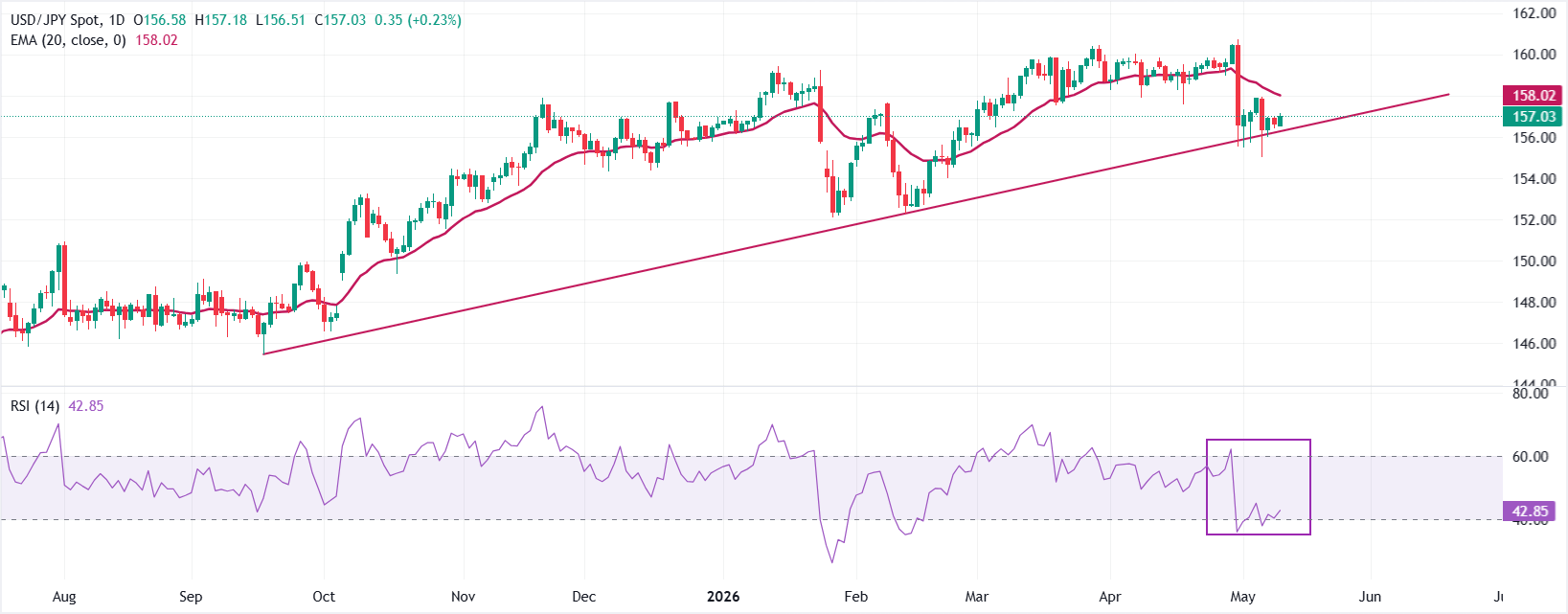
USD/JPY trades higher at around 157.00 as of writing. The pair keeps a bearish near-term tone as spot holds below the 20-day exponential moving average (EMA) at 158.02. The earlier rising support trend line, last anchored around 156.34, now sits just beneath the price and acts as the first structural floor, while the Relative Strength Index (RSI) near 43 suggests only modest downside momentum after the latest pullback.
On the topside, the 20-day EMA at 158.02 is the immediate resistance that the pair would need to reclaim to ease current downside pressure and open the way to a more sustained recovery. On the downside, a clear break below the prior uptrend support around 156.34 would expose deeper losses and signal that sellers are regaining control of the broader daily structure. Major support areas would be the February 23 low at 154 and the February 12 low at 152.27.
(The technical analysis of this story was written with the help of an AI tool.)
Japanese Yen FAQs
The Japanese Yen (JPY) is one of the world’s most traded currencies. Its value is broadly determined by the performance of the Japanese economy, but more specifically by the Bank of Japan’s policy, the differential between Japanese and US bond yields, or risk sentiment among traders, among other factors.
One of the Bank of Japan’s mandates is currency control, so its moves are key for the Yen. The BoJ has directly intervened in currency markets sometimes, generally to lower the value of the Yen, although it refrains from doing it often due to political concerns of its main trading partners. The BoJ ultra-loose monetary policy between 2013 and 2024 caused the Yen to depreciate against its main currency peers due to an increasing policy divergence between the Bank of Japan and other main central banks. More recently, the gradually unwinding of this ultra-loose policy has given some support to the Yen.
Over the last decade, the BoJ’s stance of sticking to ultra-loose monetary policy has led to a widening policy divergence with other central banks, particularly with the US Federal Reserve. This supported a widening of the differential between the 10-year US and Japanese bonds, which favored the US Dollar against the Japanese Yen. The BoJ decision in 2024 to gradually abandon the ultra-loose policy, coupled with interest-rate cuts in other major central banks, is narrowing this differential.
The Japanese Yen is often seen as a safe-haven investment. This means that in times of market stress, investors are more likely to put their money in the Japanese currency due to its supposed reliability and stability. Turbulent times are likely to strengthen the Yen’s value against other currencies seen as more risky to invest in.