
Silver slides below $81 as US Dollar Index hits a nearly four-month high
- Silver drops nearly 3% on Friday, heading for weekly losses above 3.6%.
- DXY climbs to 100.35 while the US 10-year yield rises to 4.28%.
- Q4 US GDP revised down to 0.7% as Core PCE holds at 3.1% YoY.
Silver (XAG/USD) price extends its losses for the third straight day on Friday, down over 2.90%, as Oil prices recover even though US President Donald Trump lifted sanctions on Russian Oil for 30 days, and the US Dollar trades near four-month highs. At the time of writing, XAG/USD trades at $80.16, poised to end the week with nearly 3% losses.
Rising yields, firm Oil prices weigh on XAG/USD despite growing Fed cut bets
Market mood, although positive, remains fragile, with US equities posting gains of between 0.40% and 0.43%. US economic data showed that economic growth took a hit following the 43-day government shutdown, while inflation remains sticky, with no signs of easing, as revealed by the Core PCE.
The second estimate of US Gross Domestic Product for Q4 2025 dipped from 1.4% YoY in the preliminary reading to 0.7%. At the same time, the Federal Reserve's preferred inflation gauge remained steady in January at 3.1% YoY, while the headline figure dipped modestly from 2.9% to 2.8% YoY.
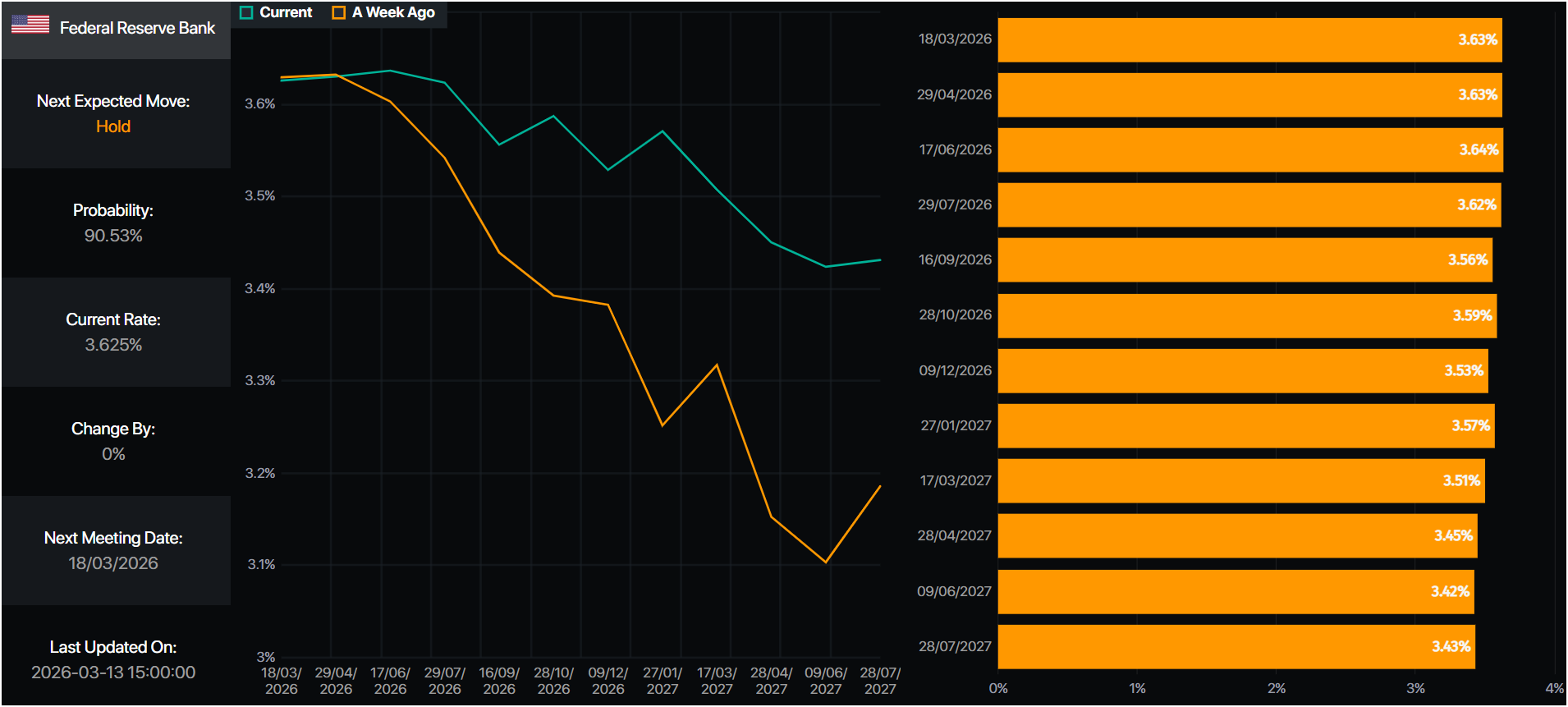
Following the GDP release, investors increased their bets on Fed rate cuts in 2026. At the beginning of the session, they were priced at 17 basis points, but as of writing, they expect at least 19.5 basis points of easing, according to Prime Market Terminal.
The ongoing Middle East conflict is expected to push global inflation higher, after West Texas Intermediate (WTI) Oil reached a yearly high near $113.00 a barrel early in the week, but as of writing, it sits at $95.90. This has pushed pump prices more than 20% higher to $3.60 per gallon since the beginning of the conflict two weeks ago.
In the meantime, the US Dollar Index (DXY), which tracks the buck's performance against six currencies, is up 0.61% to 100.35.
US Treasury yields are also up, with the 10-year T-note up 2.5 basis points to 4.287%, a headwind for the non-yielding metal.
President Donald Trump announced the US would take strong action against Iran in the coming week, following a partial 30-day waiver for buying sanctioned Russian Oil.
Traders' focus would remain on geopolitical developments throughout the weekend, before turning to the Federal Reserve's March 17-18 meeting next week. Alongside this, they would eye Industrial Production, housing data, the Producer Price Index (PPI) and jobs data.
XAG/USD Technical outlook: Short-term, Silver is bearish as sellers target break below $80
The XAG/USD daily chart depicts the near-term bias is mildly bearish as price retreats below the cluster of medium-term simple moving averages around $86–$87 while the remaining are capped by the descending resistance line from $96.62, which now tracks near the mid-$80s. The rejection sequence from the $93.80 area and subsequent lower highs into that trend-line resistance highlight fading upside momentum, with the RSI slipping toward 45 and confirming building downside pressure rather than oversold conditions.
Initial resistance emerges around $83.00, where recent swing highs align beneath the descending trend line, followed by a stronger cap near $86.00 that coincides with the grouped moving averages. A daily close above $86.00 would be needed to ease the bearish tone and reopen the $90.00 region. On the downside, immediate support sits near $78.00, guarding the more important $74.00 area, where prior lows converge with the broader rising trend-line structure from lower levels. A break below $74.00 would expose the next bearish target near $70.00 and confirm a deeper correction within the longer-term uptrend.
(The technical analysis of this story was written with the help of an AI tool.)
Silver FAQs
Silver is a precious metal highly traded among investors. It has been historically used as a store of value and a medium of exchange. Although less popular than Gold, traders may turn to Silver to diversify their investment portfolio, for its intrinsic value or as a potential hedge during high-inflation periods. Investors can buy physical Silver, in coins or in bars, or trade it through vehicles such as Exchange Traded Funds, which track its price on international markets.
Silver prices can move due to a wide range of factors. Geopolitical instability or fears of a deep recession can make Silver price escalate due to its safe-haven status, although to a lesser extent than Gold's. As a yieldless asset, Silver tends to rise with lower interest rates. Its moves also depend on how the US Dollar (USD) behaves as the asset is priced in dollars (XAG/USD). A strong Dollar tends to keep the price of Silver at bay, whereas a weaker Dollar is likely to propel prices up. Other factors such as investment demand, mining supply – Silver is much more abundant than Gold – and recycling rates can also affect prices.
Silver is widely used in industry, particularly in sectors such as electronics or solar energy, as it has one of the highest electric conductivity of all metals – more than Copper and Gold. A surge in demand can increase prices, while a decline tends to lower them. Dynamics in the US, Chinese and Indian economies can also contribute to price swings: for the US and particularly China, their big industrial sectors use Silver in various processes; in India, consumers’ demand for the precious metal for jewellery also plays a key role in setting prices.
Silver prices tend to follow Gold's moves. When Gold prices rise, Silver typically follows suit, as their status as safe-haven assets is similar. The Gold/Silver ratio, which shows the number of ounces of Silver needed to equal the value of one ounce of Gold, may help to determine the relative valuation between both metals. Some investors may consider a high ratio as an indicator that Silver is undervalued, or Gold is overvalued. On the contrary, a low ratio might suggest that Gold is undervalued relative to Silver.