
Pound Sterling bounces back after BoE cut interest rates by 25 bps to 3.75%
- The Pound Sterling rebounds sharply against its major peers after the BoE reduces interest rates to 3.75%, as expected.
- Investors expect the US headline inflation to have accelerated to 3.1% YoY in November.
- US President Trump said that the new Fed chairman believes in keeping interest rates significantly lower.
The Pound Sterling (GBP) attracts significant bids and turns positive against its major currency peers on Thursday, following the Bank of England’s (BoE) interest rate decision. As expected, the BoE has cut its interest rates by 25 basis points (bps) to 3.75% from 4%, with a 5-4 majority.
The BoE was expected to lower its key borrowing rates due to a slowdown in the United Kingdom (UK) job market, economy, and inflationary pressures. This is the fourth interest rate cut by the BoE this year.
During the month, the Office for National Statistics (ONS) reported that the UK Gross Domestic Product (GDP) declined by 0.1% in October. This was the second straight month of economic contraction. The broader data show that the UK economy has not expanded in any month after June, underpinning economic risks that typically boost the need for monetary easing.
This week, the UK labour market data for the three months ending October showed that the economy shed 17K jobs and the ILO Unemployment Rate jumped to 5.1%, the highest reading seen in almost five years.
On Wednesday, the ONS reported that inflationary pressures in November grew at a moderate pace. The headline CPI grew at a slower pace of 3.2% year-on-year (YoY) against 3.6% in October. In the same period, core inflation – which excludes volatile components of food, energy, alcohol, and tobacco – fell to 3.2% from the prior release of 3.4%.
Daily digest market movers: Investors await US CPI data for November
- The Pound Sterling recovers its early losses and rises to near 1.3400 against the US Dollar (USD) after the BoE's monetary policy decision. The GBP/USD pair rebounds strongly even as the US Dollar trades higher ahead of the United States (US) CPI data for November, which will be published at 13:30 GMT.
- At the time of writing, the US Dollar Index (DXY), which tracks the Greenback’s value against six major currencies, rises 0.15% to near 98.50.
- Investors will pay close attention to the US inflation figures as they will influence market expectations for the Federal Reserve’s (Fed) monetary policy outlook. Signs of price pressures remaining sticky would force traders to pare bets supporting more interest rate cuts in the near term. On the contrary, soft numbers would boost them.
- The US CPI report is expected to show that the headline inflation accelerated to 3.1% YoY in November from 3% in the previous month, with CPI ex Food and Energy remaining steady at 3%.
- Currently, the CME FedWatch tool shows that the probability of the Fed reducing interest rates by 25 basis points (bps) to 3.25%-3.50% in the January meeting is 24.4%.
- On Tuesday, Atlanta Fed Bank President Raphael Bostic stated that further monetary easing could boost already elevated inflation, and “that is not a risk he would choose to take right now”. Bostic also stated on Wednesday that "inflation is more worrying than jobs".
- Going forward, the announcement of Fed Chair Powell’s successor is expected to be the major driver for the US Dollar. Speaking in a national address early Thursday, US President Donald Trump refrained from naming the new chairman, but stated that he will be someone who believes in lower interest rates "by a lot”, a scenario that will be unfavourable for US Treasury yields and the US Dollar.
Technical Analysis: GBP/USD recovers to near 1.3400
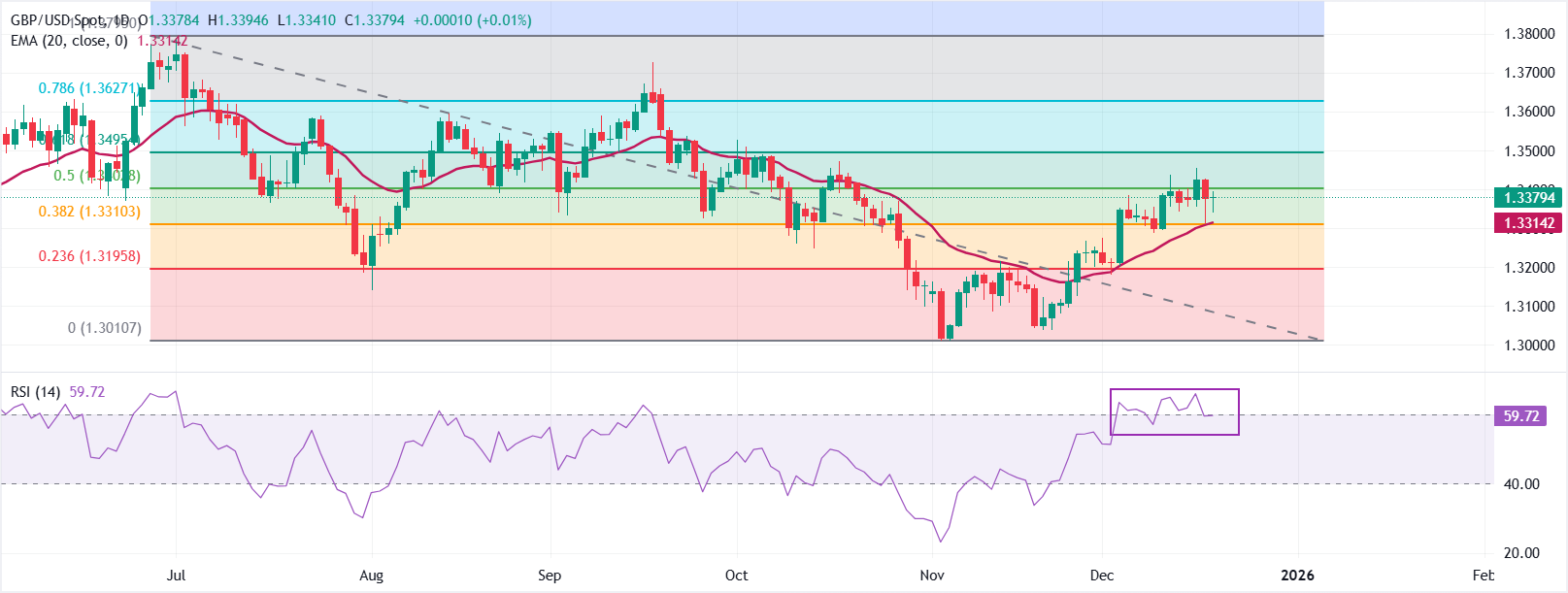
GBP/USD rises to near 1.3400 during late European trading hours on Thursday. The 20-day Exponential Moving Average (EMA) rises, and the price holds above it, with the average at 1.3314 supporting the advance.
The 14-day Relative Strength Index (RSI) at 59.7 is above its midline and confirms positive momentum.
Measured from the 1.3795 high to the 1.3011 low, the pair strives to extend the broader advance above the 50.0% retracement at 1.3403. The price would be contained between these Fibonacci markers if the price fails to do so.
(The technical analysis of this story was written with the help of an AI tool.)
BoE FAQs
The Bank of England (BoE) decides monetary policy for the United Kingdom. Its primary goal is to achieve ‘price stability’, or a steady inflation rate of 2%. Its tool for achieving this is via the adjustment of base lending rates. The BoE sets the rate at which it lends to commercial banks and banks lend to each other, determining the level of interest rates in the economy overall. This also impacts the value of the Pound Sterling (GBP).
When inflation is above the Bank of England’s target it responds by raising interest rates, making it more expensive for people and businesses to access credit. This is positive for the Pound Sterling because higher interest rates make the UK a more attractive place for global investors to park their money. When inflation falls below target, it is a sign economic growth is slowing, and the BoE will consider lowering interest rates to cheapen credit in the hope businesses will borrow to invest in growth-generating projects – a negative for the Pound Sterling.
In extreme situations, the Bank of England can enact a policy called Quantitative Easing (QE). QE is the process by which the BoE substantially increases the flow of credit in a stuck financial system. QE is a last resort policy when lowering interest rates will not achieve the necessary result. The process of QE involves the BoE printing money to buy assets – usually government or AAA-rated corporate bonds – from banks and other financial institutions. QE usually results in a weaker Pound Sterling.
Quantitative tightening (QT) is the reverse of QE, enacted when the economy is strengthening and inflation starts rising. Whilst in QE the Bank of England (BoE) purchases government and corporate bonds from financial institutions to encourage them to lend; in QT, the BoE stops buying more bonds, and stops reinvesting the principal maturing on the bonds it already holds. It is usually positive for the Pound Sterling.