
Gold struggles as Oil-driven inflation fears weigh on global interest rate outlook
- Gold remains under pressure as Oil-driven inflation fears reinforce higher-for-longer interest rate expectations.
- Strait of Hormuz disruption rattles global energy markets and Oil supply.
- Technically, XAU/USD remains confined within the $5,000-$5,200 range and heads for a second straight weekly loss.
Gold (XAU/USD) struggles to gain traction on Friday and remains on course for a second weekly decline as surging Oil prices stemming from the ongoing US-Iran war fuel inflation concerns and trigger a hawkish repricing of global interest-rate expectations, weighing on the non-yielding metal.
At the time of writing, XAU/USD trades around $5,115, fluctuating within the familiar $5,000-$5,200 range.
Markets showed limited reaction to the latest US economic data, as investors remained primarily focused on escalating geopolitical tensions in the Middle East.
The US Core Personal Consumption Expenditures (PCE) Price Index, the Federal Reserve’s (Fed) preferred inflation gauge, rose 0.4% MoM in January, matching both market expectations and the pace recorded in December.
On an annual basis, Core PCE increased 3.0% YoY, coming in below the 3.1% forecast and unchanged from December.
The second estimate of US Gross Domestic Product (GDP) showed the economy expanding at an annualized rate of 0.7% in the fourth quarter, missing the 1.4% forecast and slowing from the previous estimate of 1.4%.
Middle East war disrupts Oil flows, raising inflation risks
Tensions around the Strait of Hormuz continue to rattle global energy markets as the strategic waterway remains effectively closed by Iran’s Islamic Revolutionary Guard Corps (IRGC) since the start of the US-Israeli war against Iran.
The International Energy Agency (IEA) warned that the Middle East war is creating the largest supply disruption in the history of the global Oil market, while Iran’s new supreme leader, Mojtaba Khamenei, said in his first public statement on Thursday that the closure of the Strait of Hormuz should continue as a “tool to pressure the enemy.”
As the US-Iran war shows no signs of de-escalation and inflation fears continue to mount, Gold finds itself at a crossroads. On one hand, persistent geopolitical tensions provide underlying support and help limit deeper losses. On the other hand, expectations of higher interest rates cap the upside, leaving the metal largely range-bound.
Markets scale back Fed rate-cut bets as USD and yields rise
Before the conflict, markets were pricing in at least two Federal Reserve (Fed) rate cuts this year. Now, traders expect the Fed to hold rates steady, with only around 20 basis points of easing priced in by December, according to Bloomberg interest-rate swaps data. Meanwhile, traders now fully price in a European Central Bank (ECB) rate hike by July and are also raising bets that the Bank of England (BoE) could tighten policy by year-end.
Fading Fed rate-cut bets boost the US Dollar and US Treasury yields, adding further pressure on the precious metal. The US Dollar Index (DXY), which tracks the Greenback’s value against a basket of six major currencies, climbs above the 100 psychological mark, its highest level since November 2025, while the benchmark US 10-year Treasury yield holds around 4.25% on Friday, hovering near five-week highs.
Technical analysis: XAU/USD tests key support near 200-SMA on 4-hour chart
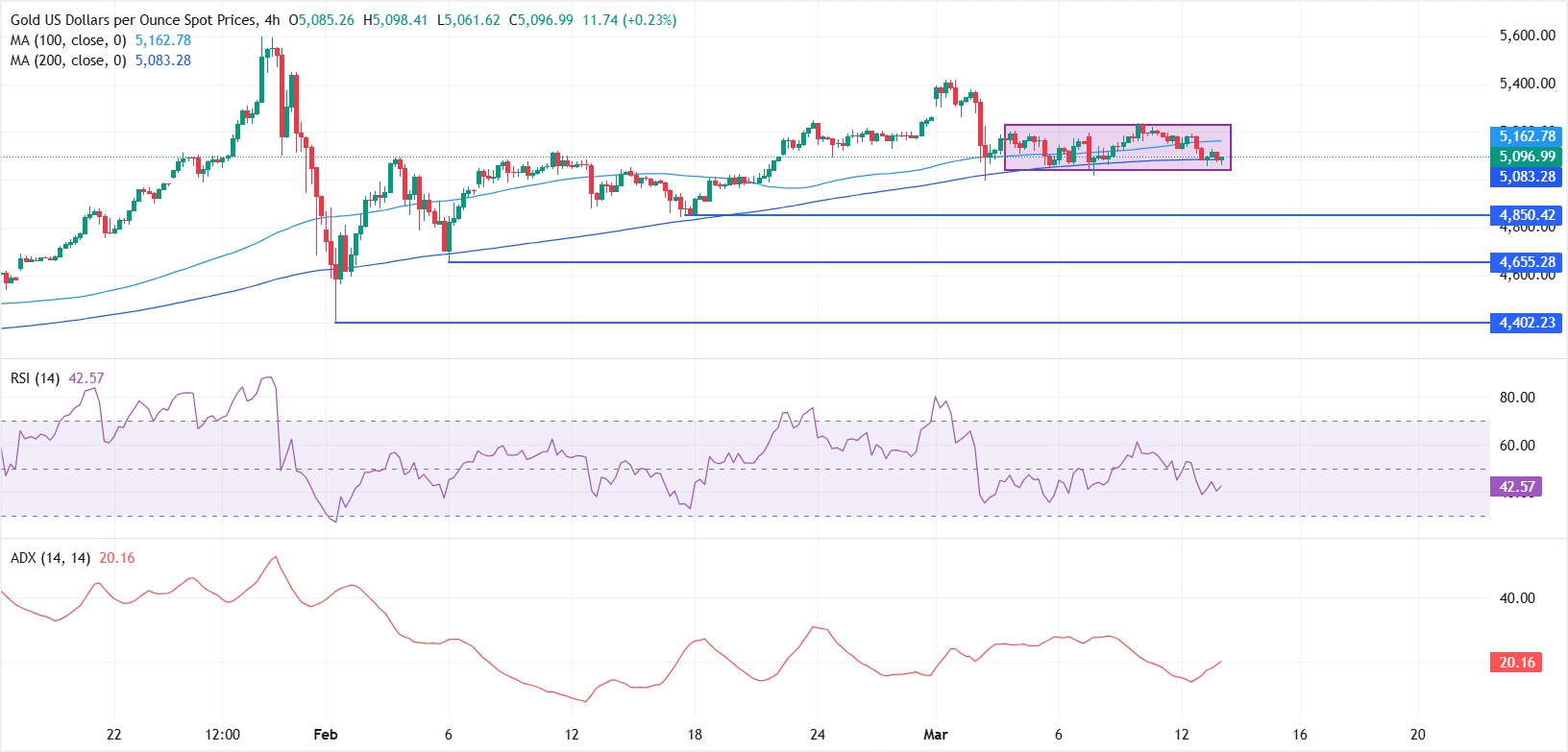
On the 4-hour chart, XAU/USD shows a mildly bearish near-term bias as the price slips below the rising 100-period Simple Moving Average (SMA) near $5,163 while testing the 200-period SMA around $5,083.
A clear break below this area would expose the next downside level near the $5,000 psychological mark. Below there, focus shifts toward $4,850 and $4,650 as deeper support levels if sellers strengthen control.
On the upside, initial resistance stands near the 100-period SMA, while a recovery above the $5,200 level would be needed to restore the prevailing uptrend.
The Relative Strength Index (RSI) hovers near 42, showing fading bullish momentum but not oversold conditions, which aligns with a controlled downside rather than aggressive selling.
The Average Directional Index (ADX) has turned higher toward 20 after a prior decline, indicating trend strength is rebuilding as the pullback develops.
Gold FAQs
Gold has played a key role in human’s history as it has been widely used as a store of value and medium of exchange. Currently, apart from its shine and usage for jewelry, the precious metal is widely seen as a safe-haven asset, meaning that it is considered a good investment during turbulent times. Gold is also widely seen as a hedge against inflation and against depreciating currencies as it doesn’t rely on any specific issuer or government.
Central banks are the biggest Gold holders. In their aim to support their currencies in turbulent times, central banks tend to diversify their reserves and buy Gold to improve the perceived strength of the economy and the currency. High Gold reserves can be a source of trust for a country’s solvency. Central banks added 1,136 tonnes of Gold worth around $70 billion to their reserves in 2022, according to data from the World Gold Council. This is the highest yearly purchase since records began. Central banks from emerging economies such as China, India and Turkey are quickly increasing their Gold reserves.
Gold has an inverse correlation with the US Dollar and US Treasuries, which are both major reserve and safe-haven assets. When the Dollar depreciates, Gold tends to rise, enabling investors and central banks to diversify their assets in turbulent times. Gold is also inversely correlated with risk assets. A rally in the stock market tends to weaken Gold price, while sell-offs in riskier markets tend to favor the precious metal.
The price can move due to a wide range of factors. Geopolitical instability or fears of a deep recession can quickly make Gold price escalate due to its safe-haven status. As a yield-less asset, Gold tends to rise with lower interest rates, while higher cost of money usually weighs down on the yellow metal. Still, most moves depend on how the US Dollar (USD) behaves as the asset is priced in dollars (XAU/USD). A strong Dollar tends to keep the price of Gold controlled, whereas a weaker Dollar is likely to push Gold prices up.