
Gold steadies as markets balance retreat in US yields with Fed hawkish outlook
- Gold rebounds modestly on Wednesday as US Treasury yields pull back from recent multi-month peaks.
- Rising energy prices tied to the US-Iran conflict reinforce expectations that the Fed may keep rates higher for longer.
- XAU/USD remains capped below the Bollinger mid-line resistance near $4,625 on the daily chart.
Gold (XAU/USD) holds firm on Wednesday after falling 1.85% the previous day, as a pause in the global bond sell-off helps reduce upward pressure on Treasury yields and offers some support to the non-yielding metal. At the time of writing, XAU/USD is trading around $4,492 after hitting an intraday low near $4,453, its weakest level since March 30.
The benchmark US 10-year Treasury yield eases to around 4.631% after climbing to a 16-month high of 4.687% on Tuesday, while the 30-year yield slips to 5.166% after touching 5.200%, its highest level since July 2007.
Despite the modest pullback in Treasury yields, they remain elevated overall as rising Oil-driven inflation risks tied to the ongoing US-Iran war continue to fuel expectations that major central banks, including the Federal Reserve (Fed), may need to keep monetary policy tighter for longer or even raise interest rates.
A higher interest rate environment typically weighs on non-yielding assets such as Gold, as rising Treasury yields increase the opportunity cost of holding bullion, and this continues to act as a key headwind for the precious metal.
Markets are increasingly pricing in the likelihood of a Fed rate hike by year-end, with the CME FedWatch Tool indicating nearly a 40% probability of a 25-basis-point (bps) increase by December, up from around 29% a week ago.
Traders now look ahead to the release of the Fed’s April meeting minutes later on Wednesday for further clues on the future interest rate path and how policymakers are assessing the inflationary impact of rising energy prices.
Philadelphia Fed President Anna Paulson said on Tuesday that policy is “mildly restrictive” and that such restrictiveness is helping to keep inflation pressures in check while the labor market remains stable. Paulson added that “an appropriate rate increase” is possible if growth exceeds potential or inflation threats arise.
On the geopolitical front, traders continue to monitor developments surrounding the US-Iran talks, as indirect negotiations remain stalled over disagreements related to Iran’s nuclear programme, keeping fears of further escalation in focus.
Meanwhile, the US Senate moved forward with a War Powers Resolution that could restrict Trump from launching military action against Iran without approval from Congress.
This uncertainty surrounding the US-Iran conflict, combined with hawkish Fed expectations, keeps the US Dollar firmly supported and adds further pressure on Gold. The US Dollar Index (DXY), which tracks the Greenback's value against a basket of six major currencies, is trading around 99.36, hovering near six-week highs.
Technical Analysis: XAU/USD tests lower Bollinger support as downside bias persists
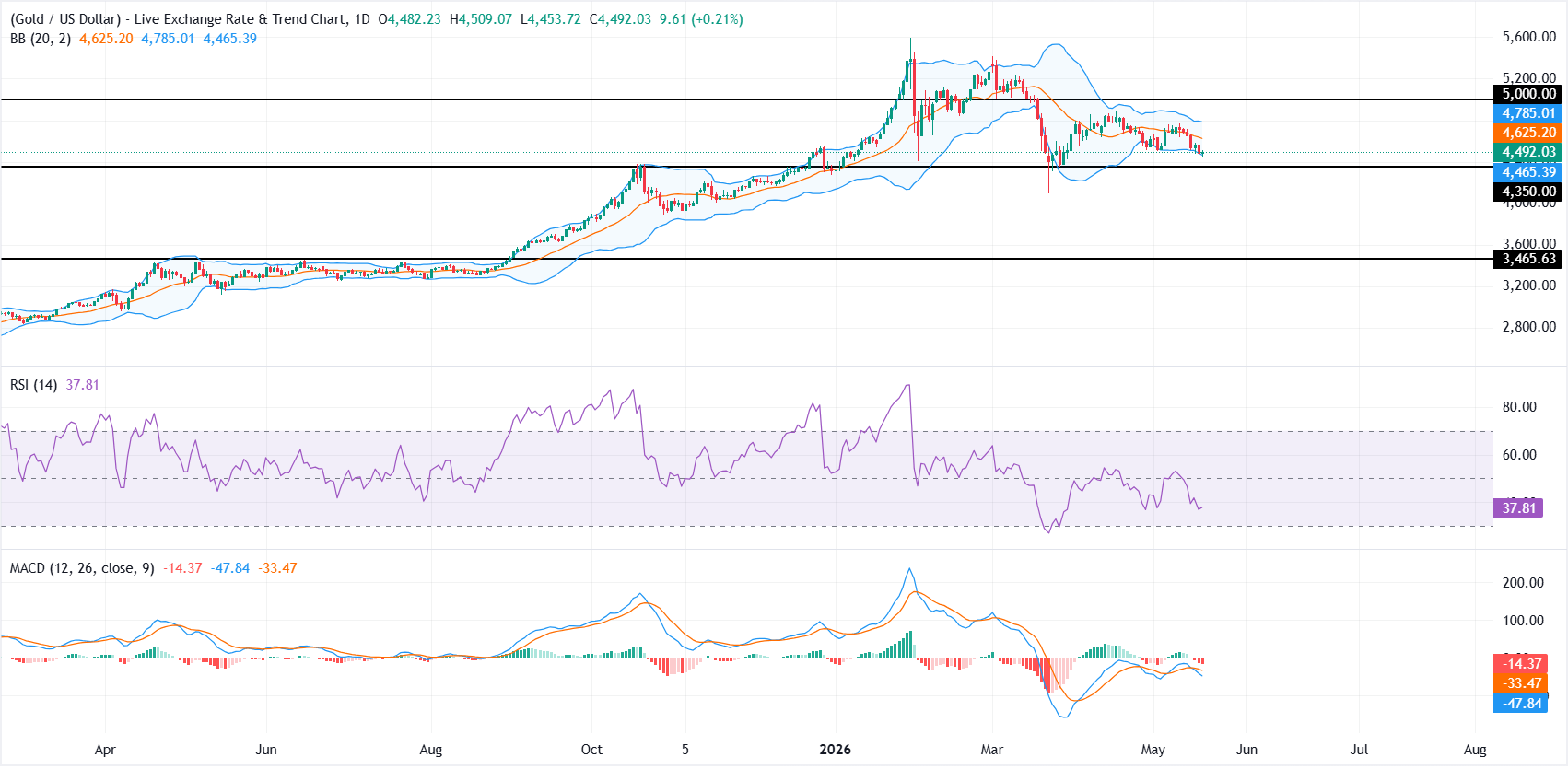
On the daily chart, XAU/USD maintains a bearish near-term tone as it holds below the 20-period Bollinger Simple Moving Average around $4,625 while hovering just above the lower Bollinger band support at roughly $4,465. The Relative Strength Index (RSI) slips to about 38 and the Moving Average Convergence Divergence (MACD) remains in negative territory, which together suggest weakening momentum and leave Gold vulnerable to further downside while capped by the mid-band.
On the topside, initial resistance emerges at the Bollinger mid-line around $4,625, followed by the upper band near $4,785, with a more strategic ceiling at the horizontal level of $5,000. On the downside, immediate support is seen close to the lower Bollinger band around $4,465, ahead of the horizontal floor at $4,350, where a break would likely reinforce the prevailing bearish bias.
(The technical analysis of this story was written with the help of an AI tool.)
Gold FAQs
Gold has played a key role in human’s history as it has been widely used as a store of value and medium of exchange. Currently, apart from its shine and usage for jewelry, the precious metal is widely seen as a safe-haven asset, meaning that it is considered a good investment during turbulent times. Gold is also widely seen as a hedge against inflation and against depreciating currencies as it doesn’t rely on any specific issuer or government.
Central banks are the biggest Gold holders. In their aim to support their currencies in turbulent times, central banks tend to diversify their reserves and buy Gold to improve the perceived strength of the economy and the currency. High Gold reserves can be a source of trust for a country’s solvency. Central banks added 1,136 tonnes of Gold worth around $70 billion to their reserves in 2022, according to data from the World Gold Council. This is the highest yearly purchase since records began. Central banks from emerging economies such as China, India and Turkey are quickly increasing their Gold reserves.
Gold has an inverse correlation with the US Dollar and US Treasuries, which are both major reserve and safe-haven assets. When the Dollar depreciates, Gold tends to rise, enabling investors and central banks to diversify their assets in turbulent times. Gold is also inversely correlated with risk assets. A rally in the stock market tends to weaken Gold price, while sell-offs in riskier markets tend to favor the precious metal.
The price can move due to a wide range of factors. Geopolitical instability or fears of a deep recession can quickly make Gold price escalate due to its safe-haven status. As a yield-less asset, Gold tends to rise with lower interest rates, while higher cost of money usually weighs down on the yellow metal. Still, most moves depend on how the US Dollar (USD) behaves as the asset is priced in dollars (XAU/USD). A strong Dollar tends to keep the price of Gold controlled, whereas a weaker Dollar is likely to push Gold prices up.