
Federal Reserve set to hold interest rates steady as Powell farewell as chair looms
- The US Federal Reserve is expected to leave the policy rate unchanged for the third consecutive meeting in April.
- The economic uncertainty created by the Middle East crisis clouds the Fed’s policy outlook.
- Fed Chair Powell’s comments could ramp up USD volatility as markets see a strong chance of the bank maintaining the status quo by end-2026.
The United States (US) Federal Reserve (Fed) announces its interest rate decision on Wednesday, another pivotal meeting for markets to gauge the stance of policymakers as energy prices remain uncomfortably high amid ongoing uncertainty in the Middle East, putting the Fed’s dual mandate under strain.
Markets widely expect the Federal Open Market Committee (FOMC) to keep interest rates unchanged in the range of 3.5%-3.75% for the third consecutive meeting in April.
As this decision is fully priced in, Fed Chair Jerome Powell’s comments in his last post-meeting press conference, given his term ends in over two weeks, could offer key clues on the policy outlook and drive the US Dollar’s (USD) performance.
Republican Senator Thom Tillis, who took a stance to block any Fed Chair nominee while the probe into Jerome Powell remained open, announced that he is prepared to move on with the confirmation of Kevin Warsh after the Department of Justice dropped the investigation on Friday. Warsh is now widely expected to become the US central bank’s new chair from May 15, when Powell’s current term ends.
The CME FedWatch Tool shows that investors see little to no chance of a rate cut at least until September, while pricing in about an 80% probability that interest rates will remain where they currently are by end-2026. Earlier in the year, there were strong expectations of multiple interest rate reductions, but surging Oil prices and the potential impact on global inflation caused investors to reassess their outlooks.
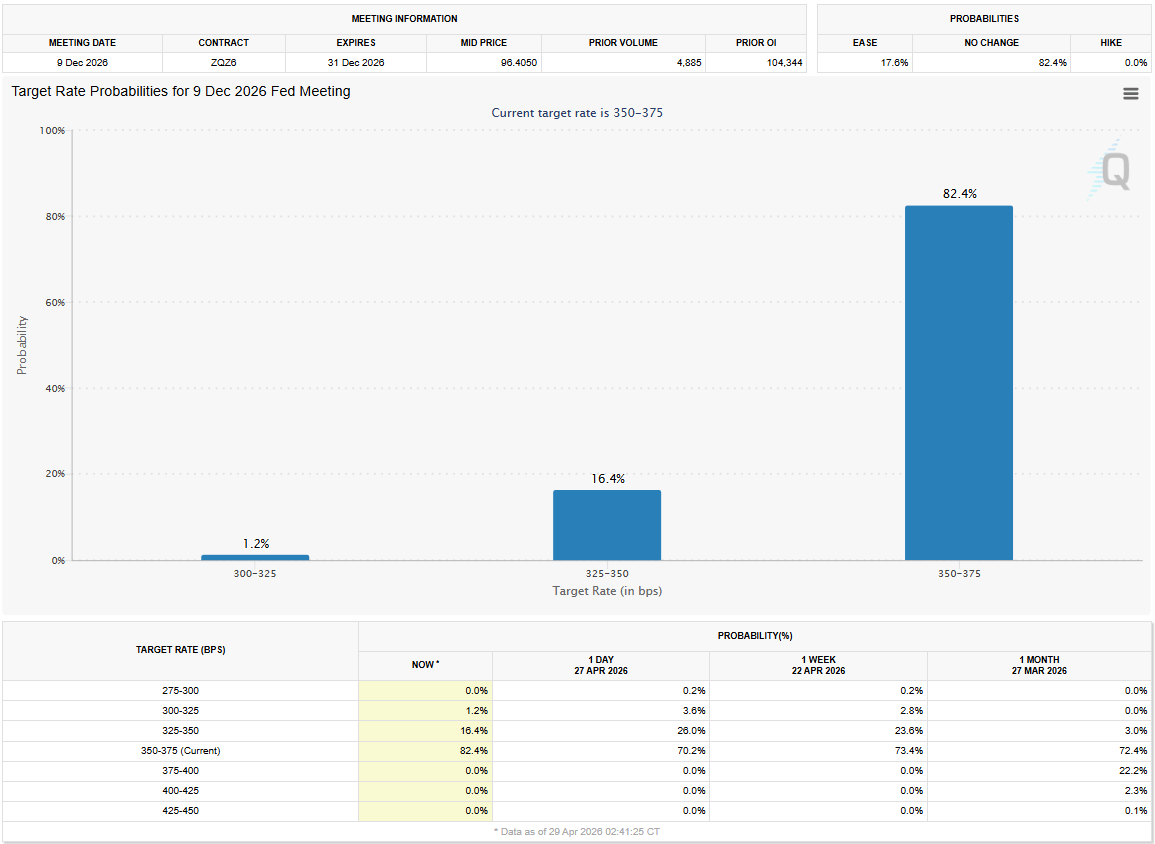
The revised Summary of Economic Projections (SEP) published in March showed that policymakers’ median projection pointed to a 25 basis points (bps) cut this year, unchanged from the SEP published in December 2025. However, the minutes of the March meeting highlighted that many participants saw risk of inflation remaining elevated for longer than expected amid persistent Oil price increase, which could even call for rate hikes.
TD Securities analysts note they expect the Fed policy rate to remain unchanged in April. “The labor market remains balanced, while headline inflation has ticked up owing to the oil shock. With uncertainty still high, the Committee will likely reiterate patience. Powell is likely to stay neutral on policy and avoid new comments on succession, despite this being originally slated as his final meeting,” they explain.
When will the Fed announce its interest rate decision and how could it affect EUR/USD?
The Fed is scheduled to announce its interest rate decision and publish the monetary policy statement at 18:00 GMT. This will be followed by Fed Chair Jerome Powell's press conference starting at 18:30 GMT.
The rate decision itself is unlikely to trigger a significant market reaction, but investors will scrutinize Fed Chair Powell’s remarks.
Powell is likely to reiterate that they need more time and data to assess whether high inflation will persist. Until now, Powell has refrained from hinting at a potential rate hike. In case he notes that option could be on the table in future meetings if the Middle East conflict prolongs and keeps Oil prices elevated, the immediate market reaction could help the USD gather strength against its rivals.
Although markets remain cautiously optimistic about a permanent truce between the US and Iran, the ongoing blockade of Iranian ports by the US military and Tehran’s reluctance to progress with negotiations until the blockade is removed don’t allow Oil prices to return to pre-war levels. The barrel of West Texas Intermediate (WTI), which was trading at around $65 before the US and Israel attacked Iran on February 28, seems to have settled above $90.
Conversely, market participants could start pricing in a September rate cut if Powell notes that the Fed will need to tilt its focus back to supporting the labor market once the situation in the Middle East is resolved. Investors could also assess Powell’s tone as being dovish if he pushes back against policy-tightening expectations and sounds optimistic about inflation quickly softening again, driven by a correction in Oil prices. In this scenario, the USD could come under selling pressure and pave the way for a bullish action in EUR/USD in the near term.
“We expect Fed Chair Powell to reiterate that the Fed’s current policy stance is appropriate, implying a high bar to resume easing. Watch out to see if Powell confirms any discussion on the next move being a hike,” BBH analysts note.
“Remember, the FOMC March meeting minutes highlighted that ‘many’ participants would favor rate increases to help bring inflation down to the 2% target in case of a lengthy war,” they further highlight.
Eren Sengezer, European Session Lead Analyst at FXStreet, provides a short-term technical outlook for EUR/USD:
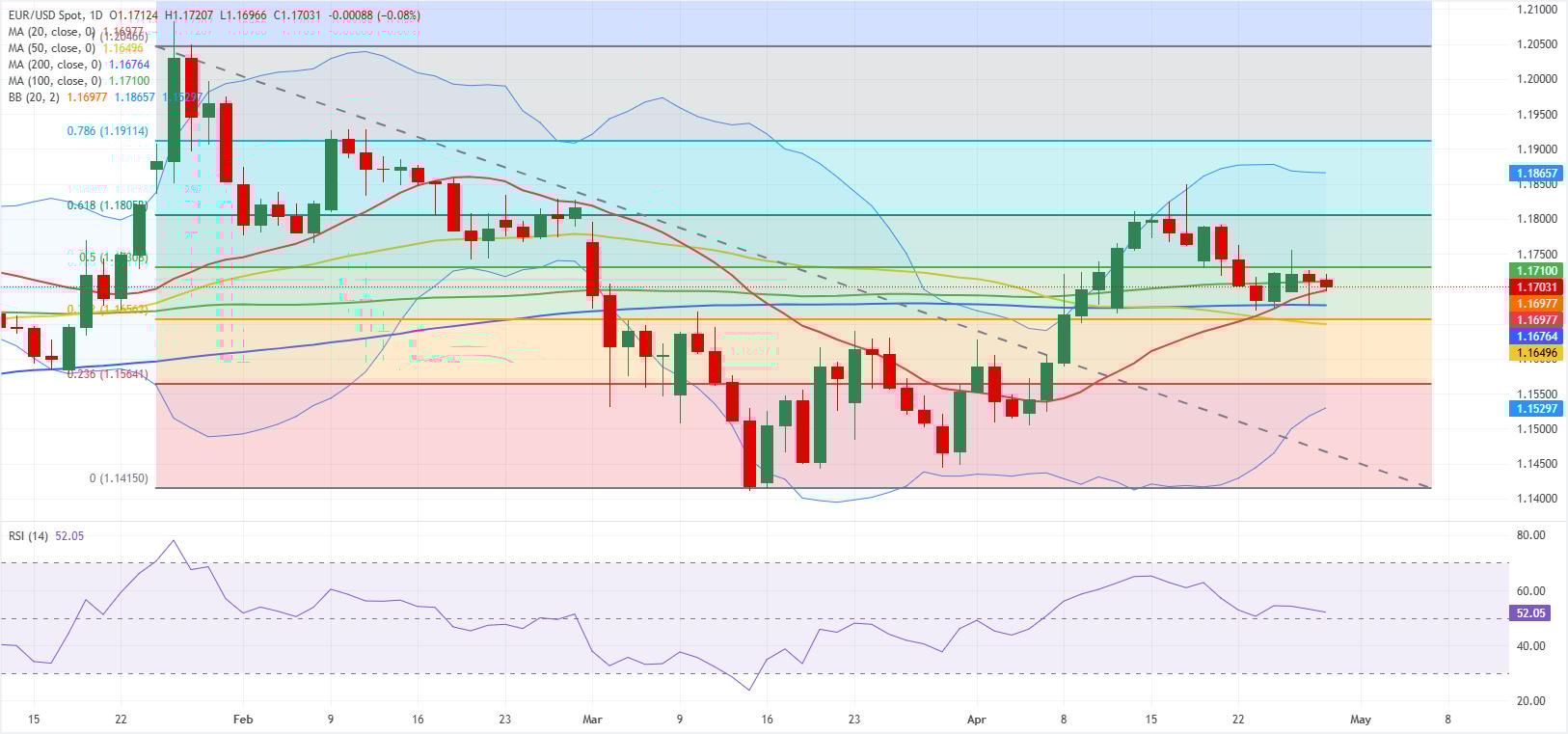
“The technical outlook points to a lack of bullish momentum in the short term. EUR/USD trades slightly above the mid-line of Bollinger Bands and holds above the 100-day and the 200-day Simple Moving Averages (SMA). Additionally, the Relative Strength Index (RSI) indicator on the daily chart moves sideways slightly above 50.”
“On the upside, 1.1800 (Fibonacci 61.8% retracement of the February-April downtrend) aligns as the next resistance level before 1.1870 (upper Bollinger Band) and 1.1900-1.1910 (round level, Fibonacci 78.6% retracement). In case the pair drops below the 1.1700-1.1680 region, where the 100-day and the 200-day SMAs align, and settles there, technical sellers could show interest. In this case, the next important support level could be spotted at 1.1560 (Fibonacci 23.6% retracement) before 1.1500 (static level, round level).”
US Dollar FAQs
The US Dollar (USD) is the official currency of the United States of America, and the ‘de facto’ currency of a significant number of other countries where it is found in circulation alongside local notes. It is the most heavily traded currency in the world, accounting for over 88% of all global foreign exchange turnover, or an average of $6.6 trillion in transactions per day, according to data from 2022. Following the second world war, the USD took over from the British Pound as the world’s reserve currency. For most of its history, the US Dollar was backed by Gold, until the Bretton Woods Agreement in 1971 when the Gold Standard went away.
The most important single factor impacting on the value of the US Dollar is monetary policy, which is shaped by the Federal Reserve (Fed). The Fed has two mandates: to achieve price stability (control inflation) and foster full employment. Its primary tool to achieve these two goals is by adjusting interest rates. When prices are rising too quickly and inflation is above the Fed’s 2% target, the Fed will raise rates, which helps the USD value. When inflation falls below 2% or the Unemployment Rate is too high, the Fed may lower interest rates, which weighs on the Greenback.
In extreme situations, the Federal Reserve can also print more Dollars and enact quantitative easing (QE). QE is the process by which the Fed substantially increases the flow of credit in a stuck financial system. It is a non-standard policy measure used when credit has dried up because banks will not lend to each other (out of the fear of counterparty default). It is a last resort when simply lowering interest rates is unlikely to achieve the necessary result. It was the Fed’s weapon of choice to combat the credit crunch that occurred during the Great Financial Crisis in 2008. It involves the Fed printing more Dollars and using them to buy US government bonds predominantly from financial institutions. QE usually leads to a weaker US Dollar.
Quantitative tightening (QT) is the reverse process whereby the Federal Reserve stops buying bonds from financial institutions and does not reinvest the principal from the bonds it holds maturing in new purchases. It is usually positive for the US Dollar.