
EUR/USD remains firm amid growing trade tensions with the US
- EUR/USD remains moderately bid on Monday, with bulls capped below 1.1640, with
- Eurozone HICP shows that inflation eased below the ECB's 2% target in December.
- Investors remain on edge after Trump threatened EU countries with new tariffs.
EUR/USD holds gains near 1.1630 at the time of writing, after bouncing from seven-week lows at 1.1585 earlier on Monday. The softer-than-expected Eurozone final Harmonised Index of Consumer Prices (HICP) has failed to hurt the Euro (EUR), which is drawing support from a weaker US Dollar on renewed tariff threats.
President Trump jolted markets over the weekend, threatening with 10% additional tariffs on the European countries that oppose the US annexation of Greenland. Europe has responded with the possibility of retaliatory measures amid an unprecedented rift among allies that might cause an existential crisis in the North Atlantic Treaty Organization (NATO).
These events have triggered a risk-off mood in the market and a strained atmosphere ahead of the Davos Economic Forum, where US President Trump and his team will meet representatives from most of the countries targeted by the latest round of levies. Trump's speech on Wednesday is likely to be one of the highlights of the week
In the Eurozone economic calendar on Monday, all eyes are on the final HICP reading for December. The US calendar is empty amid a bank holiday in observance of Martin Luther King Jr. Day, and investors will be attentive to the third quarter's US Gross Domestic Product (GDP) and the Personal Consumption Expenditures (PCE) Price Index, both due on Thursday.
Euro Price Today
The table below shows the percentage change of Euro (EUR) against listed major currencies today. Euro was the strongest against the US Dollar.
| USD | EUR | GBP | JPY | CAD | AUD | NZD | CHF | |
|---|---|---|---|---|---|---|---|---|
| USD | -0.21% | -0.20% | -0.14% | -0.20% | -0.25% | -0.49% | -0.53% | |
| EUR | 0.21% | 0.00% | 0.09% | 0.03% | -0.03% | -0.28% | -0.32% | |
| GBP | 0.20% | -0.00% | 0.08% | 0.01% | -0.04% | -0.28% | -0.32% | |
| JPY | 0.14% | -0.09% | -0.08% | -0.07% | -0.12% | -0.36% | -0.41% | |
| CAD | 0.20% | -0.03% | -0.01% | 0.07% | -0.04% | -0.28% | -0.34% | |
| AUD | 0.25% | 0.03% | 0.04% | 0.12% | 0.04% | -0.25% | -0.29% | |
| NZD | 0.49% | 0.28% | 0.28% | 0.36% | 0.28% | 0.25% | -0.05% | |
| CHF | 0.53% | 0.32% | 0.32% | 0.41% | 0.34% | 0.29% | 0.05% |
The heat map shows percentage changes of major currencies against each other. The base currency is picked from the left column, while the quote currency is picked from the top row. For example, if you pick the Euro from the left column and move along the horizontal line to the US Dollar, the percentage change displayed in the box will represent EUR (base)/USD (quote).
Daily Digest Market Movers: Trump's tariffs hurt confidence in the US Dollar
- The US Dollar is the worst-performing major currency on Monday. Investors are selling the Greenback across the board amid renewed concerns about the economic consequences of Trump's uncertain trade policy.
- European leaders have flagged retaliatory measures if the new levies come into effect. The heads of the 27 EU member states will meet in the coming days to decide on measures to take against the US. This is likely to keep investors on edge this week and might trigger sharp fluctuations in Euro (EUR) crosses.
- In the economic calendar, the final Eurozone HICP data has been revised down to a 1.9% year-on year growth in December, down from previous estimations of a 2% reading and also below November's 2.1% growth. The Core HICP growth, however, has been left unrevised at a 2.3% year-on-year.
Technical Analysis: EUR/USD bounces up from the channel's bottom
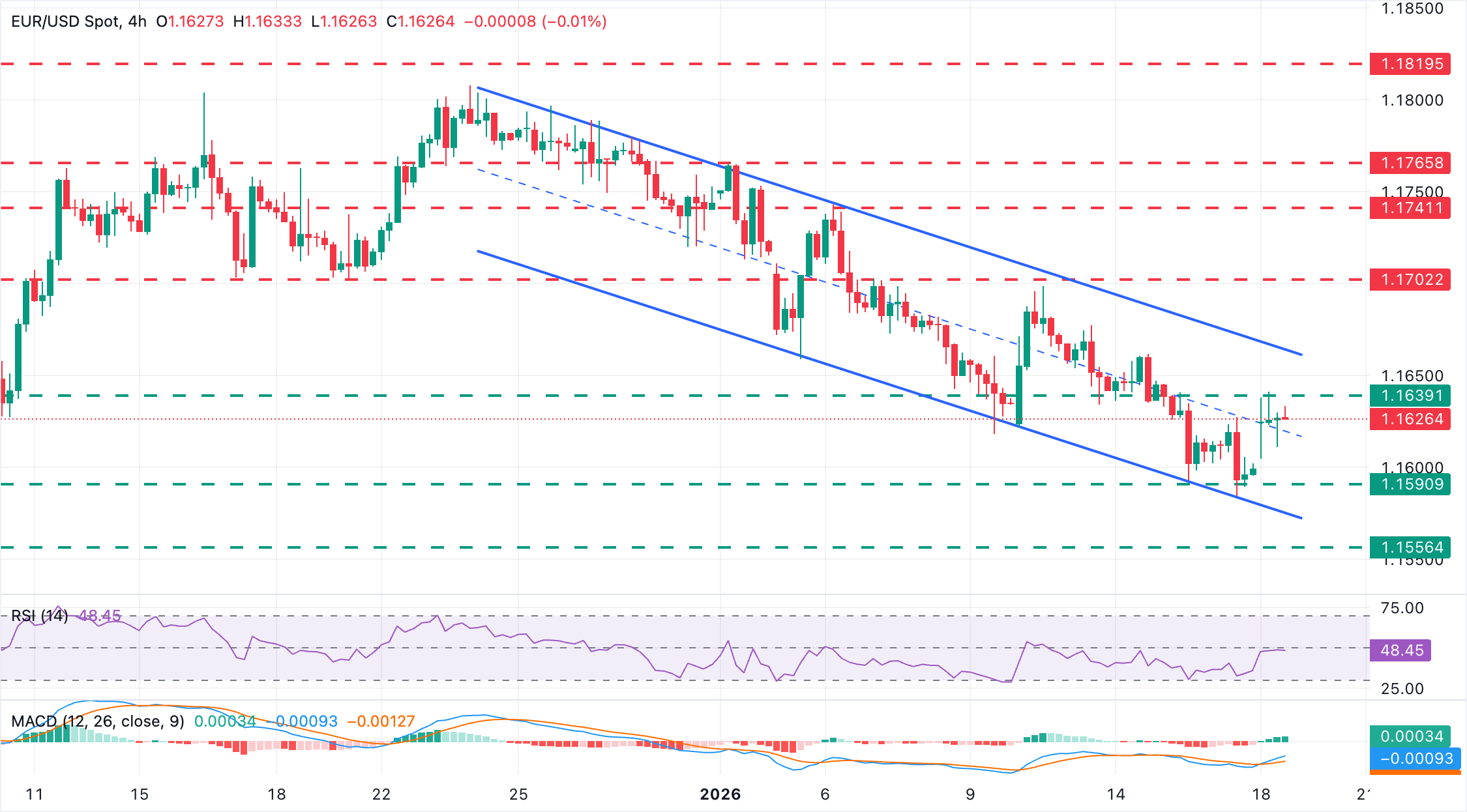
EUR/USD trades near 1.1630 at the time of writing after bouncing up from trendline support below 1.1600. Technical indicators are bouncing higher, as the Moving Average Convergence Divergence (MACD) line on the 4-hour chart climbs above the Signal line near the zero mark, highlighting a bullish crossover, and the Relative Strength Index (RSI) edges higher, hinting at a gradual build in upside pressure.
The pair, however, has been trading within a descending channel since late December, which keeps the broader bearish trend intact. Immediate resistance is at the 1.1640 area (January 13 low) ahead of the channel's top, now at the 1.1670 area.
On the downside, supports are at the mentioned channel bottom, near 1.1580. Further down, the target is the late-November lows near 1.1560.
(The technical analysis of this story was written with the help of an AI tool.)
Euro FAQs
The Euro is the currency for the 20 European Union countries that belong to the Eurozone. It is the second most heavily traded currency in the world behind the US Dollar. In 2022, it accounted for 31% of all foreign exchange transactions, with an average daily turnover of over $2.2 trillion a day. EUR/USD is the most heavily traded currency pair in the world, accounting for an estimated 30% off all transactions, followed by EUR/JPY (4%), EUR/GBP (3%) and EUR/AUD (2%).
The European Central Bank (ECB) in Frankfurt, Germany, is the reserve bank for the Eurozone. The ECB sets interest rates and manages monetary policy. The ECB’s primary mandate is to maintain price stability, which means either controlling inflation or stimulating growth. Its primary tool is the raising or lowering of interest rates. Relatively high interest rates – or the expectation of higher rates – will usually benefit the Euro and vice versa. The ECB Governing Council makes monetary policy decisions at meetings held eight times a year. Decisions are made by heads of the Eurozone national banks and six permanent members, including the President of the ECB, Christine Lagarde.
Eurozone inflation data, measured by the Harmonized Index of Consumer Prices (HICP), is an important econometric for the Euro. If inflation rises more than expected, especially if above the ECB’s 2% target, it obliges the ECB to raise interest rates to bring it back under control. Relatively high interest rates compared to its counterparts will usually benefit the Euro, as it makes the region more attractive as a place for global investors to park their money.
Data releases gauge the health of the economy and can impact on the Euro. Indicators such as GDP, Manufacturing and Services PMIs, employment, and consumer sentiment surveys can all influence the direction of the single currency. A strong economy is good for the Euro. Not only does it attract more foreign investment but it may encourage the ECB to put up interest rates, which will directly strengthen the Euro. Otherwise, if economic data is weak, the Euro is likely to fall. Economic data for the four largest economies in the euro area (Germany, France, Italy and Spain) are especially significant, as they account for 75% of the Eurozone’s economy.
Another significant data release for the Euro is the Trade Balance. This indicator measures the difference between what a country earns from its exports and what it spends on imports over a given period. If a country produces highly sought after exports then its currency will gain in value purely from the extra demand created from foreign buyers seeking to purchase these goods. Therefore, a positive net Trade Balance strengthens a currency and vice versa for a negative balance.