
Canadian Dollar gains as US inflation data fails to boost the US Dollar, BoC decision eyed
- The Canadian Dollar strengthens as US inflation data fails to provide fresh support for the US Dollar.
- USD/CAD pulls back from a six-month high ahead of the Bank of Canada's monetary policy decision
- Technically, USD/CAD maintains a bullish bias above key daily moving averages, while the RSI remains elevated near overbought levels.
The Canadian Dollar (CAD) strengthens against the US Dollar (USD) on Wednesday as traders digest the latest US Consumer Price Index (CPI) data and await the Bank of Canada's (BoC) interest rate decision. At the time of writing, USD/CAD is trading around 1.3925 after touching a six-month high of 1.3969 on Tuesday.
US inflation rose for a third straight month in May, with headline CPI increasing to 4.2% YoY and core CPI ticking up to 2.9%. Both readings came in broadly in line with market expectations. However, monthly core CPI eased to 0.2% from 0.4%.
The data failed to provide fresh support for the Greenback, although it remains underpinned by escalating tensions in the Middle East. US President Donald Trump said in a Truth Social post that Iran had "taken too long to negotiate a deal that would have been great for them" and warned that Tehran would now "have to pay the price." The remarks came after Washington and Tehran exchanged military strikes on Tuesday.
Meanwhile, traders may avoid taking aggressive directional positions ahead of the BoC's interest rate decision due at 13:45 GMT. The BoC is widely expected to keep its policy rate unchanged at 2.25% for a fifth consecutive meeting.
With the decision largely priced in, the focus will be on the central bank's forward guidance. Any signal that policymakers are considering raising interest rates in the coming months could help the Loonie recover some of its recent losses.
Technical Analysis:
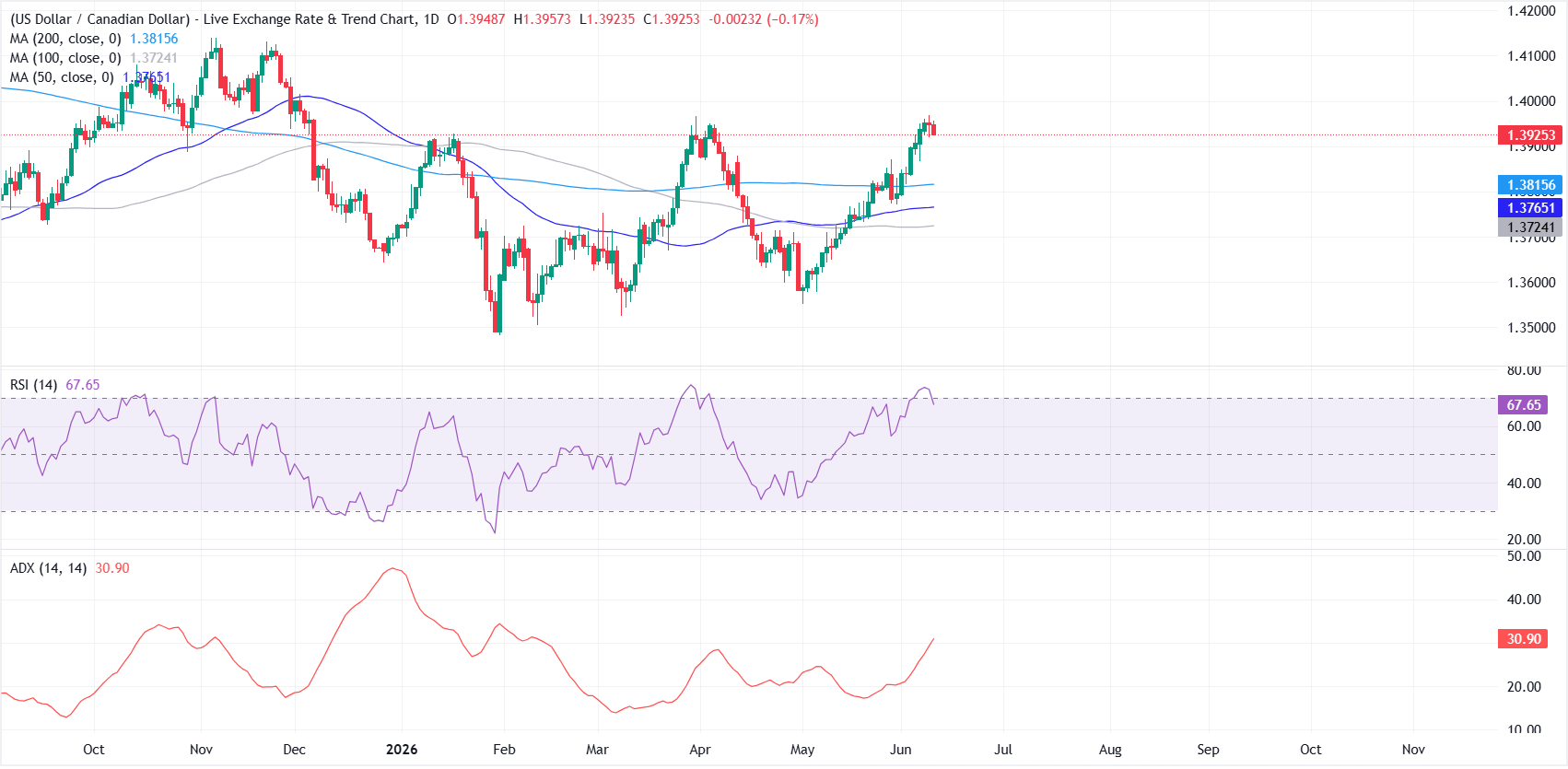
On the daily chart, USD/CAD maintains a constructive bullish bias as spot holds well above key moving averages. The Relative Strength Index (RSI) hovers just below the overbought threshold near 69, while the Average Directional Index (RSI) above 30 hints that the bullish trend is gaining strength rather than merely oscillating.
On the downside, immediate support is seen at the 200-day SMA around 1.3816, with the 50-day SMA at 1.3765 and the 100-day SMA at 1.3724 reinforcing a deeper demand zone on pullbacks. As long as USD/CAD holds above these clustered daily moving averages, dips are likely to attract buyers, and the broader risk remains skewed toward further gains despite the increasingly stretched momentum backdrop.
(The technical analysis of this story was written with the help of an AI tool.)
Bank of Canada FAQs
The Bank of Canada (BoC), based in Ottawa, is the institution that sets interest rates and manages monetary policy for Canada. It does so at eight scheduled meetings a year and ad hoc emergency meetings that are held as required. The BoC primary mandate is to maintain price stability, which means keeping inflation at between 1-3%. Its main tool for achieving this is by raising or lowering interest rates. Relatively high interest rates will usually result in a stronger Canadian Dollar (CAD) and vice versa. Other tools used include quantitative easing and tightening.
In extreme situations, the Bank of Canada can enact a policy tool called Quantitative Easing. QE is the process by which the BoC prints Canadian Dollars for the purpose of buying assets – usually government or corporate bonds – from financial institutions. QE usually results in a weaker CAD. QE is a last resort when simply lowering interest rates is unlikely to achieve the objective of price stability. The Bank of Canada used the measure during the Great Financial Crisis of 2009-11 when credit froze after banks lost faith in each other’s ability to repay debts.
Quantitative tightening (QT) is the reverse of QE. It is undertaken after QE when an economic recovery is underway and inflation starts rising. Whilst in QE the Bank of Canada purchases government and corporate bonds from financial institutions to provide them with liquidity, in QT the BoC stops buying more assets, and stops reinvesting the principal maturing on the bonds it already holds. It is usually positive (or bullish) for the Canadian Dollar.