
AUD/USD Price Forecast: Jumps to near 0.6930 ahead of Iran’s response to US ceasefire
- AUD/USD climbs to near 0.6930 as the market sentiment turns favorable for riskier assets.
- Iran prepares diplomatic response to the US proposal, which it will reveal in due time.
- Investors await the US ISM Services PMI, FOMC Minutes, and the CPI data.
The AUD/USD pair trades 0.5% higher to near 0.6930 during the European trading session on Monday. The Aussie pair strengthens as riskier assets trade firmly amid ongoing discussions between the United States (US) and Iran regarding an end to the Middle East war.
Australian Dollar Price Today
The table below shows the percentage change of Australian Dollar (AUD) against listed major currencies today. Australian Dollar was the strongest against the US Dollar.
| USD | EUR | GBP | JPY | CAD | AUD | NZD | CHF | |
|---|---|---|---|---|---|---|---|---|
| USD | -0.26% | -0.37% | -0.13% | -0.14% | -0.48% | -0.51% | -0.24% | |
| EUR | 0.26% | -0.09% | 0.13% | 0.14% | -0.23% | -0.26% | 0.01% | |
| GBP | 0.37% | 0.09% | 0.21% | 0.19% | -0.13% | -0.18% | 0.11% | |
| JPY | 0.13% | -0.13% | -0.21% | 0.00% | -0.36% | -0.40% | -0.13% | |
| CAD | 0.14% | -0.14% | -0.19% | 0.00% | -0.34% | -0.37% | -0.11% | |
| AUD | 0.48% | 0.23% | 0.13% | 0.36% | 0.34% | -0.05% | 0.24% | |
| NZD | 0.51% | 0.26% | 0.18% | 0.40% | 0.37% | 0.05% | 0.29% | |
| CHF | 0.24% | -0.01% | -0.11% | 0.13% | 0.11% | -0.24% | -0.29% |
The heat map shows percentage changes of major currencies against each other. The base currency is picked from the left column, while the quote currency is picked from the top row. For example, if you pick the Australian Dollar from the left column and move along the horizontal line to the US Dollar, the percentage change displayed in the box will represent AUD (base)/USD (quote).
Iran acknowledged in the mid-European trade that it is reviewing the ceasefire proposal from the US and will release a diplomatic response on the same in due time, Reuters reports. However, it clarified that there will be no acceptance of any proposal under pressure or deadlines.
Market participants believe Tehran to deliver the response soon as the two-tier deal being discussed between both the nations includes plans to end hostilities by Monday.
The discussions between Iran and the US regarding a ceasefire in the Middle East have diminished the safe-haven demand of the US Dollar (USD). As of writing, the US Dollar Index (DXY), which gauges the Greenback’s value against six major currencies, trades 0.3% lower to near 99.90.
In the US, investors await the US ISM Services PMI data for March, which will be published at 14:00 GMT. The Services PMI is seen lower at 55.0 against 56.1 in February.
This week, the Federal Open Market Committee (FOMC) minutes of the March meeting and the Consumer Price Index (CPI) data for March.
AUD/USD technical analysis
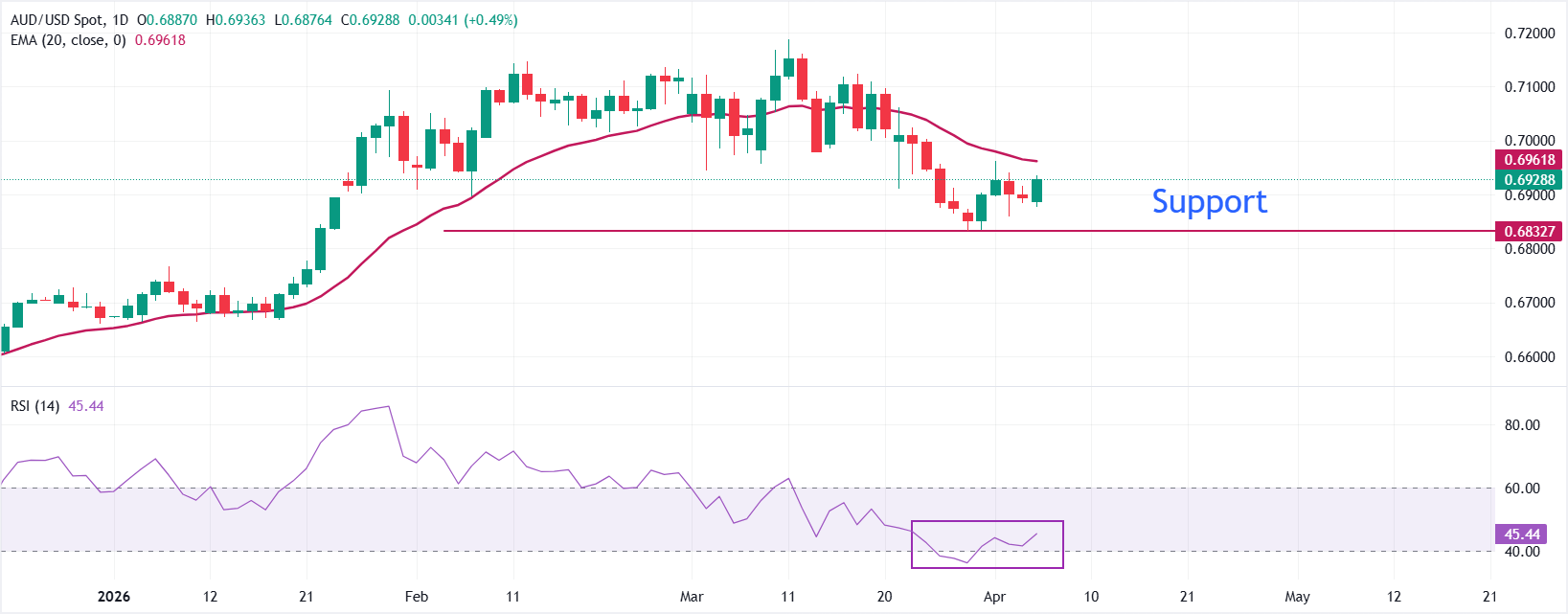
During the press time, AUD/USD trades significantly higher at around 0.6930. The pair holds a sequence of lower highs, with price holding beneath the 20-day Exponential Moving Average (EMA) around 0.6960, which preserves a mild bearish near-term bias.
Momentum remains subdued as the RSI hovers near 45, showing sellers retain control but lack capitulation. The recent failure to sustain levels above 0.7000 confirms that bounces are being sold, keeping focus on the downside while below the short-term average.
Initial resistance emerges at 0.6960, where the 20-day EMA caps the upside, followed by 0.7000 as a psychological barrier. A daily close above 0.7000 would ease immediate downside pressure and open the way toward 0.7060. On the downside, immediate support is located at 0.6900, with a break exposing 0.6850 as the next downside target. Below that area, selling could extend toward 0.6800, reinforcing the prevailing bearish tone.
(The technical analysis of this story was written with the help of an AI tool.)
Australian Dollar FAQs
One of the most significant factors for the Australian Dollar (AUD) is the level of interest rates set by the Reserve Bank of Australia (RBA). Because Australia is a resource-rich country another key driver is the price of its biggest export, Iron Ore. The health of the Chinese economy, its largest trading partner, is a factor, as well as inflation in Australia, its growth rate and Trade Balance. Market sentiment – whether investors are taking on more risky assets (risk-on) or seeking safe-havens (risk-off) – is also a factor, with risk-on positive for AUD.
The Reserve Bank of Australia (RBA) influences the Australian Dollar (AUD) by setting the level of interest rates that Australian banks can lend to each other. This influences the level of interest rates in the economy as a whole. The main goal of the RBA is to maintain a stable inflation rate of 2-3% by adjusting interest rates up or down. Relatively high interest rates compared to other major central banks support the AUD, and the opposite for relatively low. The RBA can also use quantitative easing and tightening to influence credit conditions, with the former AUD-negative and the latter AUD-positive.
China is Australia’s largest trading partner so the health of the Chinese economy is a major influence on the value of the Australian Dollar (AUD). When the Chinese economy is doing well it purchases more raw materials, goods and services from Australia, lifting demand for the AUD, and pushing up its value. The opposite is the case when the Chinese economy is not growing as fast as expected. Positive or negative surprises in Chinese growth data, therefore, often have a direct impact on the Australian Dollar and its pairs.
Iron Ore is Australia’s largest export, accounting for $118 billion a year according to data from 2021, with China as its primary destination. The price of Iron Ore, therefore, can be a driver of the Australian Dollar. Generally, if the price of Iron Ore rises, AUD also goes up, as aggregate demand for the currency increases. The opposite is the case if the price of Iron Ore falls. Higher Iron Ore prices also tend to result in a greater likelihood of a positive Trade Balance for Australia, which is also positive of the AUD.
The Trade Balance, which is the difference between what a country earns from its exports versus what it pays for its imports, is another factor that can influence the value of the Australian Dollar. If Australia produces highly sought after exports, then its currency will gain in value purely from the surplus demand created from foreign buyers seeking to purchase its exports versus what it spends to purchase imports. Therefore, a positive net Trade Balance strengthens the AUD, with the opposite effect if the Trade Balance is negative.